
Sales team collaboration steps: the sales manager's guide
Sales team collaboration steps: the sales manager’s guide
TL;DR:
- Effective sales collaboration requires structured communication channels, precise pipeline definitions, and automated workflows to prevent deals from slipping through gaps. Implementing regular cross-functional meetings, real-time dashboards, and role-specific coaching accelerates team alignment and productivity. Overcoming resistance and ensuring data trust are vital for sustaining measurable improvements in deal size and closure rates.
Your sales reps are working hard, but deals are slipping through the cracks. Sound familiar? Poor collaboration is often the hidden culprit. Research shows 67% more deals closed by teams with aligned sales and marketing functions, yet most B2B sales managers never get a structured playbook for making that alignment real. This guide walks you through the practical sales team collaboration steps that move your team from fragmented effort to coordinated execution, with specific actions you can take this week, not someday.
Table of Contents
- Preparation: essential prerequisites for sales team collaboration
- Step-by-step execution: practical sales team collaboration steps
- Troubleshooting common collaboration challenges and pitfalls
- Verifying success: measuring and sustaining improved collaboration
- Why typical sales collaboration advice misses the mark
- Enhance your team’s collaboration with LinkedIn Sales Navigator
- Frequently asked questions
Key Takeaways
| Point | Details |
|---|---|
| Structured processes matter | Clear pipeline stages and defined SLAs build accountability and prevent stalled deals. |
| Automation boosts efficiency | Automating lead routing, follow-ups, and customer handoffs saves time and reduces errors. |
| Regular coaching enhances collaboration | Weekly short coaching sessions with targeted feedback drive consistent team alignment. |
| Data-driven measurement sustains gains | Tracking collaboration KPIs allows continuous improvement and transparency. |
| AI integration is essential | Embedding AI tools in CRM workflows increases adoption and improves sales outcomes. |
Preparation: essential prerequisites for sales team collaboration
Before you can execute meaningful sales team collaboration steps, you need the right foundation. Jumping straight into new workflows without preparation is like building on sand. You will see initial movement, then collapse.
Start with your communication channels. Most sales teams have too many of them, not too few. Group chats, emails, CRM notes, shared spreadsheets, voice messages — the result is important context scattered everywhere and nobody sure where to look. Consolidate around structured channels with clear purposes: one channel for deal updates, one for prospect research sharing, one for urgent escalations. This alone reduces noise significantly.
Next, look at your tool stack. Effective collaboration tools require organized channels, deep integrations, and AI agents that centralize work. That means your CRM, email, calendar, and prospecting tools should talk to each other. If your rep has to copy data manually from one platform to another, that is a workflow problem that will quietly kill collaboration before it starts. A well-designed lean B2B outreach stack will eliminate most of this friction.
Finally, define roles with precision. Vague ownership is the most underrated collaboration killer.
| Prerequisite | What to define | Why it matters |
|---|---|---|
| Communication channels | Purpose, frequency, owner | Reduces confusion and missed updates |
| Tool integrations | Which systems sync, how often | Centralizes data for the whole team |
| Pipeline stage definitions | Entry/exit criteria per stage | Prevents deals from stalling invisibly |
| Service level agreements (SLAs) | Response times, handoff rules | Creates shared accountability |
| Team roles | Who owns what at each stage | Eliminates overlap and dropped tasks |
Also document your pipeline stages explicitly. “In negotiation” means different things to different reps. Write down what must be true for a deal to sit in each stage. When everyone works from the same definitions, you can discuss the pipeline in meetings without spending half the time just clarifying basic context. Understanding the full range of types of B2B sales tools available will help you pick only what your team genuinely needs rather than adding complexity.
Step-by-step execution: practical sales team collaboration steps
With your foundation in place, here is a concrete sequence you can follow to transform how your team works together. These steps build on each other, so the order matters.

Step 1: Separate your pipelines by deal type. Not all deals move the same way. High-performing teams create multiple pipelines and automate lead routing, task generation, and customer conversion to match their actual sales motion. Create at least two pipelines: one for fast transactional deals and one for complex, multi-stakeholder deals. This prevents your reps from applying the wrong playbook and makes pipeline reviews far more productive.
Step 2: Automate lead routing and follow-up tasks. Manual handoffs are where collaboration breaks down most visibly. Set up rules in your CRM so that when a lead hits a certain score or stage, it automatically routes to the right rep and generates a follow-up task. A solid sales follow-up workflow built on automation means no deal goes cold because someone forgot to check in.
Step 3: Run weekly cross-functional stand-ups. Keep them to 15 to 30 minutes. The goal is not a status report — it is surfacing blockers and sharing intelligence. Have each rep flag one deal that needs input from another team member. This creates a habit of asking for help, which is the foundation of real collaborative sales strategies.
Step 4: Use shared dashboards with real-time data. When every rep can see the same pipeline, the same activity logs, and the same deal status, you replace politics and guesswork with facts. Setting up your Sales Navigator account to feed account and lead data directly into your CRM extends this visibility to LinkedIn prospecting activity too.
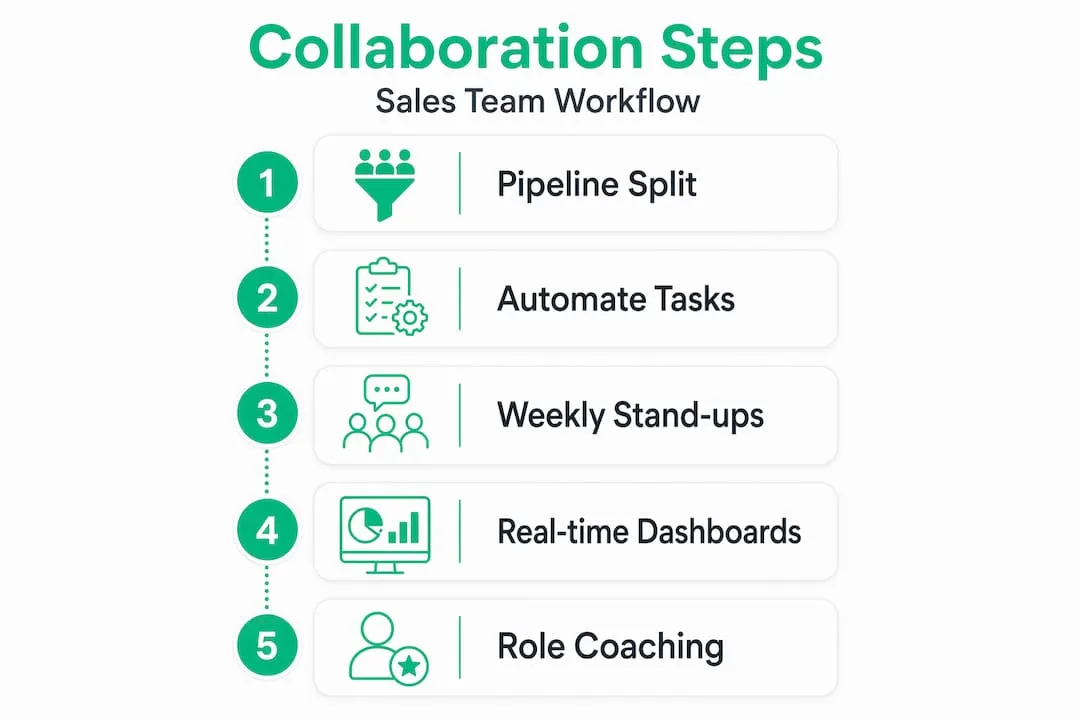
Step 5: Hold short, role-specific coaching sessions weekly. Short, consistent coaching sessions with role-playing improve remote and hybrid team collaboration significantly. Keep it focused: pick one skill, one deal, or one objection per session. Rotate the rep in the hot seat so everyone builds the habit of giving and receiving feedback.
Pro Tip: Record your role-playing sessions and share the clips in your team channel. New reps ramp faster when they can watch how your top performers handle specific objections rather than just reading a script.
Here is how traditional manual workflows compare to AI-supported ones:
| Workflow element | Manual approach | AI-augmented approach |
|---|---|---|
| Lead routing | Manager assigns manually | Auto-routed by score and territory rules |
| Follow-up tasks | Rep sets reminders manually | Auto-generated at each pipeline stage |
| Coaching insights | Manager reviews call notes | AI flags objection patterns in real time |
| Pipeline visibility | Weekly spreadsheet update | Real-time CRM dashboard for all |
| Cross-team handoffs | Email or chat notification | Automated trigger with context attached |
You can also explore proven Sales Navigator tips to layer LinkedIn intelligence into your existing collaborative workflow without adding complexity.
Troubleshooting common collaboration challenges and pitfalls
Even with the right steps in place, you will hit friction. Here are the most common problems and how to address them head on.
Resistance to change. When you introduce new processes, some reps will push back. This is rarely about stubbornness. It is usually about unclear benefits. Show each rep specifically how the new workflow saves them time or helps them close faster. Generic “this is better for the team” messaging does not land.
Incomplete AI adoption. Data trust issues and lack of training are major barriers to AI adoption that limit collaboration gains. If your team does not believe the CRM data is accurate, they will not act on AI recommendations. Fix data hygiene before expecting AI outputs to drive behavior change.
Poorly defined pipeline stages. This creates invisible stalling. Deals sit in a stage not because they belong there, but because no one is sure when to move them forward. Add explicit entry and exit criteria to every stage.
Skipping coaching sessions. When pipeline pressure gets high, coaching is the first thing managers cut. This is exactly backwards. Stressed teams need more calibration, not less. Protect your weekly sessions as non-negotiable.
The single biggest collaboration mistake managers make is adding a new tool and calling it a process change. Technology surfaces problems. It does not fix them. Fix the process first, then choose the tool that supports it.
- Common pitfalls to watch for:
- Over-automating before roles are clearly defined
- Using too many communication channels simultaneously
- Running pipeline reviews without pre-shared data
- Confusing activity volume with collaboration quality
- Neglecting post-sale handoffs to customer success teams
Improving automation in sales prospecting only works when the human process it supports is already sound.
Verifying success: measuring and sustaining improved collaboration
Implementing changes is the beginning. Knowing whether they are working requires the right metrics and a review cadence that keeps your team honest.
Start with activity-based metrics. Top-performing sales teams log 3.48x more daily activities and 3.70x more follow-ups per deal, which directly drives deal velocity. If your team’s logged activity is flat or declining after implementing new collaboration steps, something is wrong with adoption, not the process.
Then measure outcomes. Collaboration increases deal sizes by 20% and AI-augmented workflows boost revenue per rep by 33%. These are benchmarks worth tracking against your own data quarterly.
| Metric | What it measures | Review frequency |
|---|---|---|
| Deals per rep per quarter | Individual productivity within the team | Monthly |
| Daily activities logged | Collaboration tool adoption and rep engagement | Weekly |
| Follow-ups per deal | Process adherence and deal momentum | Weekly |
| Average deal size | Impact of cross-functional collaboration | Quarterly |
| Win rate by pipeline type | Effectiveness of pipeline segmentation | Monthly |
Beyond dashboards, run two standing reviews. First, a joint weekly pipeline review where every rep comes prepared with their top three active deals and one deal at risk. Second, a post-sale debrief within a week of every closed deal, won or lost. The debrief is where you surface what actually happened versus what the CRM showed, and those gaps reveal your process weak points faster than any report.
Use the improve sales conversion guide to connect your collaboration metrics directly to conversion outcomes so you can see the full impact of process improvements.
Why typical sales collaboration advice misses the mark
Most articles on effective sales teamwork follow the same script: add a CRM, hold more meetings, communicate better. It is not wrong. It is just incomplete.
The real problem is that most sales managers treat collaboration as a communication problem when it is actually a process design problem. You do not need your team talking more. You need them working within a system where the right information reaches the right person at the right moment without anyone having to ask. That requires workflow redesign, not just better meetings.
Here is what rarely gets said: the most underutilized collaboration tool most sales managers already have access to is AI-powered conversation intelligence. When managers use AI to review call recordings and extract coaching moments, team performance improves faster than any amount of group discussion. But fewer than one in five managers uses it consistently, because they see it as a surveillance tool rather than a coaching accelerator. Frame it as development, not monitoring, and adoption follows.
Another uncomfortable truth: informal communication kills accountability. When collaboration happens in side chats and verbal agreements, there is no record, no ownership, and no consequence when things fall through. Shared SLAs, documented in your CRM with clear owners and deadlines, create the accountability structure that informal culture never can. The proven sales tips that consistently show up in high-performing teams almost always include this kind of structured accountability, not just better interpersonal communication.
The teams that genuinely improve are the ones that stop asking “how do we communicate better?” and start asking “why does this step in our process require communication at all?” Sometimes the answer is automation. Sometimes it is a cleaner handoff. Rarely is the answer another meeting.
Enhance your team’s collaboration with LinkedIn Sales Navigator
With proven collaboration steps and a clear framework in place, the next move is giving your team a prospecting tool built for coordinated B2B selling.
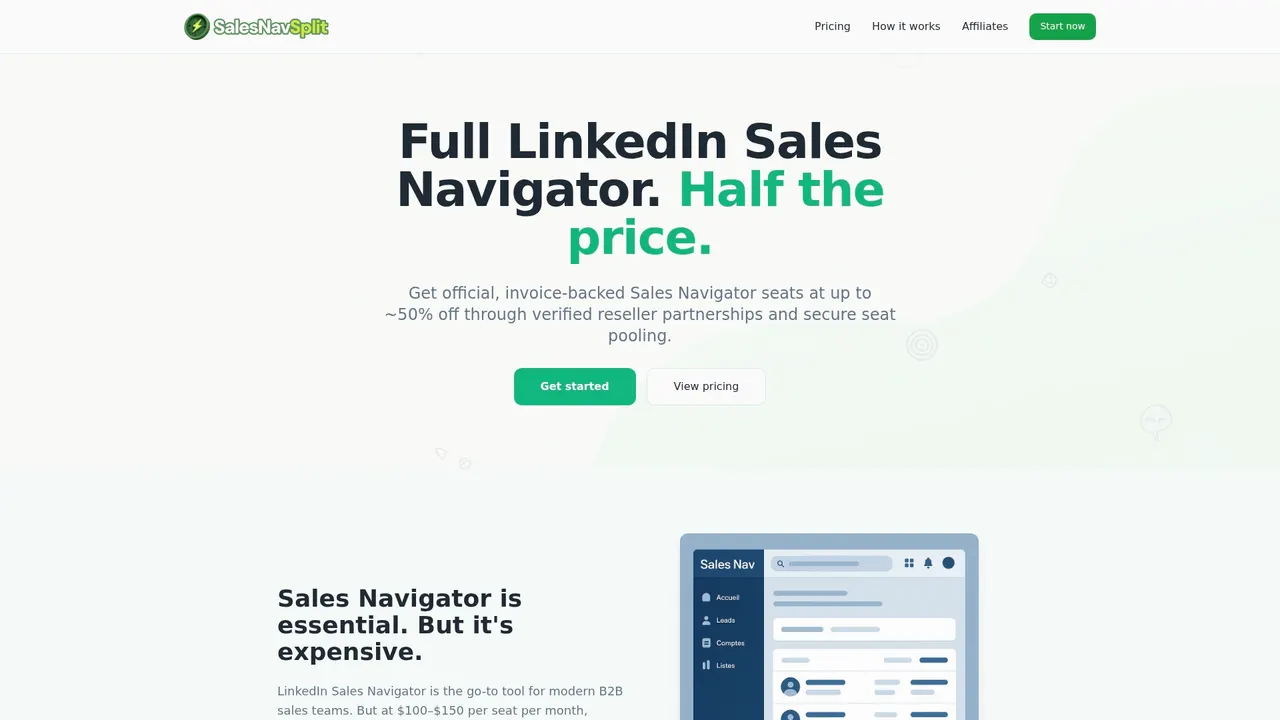
LinkedIn Sales Navigator gives your whole team shared visibility into target accounts and leads, with notes and tags that keep every rep aligned on the same prospects. You can build targeted lists collaboratively, track buyer intent signals together, and feed account data directly into your CRM for centralized workflow management. Through LinkedIn Sales Navigator licenses available via salesnavsplit.com, your team gets official, verified seats at close to 50% off standard pricing, with activation in two business hours European time and invoicing through Stripe. No credential sharing, no gray-market risk. Just a cost-effective way to scale collaborative prospecting without blowing your tool budget.
Frequently asked questions
What are the key steps to improve sales team collaboration?
Key steps include establishing structured communication channels, defining pipeline stages and SLAs, automating lead routing and follow-ups, running weekly coaching sessions, and tracking collaboration metrics consistently. Top-performing teams automate lead routing and hold weekly stand-ups to keep everyone aligned on active deals.
How does AI impact sales team collaboration?
AI handles routine tasks automatically, surfaces real-time coaching prompts, and improves forecasting accuracy, which frees reps to focus on selling. AI-augmented teams close 31% more deals and cut new rep ramp time by 37% compared to non-AI teams.
What common barriers prevent effective sales collaboration?
The biggest barriers are gaps in training on collaboration tools, poor CRM data quality, resistance to process changes, and partial adoption of available AI features. Training gaps and data trust issues are consistently the top factors limiting what AI-assisted workflows can actually deliver.
How often should sales managers hold coaching sessions to improve team collaboration?
Weekly sessions of 15 to 30 minutes focused on specific skills or deals are the most effective format for both remote and in-office teams. Weekly short coaching sessions that include role-playing produce measurably better engagement and more consistent execution across hybrid sales teams.
What metrics indicate successful sales team collaboration?
Track deals closed per rep, daily activities logged, follow-ups per deal, and average deal size to get a complete picture of collaboration health. Top teams log 3.48x more daily activities and see deal sizes that are 20% larger than teams without structured collaboration processes.
Recommended
- Sales tools checklist: Build your lean B2B outreach stack - SalesNavSplit Blog
- Boost Sales With These Proven Sales Navigator Tips - SalesNavSplit Blog
- Sales Navigator Plans: Choosing the Right Option for B2B Teams - SalesNavSplit Blog
- Build a sales follow-up workflow that closes more deals - SalesNavSplit Blog