
Sales enablement best practices: Proven strategies for B2B success
Sales enablement best practices: Proven strategies for B2B success
TL;DR:
- SMB sales success depends on centralized content, ongoing training, and a flexible playbook.
- Alignment between sales and marketing significantly boosts win rates and buyer trust.
- Continuous measurement and content updates are essential for sustaining effective sales enablement strategies.
Scattered pitch decks, outdated case studies living in someone’s inbox, and reps winging their discovery calls because the playbook hasn’t been touched in two years. Sound familiar? For B2B sales teams at small to mid-sized businesses, this kind of friction doesn’t just slow deals down, it kills them. The good news is that sales enablement best practices are well-documented, proven, and absolutely within reach for SMBs that are willing to build the right foundation, align their teams, and use technology with intention rather than impulse.
Table of Contents
- Start with the right foundation: Centralized content, clear processes, and ongoing training
- Unite sales and marketing: Alignment for higher win rates and trust
- Leverage technology: Integration, automation, and AI—for enablement without the noise
- Measure, iterate, and adapt: Driving continuous improvement in sales enablement
- What most SMBs get wrong about sales enablement (and how to fix it)
- Take your sales enablement further
- Frequently asked questions
Key Takeaways
| Point | Details |
|---|---|
| Centralized content | Organize all sales assets in one place and match them to each buyer stage for faster, more effective selling. |
| Sales-marketing alignment | Keep sales and marketing teams tightly integrated to win more deals and strengthen buyer trust. |
| Smart tech integration | Automate what matters and embed enablement tools directly in your workflows, avoiding tool overload. |
| Continuous improvement | Track KPIs and regularly update your content and processes to stay competitive. |
| Flexible playbooks | Design sales approaches that adapt to non-linear buyer journeys in the modern B2B landscape. |
Start with the right foundation: Centralized content, clear processes, and ongoing training
Before you layer on tools or automate anything, you need to get the basics right. Most SMB sales teams fail not because they lack ambition, but because their enablement foundation is shaky. Content lives in three different places, training is a one-time onboarding event, and the “playbook” is a Google Doc nobody has opened since Q2.
The fix starts with a centralized content library that maps directly to your buyer personas and sales stages. Think about it from your buyer’s perspective: a CFO evaluating your product in the late decision stage needs different content than a VP of Operations who just discovered you exist. When your reps can pull the right asset for the right moment in under 60 seconds, close rates improve and buyer confidence goes up.
Continuous training is the second pillar. One-and-done onboarding doesn’t cut it in a market where buyer behavior shifts every few quarters. Conversation intelligence tools, platforms that record and analyze sales calls, give managers concrete data on where reps struggle. Instead of guessing, you coach to specific patterns. A rep who consistently loses deals at the pricing objection gets targeted coaching on that exact moment, not a generic refresher course.
The third element is a standardized sales playbook. Not a rigid script, but a flexible guide that gives reps a repeatable framework while leaving room to adapt. Consultant growth tactics often emphasize the same principle: structure creates speed, and speed creates confidence.
Here are the core foundational elements every B2B SMB should have in place:
- A centralized content library organized by buyer stage and persona
- Continuous coaching programs supported by call recording and analysis
- A living sales playbook with objection handling, discovery questions, and messaging guides
- Onboarding tracks that get new reps to quota faster
- Regular content audits tied to pipeline performance data
“Inconsistent information erodes buyer trust. 69% of B2B buyers report encountering mismatched messaging between sales and marketing, which directly undermines deal confidence.” Gartner data on buyer trust
Pro Tip: Run a quarterly content refresh cycle where marketing and sales review the top 10 most-used assets together. Flag anything outdated, anything underperforming, and any gaps where reps are creating their own materials because nothing official exists. Pair this with a flexible playbook review that accounts for non-linear buyer journeys, because buyers rarely follow the funnel you drew on a whiteboard.
For SMBs just getting started, pairing these practices with lean B2B sales tools keeps the stack manageable while still delivering real enablement value. And if LinkedIn is part of your outreach motion, exploring LinkedIn sales strategies for SMBs can sharpen how your team shows up to buyers before the first call even happens.
Unite sales and marketing: Alignment for higher win rates and trust
Once your foundation is solid, the next biggest lever is alignment between sales and marketing. This isn’t a new idea, but most SMBs still treat it as a nice-to-have rather than a revenue driver. The term “smarketing” captures the idea: one unified team with shared goals, shared metrics, and shared accountability for pipeline outcomes.

Here’s why it matters so much. Structured enablement programs deliver 49% higher win rates on forecasted deals, and sales training alone generates a 353% ROI. Those numbers don’t come from tools. They come from teams that are pulling in the same direction.
When sales and marketing are misaligned, reps ignore marketing content because it doesn’t reflect what buyers actually say on calls. Marketing creates campaigns based on assumptions instead of field intelligence. Both teams blame each other when pipeline stalls. The result is slower deal velocity, higher customer acquisition costs, and a buyer experience that feels disjointed.
The fix involves a few concrete practices:
- Shared KPIs that tie marketing activity to pipeline outcomes, not just lead volume
- Regular cross-team content reviews where reps share what’s resonating and what’s falling flat
- Feedback loops from sales back to marketing after every lost deal
- Unified messaging frameworks so the value proposition sounds the same whether a buyer reads a blog post or gets on a discovery call
- Joint account planning for strategic target accounts
61% of B2B buyers prefer a rep-free buying experience, yet they still seek seller input for complex, contextual decisions. Buyers only spend about 17% of their total buying process time with any single supplier, which means every touchpoint has to count.
Here’s a quick snapshot of what alignment actually delivers in measurable terms:
| Metric | Without alignment | With alignment |
|---|---|---|
| Win rate on forecasted deals | Baseline | Up to 49% higher |
| Sales training ROI | Minimal | Up to 353% |
| Ramp time for new reps | 6 to 9 months | Significantly shorter |
| Buyer trust (consistent messaging) | 69% report mismatches | Consistent, unified experience |
For real-world examples of how this works in practice, sales-marketing alignment examples from B2B SaaS teams show the tactical moves that actually move the needle. If reducing customer acquisition cost is a priority, the approach to cut CAC and boost LTV through alignment is worth studying closely.
Better alignment also improves how you manage pipeline. When sales and marketing share ownership of the funnel, pipeline management for B2B becomes a team sport rather than a solo rep guessing game. It also changes how you boost B2B customer engagement, because consistent messaging across channels builds the kind of familiarity that accelerates trust. And when both teams agree on what a qualified opportunity looks like, qualifying sales leads stops being a point of friction and starts being a shared filter.
Leverage technology: Integration, automation, and AI—for enablement without the noise
Technology should amplify your enablement strategy, not replace it. The risk for SMBs is tool sprawl: adding platforms because they look impressive in a demo, then watching reps ignore them because they don’t fit the actual workflow. Forrester’s guidance is direct on this point: stop treating revenue enablement platforms as set-and-forget systems. They require continuous content governance, accurate taxonomy and metadata, and readiness pathways tied to real deals in your pipeline.
The debate between embedding enablement inside your CRM versus using standalone point solutions is real. Here’s how the two approaches compare:
| Factor | CRM-embedded enablement | Standalone enablement platform |
|---|---|---|
| Workflow integration | Seamless, reps stay in one tool | Requires context-switching |
| Automation capability | Strong for pipeline-triggered actions | Often more advanced and flexible |
| Personalization | Tied to CRM data quality | Can pull from multiple data sources |
| Data hygiene dependency | High, garbage in garbage out | Still requires clean data |
| Cost for SMBs | Lower if CRM already in use | Additional licensing cost |
| AI/deal risk scoring | Improving rapidly | More mature feature sets |
For most SMBs, the practical answer is to start with CRM-embedded enablement and add point solutions only when a specific gap is clearly identified and the ROI is measurable. Automation in sales prospecting is one area where adding a focused tool often pays off quickly, especially when it connects directly to your CRM data.
The essential integrations for a lean but powerful enablement stack include:
- CRM as the system of record for all deal and contact data
- Conversation intelligence for call recording, analysis, and coaching
- Content management integrated with CRM so reps surface assets in context
- Email sequencing and automation tied to pipeline stage triggers
- LinkedIn Sales Navigator for prospecting intelligence and relationship signals
Sales Navigator workflows are particularly effective when integrated with your CRM, because they bring real-time buyer signals into the deal context. For tactical execution, Sales Navigator tips can help your team get more out of the platform without adding complexity. If you’re exploring how AI fits into your outreach motion, AI in sales and AI chatbots for lead generation are worth reviewing for practical use cases.
Pro Tip: Run a quarterly tool audit. List every platform your team pays for, then ask two questions: Is it being used by more than 70% of the team? Is there measurable pipeline impact tied to it? If the answer to either is no, cut it or consolidate it. Fewer tools used consistently beat more tools used occasionally every single time.
Measure, iterate, and adapt: Driving continuous improvement in sales enablement
Technology and alignment mean nothing if you’re not tracking whether any of it is working. Sustainable sales enablement is a feedback loop, not a one-time project. The teams that consistently improve are the ones that treat metrics as a management tool, not a report card.
The key metrics to track for sales enablement effectiveness include:
- Win rate on forecasted deals — the clearest signal of whether your enablement is translating to closed revenue
- Quota attainment rate — what percentage of reps hit their number, and how that changes over time
- Ramp time for new hires — how quickly new reps reach full productivity after onboarding
- Content utilization rate — which assets are actually being used and which are sitting idle
- Customer satisfaction scores — post-sale feedback that reflects whether the buying experience matched the sales experience
- Deal velocity — average time from first contact to closed-won, broken down by segment
Sales training delivers a 353% ROI, and structured enablement programs significantly shorten the time it takes new reps to hit quota. These aren’t soft metrics. They translate directly to revenue per head.
The cadence matters as much as the metrics themselves. Monthly reviews should focus on leading indicators: content usage, call quality scores, and pipeline movement. Quarterly reviews should zoom out to look at win rates, ramp time trends, and enablement gaps surfaced by the field. This is also when you revisit your playbook and content library based on what the data is telling you.
Cross-functional feedback sessions are underused and undervalued. Bring reps, managers, and marketing together once a quarter to surface what’s working in the field and what isn’t. Reps often know exactly why deals are stalling, but that intelligence never makes it back to the people building the content and training programs.
Pro Tip: Build a simple “lessons learned” process after every significant win or loss. Document what content was used, what objections came up, what the buyer said made the difference, and what the rep wishes they’d had. Feed this directly into your next content refresh cycle. Over time, this creates an enablement system that actually reflects how your buyers buy, not how you wish they would.
For teams running multichannel sales engagement, tracking engagement metrics across channels adds another layer of insight into which touchpoints are driving the most pipeline movement.
What most SMBs get wrong about sales enablement (and how to fix it)
Here’s the uncomfortable truth: most SMBs that struggle with sales enablement aren’t failing because they lack tools or templates. They’re failing because they treat enablement as a setup task rather than an ongoing discipline.
The pattern is predictable. A team invests in a CRM, builds a content library, writes a playbook, and then moves on. Six months later, the playbook is outdated, the content library has orphaned files nobody uses, and the CRM is full of stale data. The tools are there. The governance isn’t.
Tool sprawl is a real risk, and the solution isn’t to avoid technology. It’s to embed enablement into existing workflows rather than bolting on new platforms. AI-driven deal risk scoring is a good example: it can surface at-risk opportunities early, but only if the underlying data is clean and a human is reviewing the flags with context. Automation without oversight creates false confidence.
The principle we keep coming back to is simple: AI accelerates, humans decide. The moment you remove human judgment from your enablement loop, you start optimizing for the wrong things.
The unglamorous work of content maintenance, process tuning, and rep feedback collection is where most SMBs underinvest. It’s not exciting. It doesn’t make for a good slide in a board deck. But it’s what separates teams that see consistent improvement from teams that plateau after the initial enablement push.
Pro Tip: Give your reps a formal channel to contribute to the playbook. A monthly “field intelligence” submission where reps share new objections, winning talk tracks, and buyer insights turns your playbook from a static document into a living system. Reps who contribute to the playbook also use it more, because it reflects their reality.
Take your sales enablement further
The best practices in this article work. But they work even better when your team has the right prospecting tools to execute on them. LinkedIn Sales Navigator is one of the highest-leverage platforms for B2B sales at SMBs, giving you advanced search filters, buyer intent signals, and account tracking that most free tools simply can’t match.
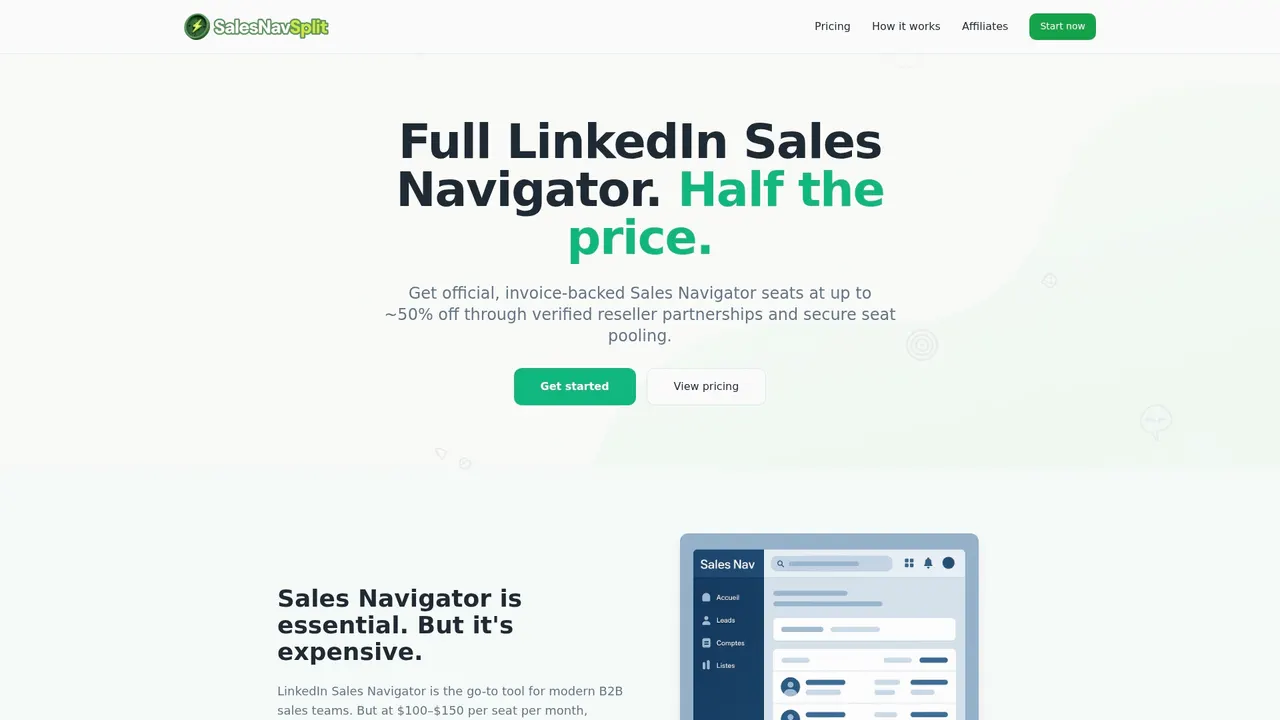
The barrier for most small teams isn’t willingness. It’s cost. That’s exactly why discounted LinkedIn Sales Navigator licenses through salesnavsplit.com exist. You get a fully authorized, official Sales Navigator seat at roughly 50% off standard pricing, sourced through verified reseller partnerships and activated within 24 to 48 hours. It’s the same platform, the same features, and the same LinkedIn compliance, at a price point that makes sense for lean B2B teams ready to put these enablement best practices into action.
Frequently asked questions
What is the single most important sales enablement best practice for B2B SMBs?
Centralizing sales content and mapping it to both buyer stages and personas is the most critical practice, as it consistently drives efficiency and gives reps the right asset at the right moment in every deal.
How much can structured sales enablement improve win rates?
Companies with structured enablement programs see win rates 49% higher on forecasted deals compared to teams without structured programs, making it one of the highest-ROI investments in B2B sales.
Why does sales-marketing alignment matter so much in enablement?
Buyers trust brands with consistent messaging, and 69% of B2B buyers report encountering mismatched information between sales and marketing, which directly erodes confidence and slows down deal cycles.
How often should SMBs update their sales enablement content?
Refresh content quarterly at minimum, aligning updates with pipeline data, field feedback, and any shifts in buyer behavior or competitive positioning.
What’s the risk of over-relying on sales enablement technology?
Tool sprawl adds noise rather than value when platforms aren’t embedded in existing workflows. The safest approach is to integrate automation into your CRM and combine AI-driven insights with regular human review to keep decisions grounded in reality.
Recommended
- Boost Sales With These Proven Sales Navigator Tips - SalesNavSplit Blog
- What Is Sales Prospecting? Proven Strategies for B2B Success - SalesNavSplit Blog
- Sales tools checklist: Build your lean B2B outreach stack - SalesNavSplit Blog
- What is sales engagement? Master multichannel LinkedIn outreach - SalesNavSplit Blog