
What is sales engagement? Master multichannel LinkedIn outreach
What is sales engagement? Master multichannel LinkedIn outreach
TL;DR:
- Effective B2B sales engagement requires structured, multi-channel outreach rather than passive waiting.
- Personalization, consistency, and timely follow-up across email, LinkedIn, and calls boost reply rates significantly.
- Sales engagement focuses on execution and relationships, while enablement provides training and content before the outreach.
Most B2B sales teams think engagement means sending a connection request and waiting. It doesn’t. True sales engagement is a structured, repeatable process across multiple channels, and the performance gap is staggering. Multichannel sequences combining email, LinkedIn, and calls outperform single-channel efforts by up to 287%. If your team is relying on one channel, you’re leaving the majority of your pipeline on the table. This guide breaks down what sales engagement actually is, how it works in practice, which tools fit small and mid-sized B2B teams, and what separates reps who consistently hit quota from those who don’t.
Table of Contents
- What is sales engagement? The core concept explained
- How sales engagement works: Channels, tools, and modern workflows
- Best practices for effective sales engagement on LinkedIn
- Sales engagement vs sales enablement: What’s the difference and why it matters
- Pitfalls, edge cases, and advanced tactics for small B2B teams
- Our take: Why sales engagement is changing and what actually works
- Take your LinkedIn sales engagement further
- Frequently asked questions
Key Takeaways
| Point | Details |
|---|---|
| Sales engagement definition | It’s every structured interaction with buyers across channels like LinkedIn, email, and calls. |
| Multichannel is essential | Combining channels such as LinkedIn, email, and calls boosts response rates and pipeline. |
| Use the right tools | Affordable SEPs help automate, track, and optimize B2B outreach for small teams. |
| Avoid common pitfalls | Customize outreach, respect LinkedIn limits, and prioritize real conversations over quantity. |
| Proactivity wins deals | Successful teams engage early and measure progress by pipeline velocity rather than just messages sent. |
What is sales engagement? The core concept explained
Sales engagement is one of those phrases that gets used constantly but rarely defined well. Let’s fix that.
At its core, sales engagement refers to all structured interactions between sales reps and buyers across channels like email, calls, LinkedIn, and meetings throughout the sales cycle, with consistent, timely, personalized outreach at the center of every touchpoint. It’s not a single message. It’s not a one-time follow-up. It’s an intentional, repeatable system.
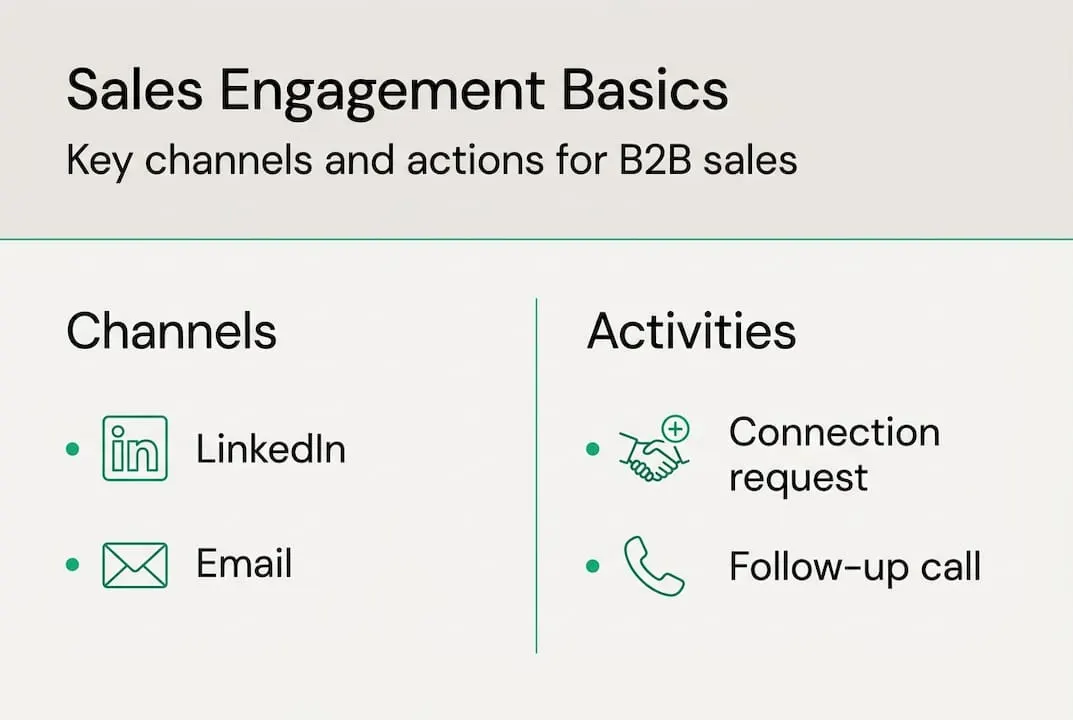
Think of it this way: if your CRM is the scoreboard, sales engagement is the actual game being played on the field. Enablement gives reps the playbook. Engagement is how they execute it, rep by rep, prospect by prospect, every single day.
The main goals of sales engagement are:
- Initiate conversations with the right buyers at the right time
- Build trust through consistent, relevant touchpoints
- Drive pipeline by moving prospects through each stage efficiently
- Win deals by staying top of mind without becoming noise
What makes engagement work isn’t volume. It’s the combination of consistency, personalization, channel variety, and timely follow-up. A rep who sends 10 highly relevant, well-timed messages across three channels will almost always outperform one who blasts 100 generic emails.
“Sales engagement is not about doing more. It’s about doing the right things, at the right time, in the right channel, with the right message.”
One critical distinction: sales engagement is action-focused, not asset-focused. It’s execution, not preparation. You can have the best sales deck in the industry, but if your engagement process is inconsistent or reactive, deals stall. For practical ways to boost LinkedIn engagement specifically, the channel-level tactics matter as much as the overall framework.
How sales engagement works: Channels, tools, and modern workflows
Now that you understand the ‘what,’ let’s break down exactly how sales engagement functions on the ground for B2B teams.
Modern sales engagement spans several channels, each with a distinct role in the buyer journey. LinkedIn is where relationships start. Email is where context gets built. Calls confirm intent and accelerate decisions. Video messages add a human layer that text can’t replicate. Meetings close the loop.

Here’s how the primary channels compare for B2B engagement:
| Channel | Strength | Best use case |
|---|---|---|
| Relationship-building, warm outreach | Top-of-funnel, research-backed personalization | |
| Scalable, trackable, async | Sequences, follow-ups, content sharing | |
| Phone calls | High intent signal, real-time | Mid-funnel qualification, decision acceleration |
| Video messages | Personal, memorable | Re-engaging cold prospects, post-demo follow-up |
To manage all of this without burning out, most teams use a Sales Engagement Platform (SEP). SEPs automate workflows, sequence multichannel cadences across email, calls, and LinkedIn, track engagement, and integrate with your CRM so reps can execute consistently without manual tracking.
For SMB teams, the must-have SEP features are:
- Multi-channel sequencing (not just email)
- CRM integration to avoid double data entry
- Automation with guardrails to prevent over-messaging
- Analytics to identify what’s working and cut what isn’t
Pro Tip: 80% of B2B leads come from LinkedIn, which makes it the single highest-priority channel for most B2B teams. If your sequence doesn’t include LinkedIn touchpoints, you’re working at a structural disadvantage.
Here’s a simple multichannel sequence in action: Day 1, comment on a prospect’s LinkedIn post. Day 3, send a personalized connection request. Day 5, follow up with a short LinkedIn DM. Day 8, send an email with a relevant resource. Day 12, make a brief call. This kind of layered approach is what separates teams that generate consistent pipeline from those that don’t.
Best practices for effective sales engagement on LinkedIn
Armed with the right tools, here’s how to actually maximize LinkedIn outreach for the best results.
The data is clear: multichannel outreach methods combining email, LinkedIn, and calls generate up to 287% more replies than single-channel efforts. That number alone should reshape how your team thinks about sequencing.
For context on what realistic performance looks like, LinkedIn benchmarks for 2026 show personalized connection acceptance rates between 9% and 30%, with reply rates ranging from 10% to 35%. Multi-channel sequences push those reply rates 40% to 287% higher depending on execution quality.
Here’s a research-backed list of LinkedIn engagement best practices:
- Start with a comment, not a DM. Engaging with a prospect’s content before reaching out warms the relationship and increases acceptance rates.
- Keep your first message under 400 characters. Short, specific messages consistently outperform long pitches in the opening touchpoint.
- Personalize based on real signals, not just their job title. Reference a post they wrote, a company milestone, or a shared connection.
- Follow up 5 to 7 times across channels before moving on. Most reps quit after 2 attempts. Most deals close after 5 or more touchpoints.
- Engage multiple stakeholders early in longer sales cycles. Waiting until late-stage to involve other decision-makers is one of the most common deal-killing mistakes.
Pro Tip: Generic personalization like “I noticed you work in sales at [Company]” no longer works. Prospects see through it immediately. Instead, reference something specific: “Saw your post about expanding into the EU market” is the kind of opener that actually gets replies. For smarter B2B prospecting at scale, signal-based targeting makes this level of personalization repeatable.
Knowing when persistence becomes pestering matters too. After 7 touches with no response, it’s time to move the prospect to a lower-frequency nurture sequence rather than continuing aggressive outreach. Respecting that boundary protects your sender reputation and your brand.
Sales engagement vs sales enablement: What’s the difference and why it matters
With practical best practices in mind, let’s address a frequent source of confusion: how sales engagement fits with enablement.
These two terms get used interchangeably, but they describe fundamentally different functions. Engagement vs enablement breaks down like this: engagement executes buyer interactions and outreach, while enablement provides the training, content, and tools beforehand. They complement each other, with enablement powering the messaging and engagement delivering it at scale.
| Dimension | Sales engagement | Sales enablement |
|---|---|---|
| Focus | Executing buyer interactions | Preparing reps to execute |
| Key activities | Sequences, follow-ups, LinkedIn outreach | Training, content creation, onboarding |
| Primary tools | SEPs, LinkedIn Sales Navigator, dialers | LMS platforms, content libraries, coaching tools |
| Measured by | Reply rates, pipeline velocity, meetings booked | Ramp time, content usage, quota attainment |
What happens when teams focus on only one?
- Enablement without engagement: Reps are well-trained but inconsistent in outreach. Pipeline dries up because execution is reactive.
- Engagement without enablement: Reps send lots of messages but lack the right content, positioning, or skills to convert. High activity, low results.
Small B2B teams often make the mistake of investing heavily in one and ignoring the other. A practical example: creating a strong case study is an enablement activity. Using that case study as a personalized LinkedIn DM attachment to a warm prospect is engagement. Both are necessary. For building a stronger foundation, proven prospecting strategies bridge the gap between the two functions effectively.
Pitfalls, edge cases, and advanced tactics for small B2B teams
Finally, let’s ensure your team avoids common mistakes and leverages advanced tactics that make a real difference for B2B LinkedIn engagement.
Even well-intentioned teams hit walls. Here are the most common pitfalls based on LinkedIn outreach nuances that trip up B2B sales teams:
- Exceeding LinkedIn’s daily limits: Sending more than 25 to 30 connection requests per day triggers restrictions. Automation tools that ignore this limit put your account at risk.
- Generic personalization: Messages with surface-level personalization see reply rates around 5%, while genuinely tailored messages hit 12% to 18%. The difference is real.
- Over-following-up: Hitting the same prospect on every channel every two days reads as desperation, not persistence.
- No mobile execution layer: Field sales reps need tools that work seamlessly on mobile. Ignoring this creates gaps in follow-up consistency.
- Skipping human review on AI-generated messages: AI can draft at scale, but without human oversight, tone and relevance suffer. Always review before sending.
On the tool side, affordable SEPs like Apollo.io and Lemlist offer LinkedIn multichannel features at roughly $49 to $59 per user per month, making them practical for SMB budgets. Enterprise platforms like Outreach are powerful but priced for teams with larger budgets and dedicated ops support.
For longer sales cycles involving multiple stakeholders, the advanced play is to map all key decision-makers early and engage each one with tailored messaging. Don’t wait for the champion to introduce you. Proactively connect with the economic buyer, the technical evaluator, and the end user simultaneously. For small business sales solutions that fit this kind of multi-stakeholder approach, the right tools make coordination far less chaotic.
Our take: Why sales engagement is changing and what actually works
Here’s something most playbooks won’t tell you: the reps consistently hitting quota in 2026 aren’t the ones sending the most messages. They’re the ones engaging the fastest and the most relevantly.
The shift is away from measuring raw activity volume toward tracking pipeline velocity, which is how quickly deals move through each stage as a result of engagement quality. That’s a fundamentally different scorecard.
The contrarian truth is that buyers now self-educate 60 to 70% of the way through the buying journey before ever talking to a rep. By the time they respond to your outreach, they’ve already formed an opinion. That means early, relevant, multi-stakeholder engagement isn’t a nice-to-have. It’s the only way to shape the buying narrative before it’s already written.
“The reps who win in 2026 aren’t the busiest. They’re the ones who show up early, in the right channels, with the right message, before the prospect has already decided.”
What to leave behind: spray-and-pray sequencing, generic personalization tokens, and the idea that more follow-ups automatically mean more deals. What to lean into: signal-based targeting, early multi-stakeholder engagement, and measuring pipeline velocity over raw activity. That’s the actual playbook.
Take your LinkedIn sales engagement further
Putting a strong sales engagement system into practice requires the right tools, and on LinkedIn, that starts with Sales Navigator. The challenge for most small and mid-sized B2B teams is the cost.
At salesnavsplit.com, you can access discounted LinkedIn Sales Navigator seats at roughly 50% off standard pricing through verified reseller partnerships in the US and Europe. Every seat is official, compliant, and activated within two business hours European time. The licence costs $50 a month instead of LinkedIn’s $119.99, and renews every 30 days. If you’re serious about executing the strategies in this guide, starting with the right tool at the right price is the logical first step.
Frequently asked questions
What is sales engagement in sales?
Sales engagement is the set of structured interactions between sales reps and buyers across multiple channels, aimed at building relationships and driving revenue through consistent, personalized outreach.
Why is multichannel engagement better than just email for LinkedIn sales?
Multichannel outreach combining LinkedIn, email, and calls outperforms single-channel efforts by up to 287% in reply rates, because varied touchpoints increase visibility and relevance across the buyer journey.
How many LinkedIn connection requests can I send safely each day?
To avoid account restrictions, limit requests to 25 to 30 per day and focus on genuine personalization rather than volume-based automation.
What is the difference between sales engagement and sales enablement?
Sales enablement prepares reps with the right content and training, while engagement is how reps actively interact with buyers and deliver value across channels.
What affordable tools help with LinkedIn sales engagement?
Platforms like Apollo.io and Lemlist offer strong LinkedIn engagement features for SMB budgets at $49 to $59 per user per month, making them practical alternatives to enterprise-level tools.