
B2B Pipeline Management: Optimize Sales with LinkedIn
B2B Pipeline Management: Optimize Sales with LinkedIn
TL;DR:
- Clear, buyer-focused pipeline stages improve forecast accuracy and deal progression.
- Regular hygiene practices prevent stagnant deals and pipeline bloat.
- Cost-effective tools like LinkedIn Sales Navigator enable targeted prospecting and smarter pipeline management.
Stalled deals, bloated pipelines, and missed revenue targets are not random bad luck. They are the predictable result of unclear processes, vague stage definitions, and the wrong tools. For small business sales teams and startup reps, a chaotic pipeline is not just frustrating, it is expensive. Every zombie deal sitting in your CRM is a distraction from a real opportunity. This guide walks you through a practical, step-by-step approach to cleaning up your B2B sales pipeline, structuring it for scale, and using cost-effective tools like LinkedIn Sales Navigator to prospect smarter and close more consistently.
Table of Contents
- Understand the modern sales pipeline
- Set up a clear, scalable pipeline structure
- Leverage cost-effective digital tools for prospecting
- Monitor, review, and continuously improve pipeline health
- A better way: Why sales pipeline success begins with radical focus
- Get more from your sales pipeline with Sales Navigator tools
- Frequently asked questions
Key Takeaways
| Point | Details |
|---|---|
| Define clear stages | Set unambiguous exit criteria for every pipeline stage to prevent zombie deals. |
| Leverage digital tools | Use cost-effective solutions like LinkedIn Sales Navigator for precision prospecting and pipeline hygiene. |
| Review weekly | Weekly pipeline reviews prevent bloat and boost deal progression for small teams. |
| Track key metrics | Monitor velocity, win rate, and deal age for ongoing pipeline health and smart forecasting. |
Understand the modern sales pipeline
A sales pipeline is a visual representation of where every active deal stands in your sales process, from first contact to closed revenue. It is not the same as a sales funnel. A funnel measures conversion rates across a broad audience, while a pipeline tracks individual deals and their movement through defined stages. Confusing the two is one of the most common pipeline pitfalls that small teams fall into, leading to misaligned forecasts and poor coaching decisions.
Typical pipeline stages include prospecting, qualification, discovery, proposal, negotiation, and closed/won or closed/lost. Each stage should represent a clear milestone in the buyer’s decision process, not just an internal sales activity. The problem is that most small teams define stages around what the rep is doing rather than what the buyer has committed to. This creates subjective criteria that make it impossible to compare deals or coach consistently.
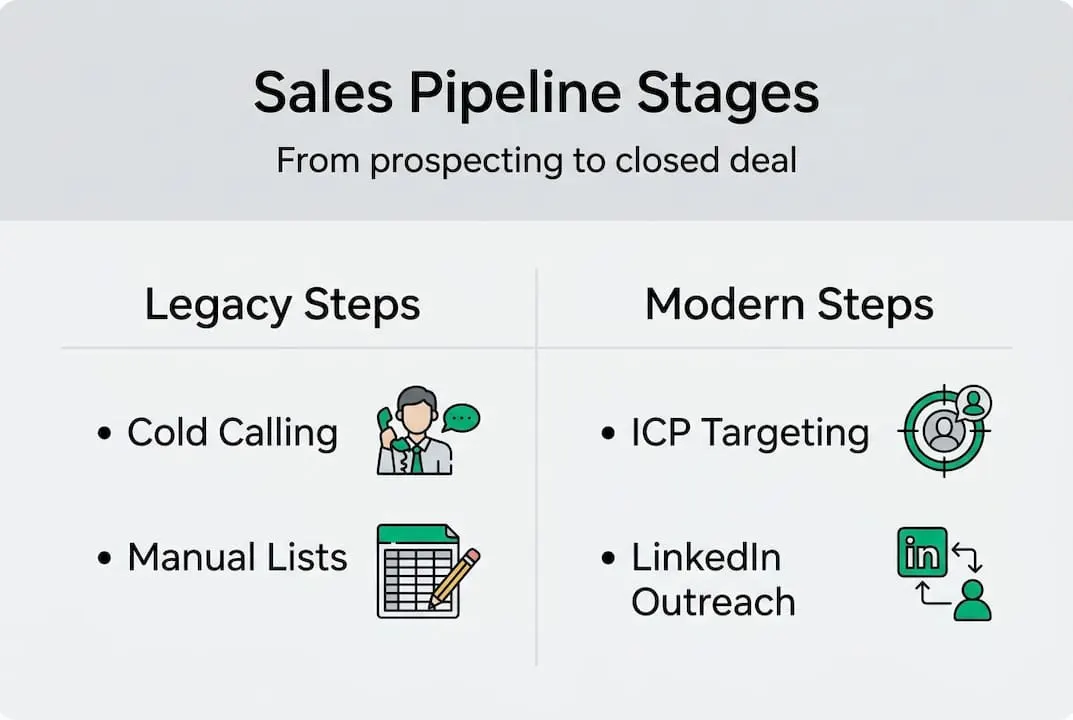
The rise of digital tools and holistic selling is fundamentally changing how pipeline management works. Buyers now research independently, engage on multiple channels, and expect personalized outreach before they ever respond. Legacy pipeline management assumed a linear, rep-driven process. Modern approaches are buyer-centric, data-informed, and built around collaborative sales workflows that keep entire teams aligned.
Here are the most damaging pipeline pitfalls for small teams:
- Zombie deals: Opportunities that have not moved in 30+ days but remain active, inflating your pipeline value
- Pipeline bloat: Too many deals at early stages, creating false confidence in revenue forecasts
- Subjective stage criteria: Reps disagree on what qualifies a deal to move forward
- Funnel vs. pipeline confusion: Reporting on volume metrics when you need deal-level insight
| Pipeline stage | Legacy practice | Modern practice |
|---|---|---|
| Prospecting | Cold call lists | ICP targeting via Sales Navigator filters |
| Qualification | Rep’s gut feeling | Defined BANT or MEDDIC criteria |
| Discovery | One-size-fits-all pitch | Buyer-specific pain mapping |
| Proposal | Static PDF | Dynamic, personalized deck |
| Negotiation | Price haggling | Value-based discussion |
| Closed/lost | Forgotten | Structured loss analysis |
Strong sales prospecting strategies start with understanding your pipeline structure first. Without that foundation, even the best prospecting tactics produce leads that stall and clutter your stages. Pair that with modern B2B sales solutions and you have a system that actually scales.
Set up a clear, scalable pipeline structure
Vague stages kill deal momentum. When a rep is unsure whether an opportunity belongs in “discovery” or “proposal,” they default to optimism, and optimism is the enemy of accurate forecasting. The fix is not more stages. It is better-defined exit criteria for each stage you already have.
Here is how to build a pipeline structure that works for a small team:
- List your current stages and write down what it means for a deal to exit each one. Be specific. “Prospect agreed to a 30-minute discovery call” is an exit criterion. “Looks promising” is not.
- Tie each stage to a buyer action, not a rep action. The buyer requesting a proposal is a stronger signal than the rep sending one.
- Align stages with your buyer journey. If your buyers typically take 60 days to decide, your pipeline should reflect that timeline with checkpoints, not just activities.
- Set a maximum deal age per stage. Any deal older than your threshold gets flagged automatically for review.
- Clean weekly. Remove or archive deals that no longer meet entry criteria. This is not failure, it is discipline.
For small B2B teams and startups, working backward from revenue goals and applying strict stage exit criteria is the most reliable way to build a pipeline that reflects reality rather than wishful thinking.
| Factor | Legacy pipeline | Modern pipeline |
|---|---|---|
| Stage criteria | Subjective, rep-defined | Objective, buyer-action-based |
| Clean-up frequency | Monthly or never | Weekly |
| Tool use | Spreadsheet or basic CRM | CRM + Sales Navigator + automation |
| Forecast accuracy | Low | High |
| Coaching basis | Anecdote | Pipeline data |
Pro Tip: Run a 15-minute weekly pipeline review every Monday. Each rep flags any deal that has not had a buyer-initiated action in the past 7 days. Those deals either get a clear next step assigned or they get archived. No exceptions.

This level of discipline feels harsh at first. But it is the single fastest way to improve your sales conversion rates and give leadership a forecast they can actually trust. Pair this structure with the right small business sales solutions and you stop guessing and start predicting.
Leverage cost-effective digital tools for prospecting
Small teams do not need a massive tech stack. They need a small set of tools that do their job extremely well. The mistake most startups make is buying a complex CRM with 200 features and using 4 of them. Tool sprawl creates confusion, not efficiency.
The core toolkit for a lean B2B sales team in 2026 looks like this:
- LinkedIn Sales Navigator: Advanced search filters to target your ideal customer profile (ICP) by industry, company size, seniority, and growth signals
- A lightweight CRM: HubSpot’s free tier or Pipedrive for deal tracking without the bloat
- Discounted seats: An official Sales Navigator licence per person through a verified reseller, so the team keeps full access at a lower cost per seat
- Automated reporting: Scheduled pipeline health reports so you are not pulling data manually every week
Sales Navigator is cost-effective for ICP prospecting and enables smarter collaboration across small sales teams. Its filters let you build hyper-targeted lead lists based on real signals, not just job titles. You can track account changes, spot hiring trends, and identify decision-makers who are actively engaging with relevant content.
“Buyer-centric, digital-first selling is replacing hard-sell tactics. Reps who show up with context and relevance win. Those who show up with a pitch lose.”
The AI-assisted pipeline tools emerging in 2026 are also worth watching. AI can now flag deals at risk of stalling, suggest next-best actions, and even draft personalized outreach based on a prospect’s recent activity.
Pro Tip: Track pipeline velocity for every stage. Velocity = (number of deals x average deal value x win rate) divided by average sales cycle length. When velocity drops in a specific stage, you know exactly where to focus coaching and process fixes.
A well-structured Sales Navigator workflow turns prospecting from a guessing game into a repeatable system. And if you want to go deeper on targeting, advanced prospecting techniques using Sales Navigator’s Boolean search and filter combinations can dramatically shrink your time-to-qualified-lead.
Monitor, review, and continuously improve pipeline health
Building a pipeline is not a one-time event. It is a living system that needs regular attention. Most small teams set up their pipeline stages once and then wonder why deals stall six months later. The answer is almost always neglected hygiene.
Here is a weekly review workflow that takes less than 30 minutes:
- Pull your pipeline report filtered by last activity date. Sort by oldest first.
- Flag every deal with no buyer-initiated contact in the past 10 days.
- Coach reps on the flagged deals. What is the next concrete action? Who owns it? When does it happen?
- Archive dead deals immediately. Do not let them sit. A clean pipeline is a trustworthy pipeline.
- Update your forecast based on what actually moved, not what you hoped would move.
Weekly reviews and velocity tracking are the most reliable fix for stagnant pipelines and inconsistent forecasting. They also create natural coaching moments that improve rep performance over time without requiring formal training sessions.
| Metric | What it measures | Healthy benchmark |
|---|---|---|
| Pipeline velocity | Speed of deal movement | Increasing quarter over quarter |
| Win rate | Deals closed vs. total entered | 20-30% for B2B SMBs |
| Deal age | Time in current stage | Under your defined max per stage |
| Pipeline bloat | Deals with no recent activity | Under 15% of total pipeline |
| Stage conversion | % moving to next stage | Consistent or improving |
Pro Tip: Set a recurring calendar block every Monday morning titled “Pipeline hygiene.” Treat it like a non-negotiable meeting. Teams that protect this time consistently outperform those that review pipelines only when leadership asks.
Hybrid pipeline views, mixing stage data with lead source data, are especially powerful. They reveal whether deals from LinkedIn outreach stall at a different stage than deals from referrals. That insight shapes where you invest prospecting time. Reviewing pipeline health practices regularly and using tools that support automated sales processes keeps your team focused on deals that actually move.
A better way: Why sales pipeline success begins with radical focus
Here is an uncomfortable truth most sales content will not say out loud: adding more tools, more stages, or more dashboards almost never fixes a broken pipeline. The teams we have seen consistently hit quota are not the ones with the fanciest CRM setup. They are the ones who ruthlessly cut their pipeline to only include deals that meet strict criteria, and they do the boring weekly clean-up without skipping it.
Most startups overvalue shiny dashboards and undervalue process discipline. A pipeline with 10 real, qualified deals is worth more than one with 60 wishful entries. The math is simple but the behavior is hard. It requires saying no to deals that feel good but lack real buyer commitment.
Hyper-focusing on a handful of genuine ICP fits, using tools like Sales Navigator to qualify fast and move on quickly when there is no fit, is what separates teams that grow from teams that spin their wheels. Less pipeline, more results. That is the contrarian truth. Strong sales engagement practices reinforce this focus by keeping your outreach targeted and your follow-ups meaningful rather than scattered.
Get more from your sales pipeline with Sales Navigator tools
If this guide helped you see where your pipeline needs work, the next step is making sure you have the right tools without overpaying for them.
At salesnavsplit.com, you can access official LinkedIn Sales Navigator seats at roughly 50% off standard pricing, sourced through verified reseller partnerships in the US and Europe. Seats activate within two business hours European time, billing runs through Stripe, and every license is fully compliant with LinkedIn’s terms. Each licence covers one LinkedIn account, at $50 a month instead of $119.99. Whether you are a solo rep or building out a small team, this is how you get enterprise-grade prospecting power at a startup-friendly price.
Frequently asked questions
What is the most common mistake in sales pipeline management for small businesses?
Leaving deals in the pipeline too long without strict exit criteria is the top mistake, creating zombie deals and pipeline bloat that inflate forecasts and lower win rates.
How often should a sales pipeline be reviewed?
Pipelines should be reviewed weekly for pipeline hygiene and deal progression, not monthly or only when leadership requests a report.
Why use LinkedIn Sales Navigator for SMB sales pipelines?
Sales Navigator offers advanced filters that let small teams prospect ICP fits cost-effectively, cutting time-to-qualified-lead without requiring a large team or budget.
What metrics best indicate pipeline health?
Velocity, win rate, deal age, and stagnant deal frequency are the four metrics that most reliably surface pipeline health issues before they become revenue problems.
Recommended
- Blog - SalesNavSplit
- Top sales engagement tips to boost LinkedIn results - SalesNavSplit Blog
- Advanced sales search: Smarter B2B prospecting with Navigator - SalesNavSplit Blog
- Small business sales solutions for smarter B2B growth - SalesNavSplit Blog
- LinkedIn Photoshoot Guide: Elevate Your Profile in 2026