
What Is Sales Prospecting? Proven Strategies for B2B Success
What Is Sales Prospecting? Proven Strategies for B2B Success
TL;DR:
- Modern prospecting focuses on identifying and qualifying the right customers rather than cold calling.
- Effective prospecting builds a predictable pipeline, reducing costs and shortening sales cycles.
- Consistency and routine, especially on platforms like LinkedIn Sales Navigator, are key to successful B2B prospecting.
Most sales professionals think prospecting means picking up the phone and cold calling strangers until someone says yes. That mental model is outdated and costly. Real prospecting is a disciplined process of finding the right people, qualifying them against your ideal customer profile, and moving them into a healthy pipeline. When done with intention, it does not just fill your calendar with meetings. It builds predictable revenue. This article covers the definition, the data behind its impact, the top strategies for B2B teams in 2026, and a practical playbook for using LinkedIn Sales Navigator to prospect smarter every single day.
Table of Contents
- What is sales prospecting? Core concepts explained
- Why prospecting matters: Impact on B2B sales growth
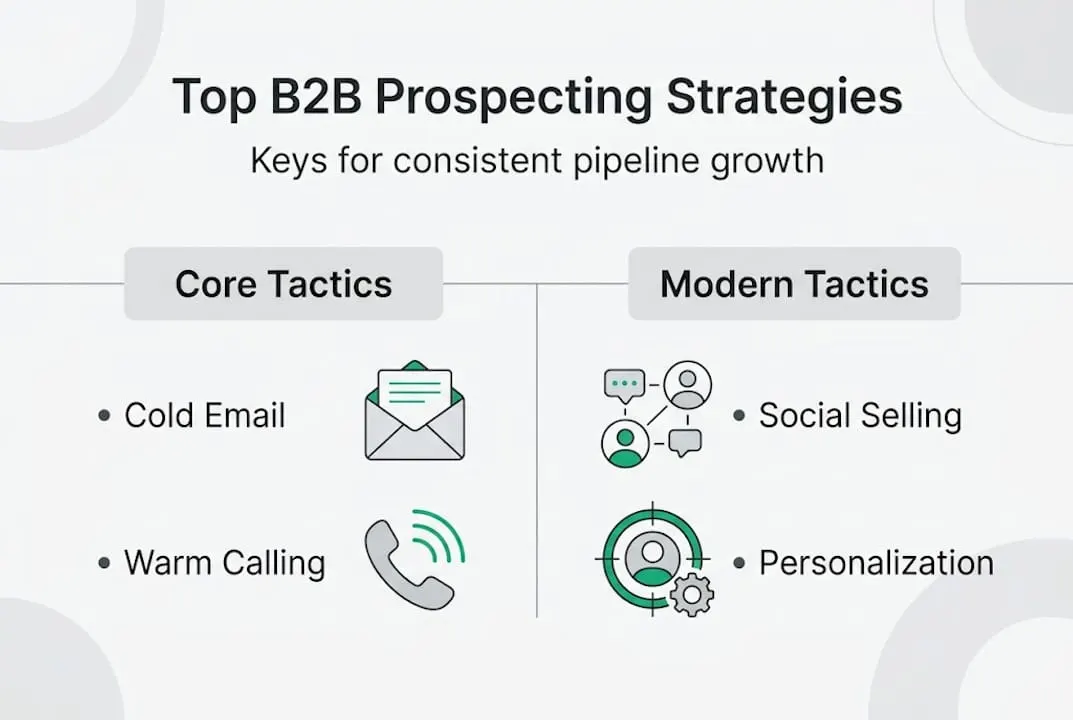
- Major sales prospecting strategies for B2B success
- How to use LinkedIn Sales Navigator for advanced sales prospecting
- The real challenge of modern prospecting: Consistency over novelty
- Get more from your Sales Navigator investment
- Frequently asked questions
Key Takeaways
| Point | Details |
|---|---|
| Sales prospecting defined | It’s the process of identifying and qualifying potential customers for your business. |
| B2B growth impact | Effective prospecting directly fuels faster sales growth and stronger pipelines in B2B sectors. |
| Modern prospecting strategies | Combining social selling with classic outreach strategies yields the best results for today’s teams. |
| Use LinkedIn tools | Advanced tools like LinkedIn Sales Navigator make it easier to find, organize, and reach out to top-quality leads. |
| Consistency wins | Daily, disciplined prospecting habits matter more than chasing the latest sales tool. |
What is sales prospecting? Core concepts explained
Let’s start with a clean definition. Sales prospecting is identifying and qualifying potential customers who have a realistic chance of buying your product or service. Notice what that definition excludes: it is not about blasting a list of random contacts, and it is not the same as marketing. Prospecting is a deliberate, sales-led activity that sits at the very top of your revenue funnel.
A lot of people confuse three related terms: leads, prospects, and customers. Here is how they actually differ:
- Lead: Any contact who has shown some level of interest or fits a basic demographic criterion. They have not been vetted yet.
- Prospect: A lead who has been qualified. They match your ideal customer profile, have a likely need, and show some buying signal.
- Customer: A prospect who has made a purchase and entered a business relationship with you.
Skipping the qualification step is where most B2B teams waste time. They treat every lead like a prospect and burn hours chasing contacts who will never convert.
Traditional prospecting relied on cold calls, trade show networking, and purchased contact lists. Modern prospecting layers in data intelligence, social platforms, intent signals, and CRM tools to filter smarter before you ever reach out. The result is a higher ratio of qualified prospects to raw leads, which means less wasted effort and more closed deals.
“Prospecting is not about talking to everyone. It is about talking to the right people at the right time with the right message.”
Think of your B2B prospecting guide as the blueprint that defines who your ideal buyer is, where to find them, and how to qualify them before investing time in outreach. Without that blueprint, your pipeline looks busy but rarely converts. With it, every conversation you start has a clear purpose and a realistic path to revenue.
Sales prospecting is the first critical step in a healthy pipeline. If you neglect it, every downstream stage suffers. Weak prospecting leads to low-quality meetings, poor conversion rates, and a sales cycle that drags on without closing.
Why prospecting matters: Impact on B2B sales growth
With a foundation in what prospecting is, let’s look at its measurable effects on B2B sales. The numbers are hard to ignore. Companies that excel at prospecting generate 50% more sales-ready leads at 33% lower cost. That is not a marginal improvement. That is a structural advantage that compounds over time.
Here is a snapshot of what better prospecting delivers across key business metrics:
| Metric | Poor prospecting | Strong prospecting |
|---|---|---|
| Pipeline fill rate | Inconsistent, reactive | Steady, predictable |
| Cost per qualified lead | High | Up to 33% lower |
| Sales cycle length | Long, stalled | Shorter, more focused |
| Win rate | Below average | Above average |
| Revenue predictability | Low | High |
The table above is not theoretical. These are patterns that emerge when B2B teams commit to a structured sales prospecting workflow versus a reactive, ad hoc approach.
Poor prospecting has real costs beyond just missed quota. When reps spend time on unqualified leads, they burn energy that could go toward closing. They also create false pipeline signals that mislead forecasting. Leadership sees a full funnel but a weak close rate, and the root cause is almost always poor qualification at the top.
Pro Tip: Block 30 to 45 minutes every morning specifically for prospecting activity before you check email or join calls. Reps who protect this time consistently outperform those who prospect reactively.
The quick wins that B2B sales growth solutions consistently point to include tightening your ideal customer profile, using intent data to prioritize outreach, and building a repeatable daily cadence. None of these require expensive new tools. They require discipline and a clear process.
Major sales prospecting strategies for B2B success
Knowing the impact, you need to understand the top strategies to prospect efficiently. No single approach works for every business, but combining two or three creates a compounding effect that individual tactics cannot match.

Here is a comparison of the most common B2B prospecting strategies:
| Strategy | Best for | Key limitation |
|---|---|---|
| Cold calling | High-volume outreach, SMB targets | Low response rates without personalization |
| Email outreach | Scalable, trackable communication | Inbox competition, spam filters |
| Inbound content | Long-term lead generation | Slow to build, requires consistent effort |
| Social selling | Relationship-driven B2B sales | Requires time investment and personal brand |
| Referral programs | High-trust, warm introductions | Hard to scale without a system |
Here is how to sequence them for maximum impact:
- Define your ideal customer profile before choosing any channel. The profile determines where your buyers spend time.
- Start with inbound content to build credibility and attract warm leads over time.
- Layer in email and cold calling for outbound momentum while inbound scales.
- Use social selling on LinkedIn to engage decision-makers in context, not cold.
- Build a referral system once you have happy customers who can advocate for you.
Social selling deserves special attention in 2026. Social selling on LinkedIn delivers higher-quality leads compared to cold outreach alone. The reason is context. When you engage with a prospect’s content, comment thoughtfully, and then reach out, you are not a stranger. You are a familiar name with a relevant perspective.
Pro Tip: Before sending a LinkedIn connection request to a prospect, engage with two or three of their recent posts. This warms the relationship and dramatically improves your acceptance rate.
For practical sales engagement tips that work across channels, the common thread is personalization at scale. Generic outreach gets ignored. Specific, relevant messages get responses.
How to use LinkedIn Sales Navigator for advanced sales prospecting
Since LinkedIn is the most powerful B2B platform, let’s break down how Sales Navigator can supercharge your prospecting. The tool is not just a fancier search bar. It is a full prospecting system when used correctly.
Here is a step-by-step workflow to get results:
- Build your ideal customer profile inside Sales Navigator using filters like industry, company size, seniority level, geography, and job function.
- Run an advanced lead search using Boolean logic to narrow results to your exact target persona.
- Save leads and accounts to dedicated lists so you can track activity signals over time.
- Set up alerts for job changes, company news, and profile updates. These are natural conversation starters.
- Use the InMail feature for direct outreach when a prospect is not yet in your network.
- Review TeamLink to see if any colleagues have existing connections to your target accounts.
Sales Navigator helps to filter, organize, and track prospects more efficiently than manual LinkedIn search ever could. The difference in output is significant, especially for small teams without a large SDR function.
Beyond the basics, power users integrate Sales Navigator with their CRM to sync lead data automatically. This eliminates manual data entry and keeps your pipeline current without extra admin work. If you are evaluating tools alongside Sales Navigator, it is worth checking out Zoftwarehub alternatives to understand the full landscape of options available.
Key habits that separate average users from top performers:
- Review saved lead alerts every morning before outreach
- Tag leads by buying stage so lists stay organized
- Export account lists monthly to review pipeline coverage
- Use the “Similar leads” feature to expand your target universe without starting from scratch
Pro Tip: Use the “Spotlights” filter in Sales Navigator to find prospects who have recently changed jobs or posted on LinkedIn. These signals indicate active engagement and make your outreach far more timely and relevant.
For a deeper look at building a full workflow, the Sales Navigator guide walks through setup, search strategies, and outreach frameworks that B2B teams can implement immediately.
The real challenge of modern prospecting: Consistency over novelty
Here is the uncomfortable truth that most sales content avoids: the biggest prospecting problem is not the tool you are using. It is showing up every single day and doing the work.
Top-performing B2B reps are not necessarily using the most sophisticated automation stack. They are the ones who prospect every morning without exception. They have a routine. They protect it. They do not skip it because a meeting ran long or because a deal is close to closing.
Most teams struggle with improving prospecting consistency because they treat it as something to do when the pipeline looks thin. That reactive mindset creates a feast-and-famine cycle that is exhausting and predictable in the worst way.
The reps who build durable pipelines treat prospecting like exercise. You do not wait until you are out of shape to start running. You build the habit before you need the results. Master the basics with discipline first. Then layer in automation and advanced tools to multiply what already works. Chasing the next shiny feature before your fundamentals are solid is how teams stay stuck.
Get more from your Sales Navigator investment
If you are ready to implement what you have learned, here are next steps to make it even easier. The strategies in this article only deliver results if you have access to the right tools at a cost that makes sense for your business.
At SalesNavSplit, we provide official Sales Navigator licenses at up to 50% off standard LinkedIn pricing. These are genuine, verified seats sourced through authorized reseller partnerships in the US and Europe, fully compliant with LinkedIn’s terms of service. Activation happens within two business hours European time. The licence costs $50 a month instead of LinkedIn’s $119.99. If you are serious about B2B prospecting, this is the most cost-effective way to get started with the industry’s most powerful sales tool.
Frequently asked questions
What is the main goal of sales prospecting?
The main goal is to find and qualify potential customers who are likely to buy your product or service, so your pipeline stays healthy and conversion rates stay high.
How does LinkedIn Sales Navigator help with sales prospecting?
Sales Navigator lets you filter, organize, and track prospects with precision, so you spend time on high-quality leads instead of unqualified contacts.
What is the difference between a lead and a prospect?
A lead is any potential contact in your database, while a prospect is a qualified lead who fits your ideal client profile and shows genuine buying signals.
Which sales prospecting strategy works best for B2B?
Social selling on LinkedIn consistently produces higher-quality B2B leads because it builds context and familiarity before any direct outreach begins.