
Proven Steps to Qualify Sales Leads and Boost B2B Results
Proven Steps to Qualify Sales Leads and Boost B2B Results
TL;DR:
- A structured qualification process improves sales efficiency by focusing on high-potential leads.
- Implementing frameworks like CHAMP and tools like LinkedIn Sales Navigator enhances lead scoring accuracy.
- Speed and discipline in follow-up significantly increase the chances of converting qualified prospects.
Chasing the wrong leads is one of the most expensive habits in sales. You spend hours on calls, crafting messages, and building rapport, only to discover the prospect had no budget, no authority, or no real urgency to buy. This cycle kills pipeline health and drains motivation fast. The good news is that a structured qualification process, particularly on LinkedIn where decision-makers are highly active, can flip this dynamic entirely. This article walks you through exactly how to identify, qualify, verify, and prioritize sales leads so you spend your time on prospects that are genuinely worth pursuing.
Table of Contents
- Understanding what makes a qualified sales lead
- Essential tools and frameworks for lead qualification
- A step-by-step process to qualify sales leads on LinkedIn
- Verifying and prioritizing leads for a healthier pipeline
- Why most sales teams miss the mark with lead qualification
- Take your lead qualification to the next level
- Frequently asked questions
Key Takeaways
| Point | Details |
|---|---|
| Qualify leads efficiently | Prioritize fast, criteria-driven qualification to focus on prospects who will convert and buy. |
| Leverage smart tools | Use frameworks like CHAMP and AI lead scoring to boost accuracy and conversions. |
| Act quickly | Responding to inbound leads within one hour can increase qualification success up to sevenfold. |
| Verify and prioritize | Always confirm data and segment leads to keep your pipeline high-quality and manageable. |
Understanding what makes a qualified sales lead
Before you can qualify a lead, you need a clear definition of what “qualified” actually means in your B2B context. A qualified sales lead is a prospect who has demonstrated enough alignment with your offer to justify continued sales effort. That means they have the budget to buy, the authority to decide, a genuine need for your solution, and a realistic timeline for making a purchase decision.
Most sales teams skip this definition step and go straight to volume. They treat lead generation as a numbers game, believing that more outreach equals more closed deals. It does not. Flooding your pipeline with unqualified contacts creates noise, wastes time, and leads to inaccurate forecasting. Quality always beats quantity in B2B sales.
The classic criteria for a qualified lead break down into four areas:
- Budget: Can this company realistically afford your solution?
- Authority: Are you speaking with someone who can actually say yes?
- Need: Is there a genuine problem your product solves?
- Timeline: Is there urgency, or are they just browsing?
These four filters alone will eliminate a significant portion of contacts that were never going to convert. Understanding lead generation tips specific to LinkedIn will also help you attract better-fit prospects from the start, before qualification even begins.
One often-overlooked factor is speed. According to B2B marketing benchmarks, responding within one hour gives you 7x higher qualification odds compared to slower follow-up. The same research shows AI lead scoring boosts qualification accuracy by 40% and conversion rates by 51%. Speed and smart technology together are your biggest levers.
“The fastest-growing B2B sales teams are not the ones with the most leads. They are the ones who qualify the fastest and follow up the quickest.”
Pro Tip: Document your exact qualification criteria in your CRM as a required field. When every rep records the same four data points on every lead, your entire pipeline becomes measurable and consistent. Pair this with solid B2B prospecting strategies and your qualification rate will improve within weeks.
Essential tools and frameworks for lead qualification
With a clear definition of a qualified lead in place, the next step is choosing the right framework to guide your qualification conversations and the right tools to support them.
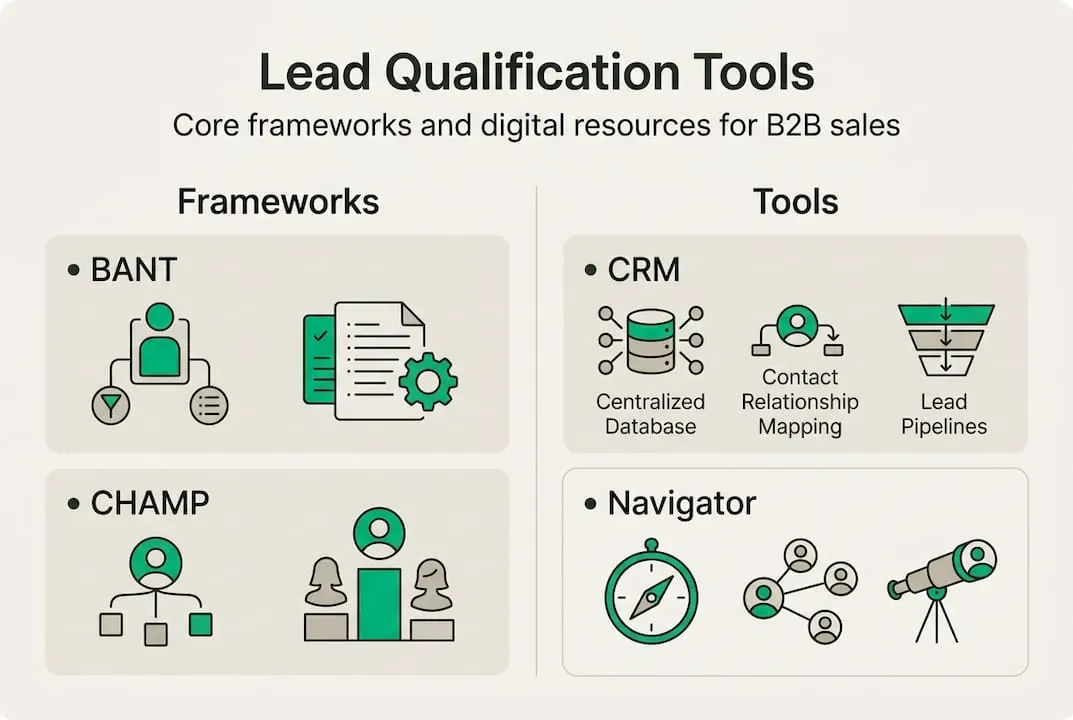
The most widely used qualification frameworks in B2B sales each have distinct strengths. Here is a quick comparison to help you choose:
| Framework | Best for | Strength | Weakness |
|---|---|---|---|
| BANT | Traditional enterprise sales | Simple and fast | Too seller-centric |
| CHAMP | Consultative B2B SaaS | Customer-focused | Requires deeper discovery |
| MEDDIC | Complex, high-value deals | Very thorough | Time-intensive |
| AI scoring | High-volume outreach | Scalable and data-driven | Requires CRM integration |
CHAMP stands for Challenges, Authority, Money, and Prioritization. It is especially effective for consultative B2B SaaS sales because it starts with the customer’s challenges rather than your product pitch. This approach builds trust earlier in the conversation and surfaces real buying intent faster.
Here are three tools that make qualification more reliable at scale:
- LinkedIn Sales Navigator: Lets you filter prospects by company size, job title, seniority level, and recent activity. This pre-qualification step means you are only reaching people who already meet your baseline criteria. Use advanced LinkedIn search to build hyper-targeted prospect lists before you ever send a message.
- A CRM with lead scoring: Platforms like HubSpot and Salesforce allow you to assign point values to behaviors and firmographic data, surfacing your hottest leads automatically.
- AI-powered enrichment tools: Tools that pull intent data and company signals can flag accounts showing active buying behavior. A detailed breakdown of how AI-powered B2B lead generation works at scale is worth exploring if you are not yet using intent signals.
Pro Tip: Use LinkedIn Sales Navigator’s “Saved Search” feature to set up automatic alerts when new prospects match your ideal customer profile. This keeps your top-of-funnel fresh without manual effort and integrates naturally into pipeline management with LinkedIn.
A step-by-step process to qualify sales leads on LinkedIn
Equipped with smart tools and frameworks, here is exactly how to qualify sales leads on LinkedIn with a proven sequence that saves time and improves conversion.
Step-by-step qualification workflow:
- Define your ICP (Ideal Customer Profile): Before any outreach, document the company size, industry, tech stack, and seniority of your ideal buyer.
- Search and filter on Sales Navigator: Use Boolean search and advanced filters to generate a list of prospects matching your ICP.
- Review profile signals: Check for recent posts, job changes, company growth signals, and shared connections before reaching out.
- Send a personalized connection request: Reference something specific from their profile. Generic messages get ignored.
- Initiate a qualifying conversation: Ask one open-ended question that surfaces need or urgency without pitching immediately.
- Log your CHAMP data: Record what you learn in your CRM immediately after each exchange.
| Step | Task | Time estimate |
|---|---|---|
| 1 | Define ICP and filters | 30 minutes (one time) |
| 2 | Build prospect list | 20 minutes per session |
| 3 | Profile review | 3 to 5 minutes per lead |
| 4 | Send connection request | 2 minutes per lead |
| 5 | Qualifying conversation | 10 to 15 minutes per lead |
| 6 | CRM update | 5 minutes per lead |
Common pitfalls to avoid at each stage:
- Skipping profile review and sending mass messages
- Pitching in your first message instead of asking a discovery question
- Letting promising leads go cold because of slow follow-up
- Failing to log qualification data, making it impossible to track patterns
The follow-up timing matters more than most reps realize. Responding within one hour gives you a 7x advantage in qualification odds. Set calendar reminders or use CRM automation to keep response times tight. A well-structured sales prospecting workflow built around this timing will outperform most manual approaches.
Pro Tip: Automate a “follow-up reminder” task in your CRM the moment a prospect accepts your connection request. Aim to send your qualifying question within 60 minutes. Also, follow compliant LinkedIn prospecting guidelines to protect your account while scaling outreach, and study sales engagement tips to sharpen your messaging at every step.
Verifying and prioritizing leads for a healthier pipeline
Qualifying a lead is not the same as verifying one. Once a prospect passes your initial qualification filters, you need to confirm the information is accurate before moving them deeper into your pipeline.
Verification steps to run on every qualified lead:
- Confirm budget: Ask indirect questions about current tool spend or team size to validate budget range without being blunt.
- Verify authority: Confirm who else is involved in the buying decision. One contact rarely signs off alone.
- Check intent signals: Look at their LinkedIn activity, recent posts, and whether they have engaged with competitor content.
- Validate company health: Check funding rounds, hiring trends, or recent press to confirm the company is in a position to invest.
Once verified, segmenting leads into tiers (hot, warm, cold) allows you to allocate your time where it matters most. Hot leads get same-day follow-up. Warm leads enter a nurture sequence. Cold leads stay in a re-engagement queue.
AI lead scoring makes this prioritization process more accurate. According to 2026 B2B benchmarks, AI-driven scoring improves accuracy by 40% and boosts conversion rates by 51%. That kind of impact is not a minor upgrade. It fundamentally changes how well your pipeline reflects real revenue potential.
“A clean, verified pipeline is worth ten times a bloated, unqualified one. Forecast accuracy starts with verification, not wishful thinking.”
Better verification also improves your sales forecasting. When every deal in your pipeline has confirmed budget, authority, and intent, your close-rate predictions become far more reliable. Strong customer engagement practices and data-backed approaches to improving sales conversion complete the loop from qualification to closed revenue. Supporting all of this with a sound B2B SEO strategy ensures inbound leads arriving at your pipeline are already better pre-qualified.

Why most sales teams miss the mark with lead qualification
Here is a truth most sales managers will not say out loud: quota pressure is the number one enemy of good qualification. When reps are behind on their numbers, they stop filtering. Every lead looks like a potential save. They rush through discovery, skip verification, and move unqualified prospects into late-stage deals just to make the pipeline look healthy. The result is missed forecasts and wasted closing effort.
The teams that consistently outperform do the opposite. They are more selective when under pressure, not less. They know that one well-qualified deal closes faster and with fewer concessions than five poorly qualified ones.
The real shift is treating qualification as a revenue protection tool, not an administrative task. That means using CHAMP as a non-negotiable conversation structure, setting hard response-time targets, and trusting AI scoring data over gut instinct. Strong B2B pipeline lessons reinforce this point clearly: discipline in qualification compounds over time. Being selective is not cautious. It is the most profitable move a sales team can make.
Take your lead qualification to the next level
You now have the frameworks, the tools, and the step-by-step process to qualify leads more efficiently on LinkedIn. The next real accelerator is having access to LinkedIn Sales Navigator without paying full retail price.
At salesnavsplit.com, we offer official Sales Navigator seats at approximately 50% off standard pricing through verified reseller partnerships in the US and Europe. Every seat is genuine, secure, and fully compliant with LinkedIn’s terms. Activation takes two business hours European time, invoicing is handled through Stripe, and your account is protected from credential risks. Before purchasing, review our Sales Navigator terms to understand exactly what is included. Better qualification starts with better tools, and now those tools are within reach for teams of any size.
Frequently asked questions
What are the first signs that a lead is qualified?
A qualified lead matches your ideal customer profile and shows clear interest, decision-making authority, and a relevant business need. Early signals include direct engagement with your outreach and specific questions about features or pricing.
Which framework works best for B2B SaaS lead qualification?
CHAMP is highly effective for B2B SaaS because it centers the customer’s challenges, authority, budget, and prioritization rather than leading with a sales pitch.
How can AI improve sales lead qualification?
AI boosts scoring accuracy by 40% and conversions by 51%, especially when reps follow up within one hour of a prospect showing interest.
What common mistakes slow down lead qualification on LinkedIn?
Relying on generic outreach messages and responding slowly are the two biggest reasons qualified leads go cold before they ever enter your pipeline.
Recommended
- Blog - SalesNavSplit
- What Is Sales Prospecting? Proven Strategies for B2B Success - SalesNavSplit Blog
- B2B Pipeline Management: Optimize Sales with LinkedIn - SalesNavSplit Blog
- How to improve sales conversion: a step-by-step guide - SalesNavSplit Blog
- Step-by-step guide to AI-powered B2B lead generation
- Optimize Your B2B Lead Generation Workflow for Sales Success