
Customer Engagement on LinkedIn: Boost B2B Sales
Customer Engagement on LinkedIn: Boost B2B Sales
TL;DR:
- Genuine customer engagement on LinkedIn builds trust and accelerates B2B sales pipelines.
- Active interactions like commenting, personalized messaging, and sharing relevant content are more effective than automation.
- Consistent, human-focused engagement strategies lead to higher response rates, stronger relationships, and better sales results.
Most sales professionals treat LinkedIn like a job board or a cold email inbox. They fire off generic InMail messages, collect connections like trading cards, and wonder why the pipeline stays dry. That mindset misses the real engine behind LinkedIn’s power: genuine customer engagement. Genuine LinkedIn engagement directly impacts lead generation and B2B relationships in ways that most reps never fully tap. This article breaks down exactly what customer engagement on LinkedIn means, why it drives B2B sales results, and which strategies your team can start using today to build real relationships that convert.
Table of Contents
- What is customer engagement on LinkedIn?
- Why customer engagement matters for B2B sales success
- Core strategies to drive customer engagement on LinkedIn
- Real-world B2B use cases and success stories
- A fresh perspective: Why genuine engagement wins on LinkedIn in 2026
- Take your LinkedIn engagement further with SalesNavSplit
- Frequently asked questions
Key Takeaways
| Point | Details |
|---|---|
| Engagement redefined | On LinkedIn, customer engagement means ongoing, genuine business relationship-building beyond simple post interactions. |
| Sales performance boost | Active LinkedIn engagement translates into higher lead generation and conversion rates for B2B teams. |
| Actionable strategies | Simple steps like profile optimization, personalized messaging, and consistent posting significantly enhance engagement. |
| Avoid automation traps | Focusing on authentic connections outperforms mass outreach and yields more sustainable results. |
What is customer engagement on LinkedIn?
Customer engagement on LinkedIn is not just clicking “like” on someone’s post. It is the full range of meaningful interactions between you and your prospects, clients, or partners on the platform. Think of it as every touchpoint that builds familiarity, trust, and business momentum.
LinkedIn is structurally different from other social platforms. It is a professional network, which means the context behind every interaction carries weight. A comment you leave on a CEO’s post is visible to their entire network. A recommendation you write for a colleague signals your professional credibility. A personalized connection request shows intentionality. Customer engagement spans far beyond post interactions, covering personalized messages, profile views, and network-building actions that other platforms simply do not replicate.
Here is what genuine customer engagement on LinkedIn actually looks like:
- Commenting on a prospect’s post with a relevant, thoughtful observation
- Sending personalized messages that reference shared interests or recent activity
- Endorsing skills to stay visible in a non-intrusive way
- Sharing relevant content that your target audience finds genuinely useful
- Writing recommendations to strengthen your professional reputation
- Reacting to company updates from accounts you are actively pursuing
For B2B engagement tips to work, they need to feel human. The moment your engagement looks automated or generic, trust evaporates.
Why does this matter so much in B2B sales specifically? Because B2B buying cycles are long, involve multiple decision-makers, and rely heavily on trust. LinkedIn’s professional environment makes it easier to establish credibility before a sales conversation even begins. You are not interrupting someone’s social scroll. You are entering their professional world.
Pro Tip: Before sending any LinkedIn message, visit the prospect’s profile and spend 60 seconds reading their recent posts or activity. Reference something specific. That one small step dramatically increases your response rate.
Why customer engagement matters for B2B sales success
Engagement on LinkedIn is not a vanity metric. It is a pipeline accelerator. Sales teams that consistently engage with their target accounts see measurable differences in response rates, relationship depth, and deal velocity.

Here is the core truth: consistent engagement delivers higher conversion rates and stronger customer relationships. That is not wishful thinking. It reflects the way B2B buyers make decisions. They buy from people they recognize and trust. If your name appears in their feed regularly, with relevant and helpful content, you become a familiar face rather than a cold caller.
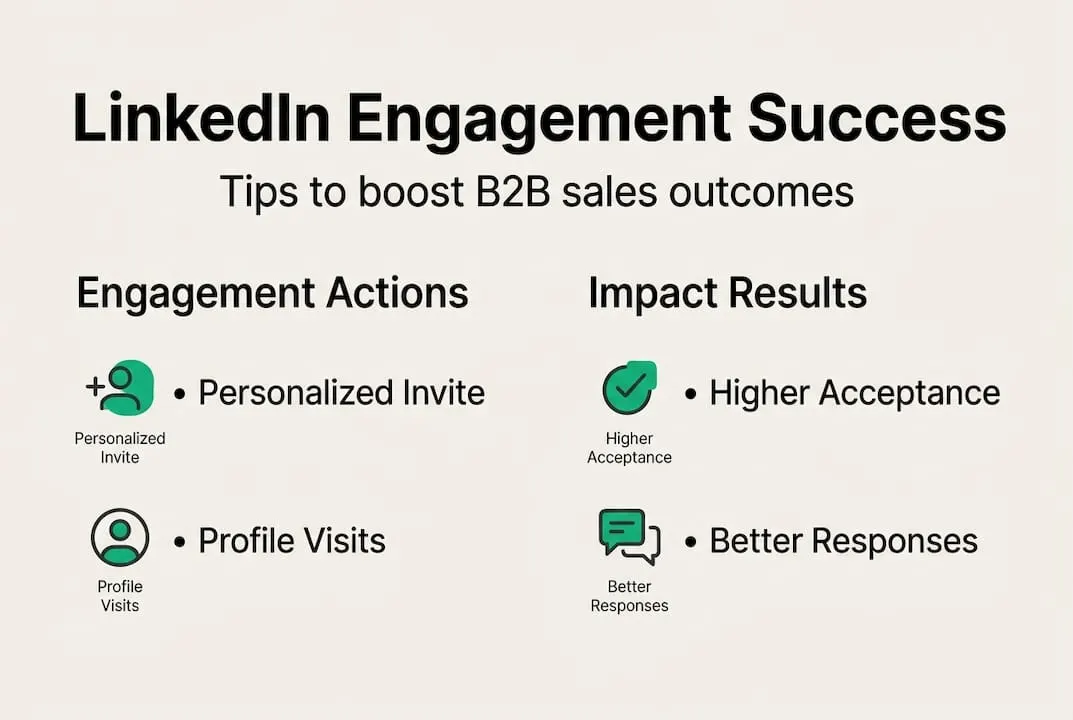
Let’s break down what active versus passive engagement actually looks like in practice:
| Engagement type | Passive approach | Active approach |
|---|---|---|
| Content | Post occasionally and wait | Share weekly, comment daily |
| Messaging | Generic InMail blasts | Personalized notes tied to activity |
| Network building | Accept random connections | Strategic connection requests |
| Profile activity | Static profile | Regular updates and engagement |
| Relationship depth | Surface-level | Multi-touch, ongoing conversations |
The difference in outcomes is significant. Sales professionals who engage actively are not just more visible. They are perceived as more knowledgeable and more invested in their clients’ success.
Active engagement also shortens the trust gap. In B2B sales, trust is the gatekeeper. A prospect who has seen you comment thoughtfully on industry trends for three months is far more likely to respond to your outreach than someone receiving a cold message from a stranger. This is the foundation of increasing sales conversions on LinkedIn.
“The reps who close the most LinkedIn deals are rarely the ones with the biggest networks. They are the ones with the most genuine conversations.”
Key benefits of active LinkedIn engagement for B2B teams:
- Faster pipeline progression because prospects already know you
- Higher InMail and connection request acceptance rates
- Stronger referral potential from existing connections
- Better positioning as a subject-matter expert in your field
- Lower cost per lead compared to paid advertising channels
Core strategies to drive customer engagement on LinkedIn
Knowing why engagement matters is half the battle. The other half is building a repeatable system that your team can execute consistently without burning out.
B2B engagement is most effective when it combines personalized messages with regular content sharing. Here is a practical sequence to follow:
-
Optimize your profile first. Your profile is your first impression. A complete, professional, and prospect-focused LinkedIn profile optimization ensures that when someone clicks your name after seeing your comment, they are impressed rather than confused.
-
Build a targeted connection list. Use LinkedIn’s search filters to identify decision-makers in your target accounts. Connect with a short, personalized note that references a specific reason you want to connect.
-
Engage before you pitch. Spend one to two weeks commenting on a prospect’s posts or sharing relevant articles before sending any direct outreach. This warms the relationship organically.
-
Create and share content consistently. Aim for two to three posts per week that address real pain points your audience faces. Content builds credibility at scale while you sleep.
-
Follow up with context. When you finally message a prospect, reference something specific from their activity. “I saw your post about supply chain challenges last week” lands better than any generic opener.
-
Use analytics to refine. Check which posts drive the most profile visits, connection requests, or message replies. Double down on what works and cut what does not.
| Engagement action | Typical impact |
|---|---|
| Personalized connection request | 30 to 50% higher acceptance rate |
| Comment on prospect’s post | Visible to their entire network |
| Weekly content posting | 2x profile view increase over 30 days |
| Skill endorsement | Non-intrusive visibility reminder |
| Video or document post | 3x more engagement than text-only |
Pro Tip: Block 20 minutes every morning for LinkedIn engagement. Comment on five posts, send two personalized messages, and check your analytics. Consistency beats intensity every time.
For teams looking to scale outreach without losing personalization, proven prospecting strategies built around Sales Navigator can dramatically speed up the process. And pairing those strategies with solid B2B growth tactics gives your team a compounding advantage over time.
Real-world B2B use cases and success stories
Strategies only matter if they work in practice. Here are three patterns we see repeatedly among high-performing LinkedIn sales teams.
The consistent commenter. A SaaS account executive at a mid-sized software company made it a rule to comment on five target accounts’ posts every day for 30 days. No pitches. Just genuine observations about what the post said. By the end of the month, three of those contacts had reached out to him. He closed one deal worth over $40,000 within 60 days of that first comment.
The content-first agency. A small B2B marketing agency started posting client success breakdowns every Tuesday. Short, specific, and tied to real results. Within 90 days, inbound connection requests from qualified prospects tripled. The LinkedIn client engagement workflow they built around content eventually replaced cold outreach as their primary lead source.
The referral builder. A financial services consultant focused on writing LinkedIn recommendations for former clients and colleagues over a four-month period. Those recommendations surfaced in searches, generated gratitude messages, and created organic introductions to new prospects. Professional service providers highlight client engagement as the top factor in successful LinkedIn deals, and this story is a textbook example.
Key lessons from these cases:
- Consistency over a defined period produces compounding results
- Content creation serves both inbound and outbound goals simultaneously
- Giving value first, through recommendations, comments, and shares, builds goodwill that converts
“LinkedIn is not a sprint. It rewards the sales professional who shows up every single week, adds value, and plays the long game.”
Teams that structure their LinkedIn reseller strategies around engagement rather than pure volume consistently outperform those chasing quick wins. Building a reliable sales prospecting workflow around these principles turns LinkedIn from a passive tool into an active revenue driver.
A fresh perspective: Why genuine engagement wins on LinkedIn in 2026
Here is an uncomfortable truth most sales tech vendors will not tell you: automation is making LinkedIn harder to win, not easier. The more teams rely on bots and mass-message sequences, the more prospects tune out anything that feels scripted. The noise level on LinkedIn has never been higher. And that is actually good news for reps who engage authentically.
When everyone else is spamming, a single genuine comment stands out. When every InMail looks identical, a personalized message with real context becomes memorable. The conventional wisdom says to scale your outreach as broadly as possible. But the data, and the experience of top-performing sales teams, points in the opposite direction: go deeper with fewer, better-targeted interactions.
This does not mean you should avoid tools entirely. Smarter B2B prospecting uses technology to identify the right people, then applies human judgment and genuine engagement to close the gap. The rep who pairs sharp prospecting with authentic engagement will always outperform the one who automates everything. In 2026, the reps winning on LinkedIn are the ones who sound like people, not programs.
Take your LinkedIn engagement further with SalesNavSplit
The strategies in this article work even better when you have access to LinkedIn’s most powerful prospecting tools. Sales Navigator gives you advanced filters, lead recommendations, real-time activity alerts, and messaging capabilities that standard LinkedIn simply cannot match.
At SalesNavSplit, we offer authorized LinkedIn Sales Navigator Seats at roughly 50% off standard pricing, sourced through verified reseller partnerships in the US and Europe. Your seat is official, secure, and activated within two business hours European time. The licence costs $50 a month instead of LinkedIn’s $119.99, and renews every 30 days. Great engagement strategy deserves great tools to back it up.
Frequently asked questions
What counts as customer engagement on LinkedIn?
Customer engagement includes likes, comments, private messages, endorsements, and direct profile interactions that build business relationships over time.
How can sales teams measure engagement on LinkedIn?
Use LinkedIn analytics to track content performance, connection growth, message response rates, and profile visit frequency. Analytics play a crucial role in understanding what is working and where to adjust your approach.
What are common mistakes in LinkedIn customer engagement?
Relying on impersonal mass messaging and skipping profile optimization are the two most frequent errors. Personalization and regular content sharing are the foundations that most struggling teams overlook.
Do automated engagement tools hurt or help on LinkedIn?
Automation can help you identify prospects faster, but overusing it for outreach hurts authenticity and typically reduces response rates. Authentic engagement drives the best long-term sales outcomes on the platform.