
Why official licenses matter for effective B2B sales
Why official licenses matter for effective B2B sales
TL;DR:
- Using official sales licenses ensures legal compliance, account security, and reliable access to platform data for B2B prospecting.
- Unlicensed or grey-market data sources pose significant risks of GDPR violations, platform bans, and reputational damage, often costing more long-term.
- Investing in verified, official licenses streamlines workflows, supports cross-border outreach, and provides a defensible, sustainable sales process.
Every sales team wants to move faster and spend less. That instinct drives a lot of shortcuts, especially when it comes to sales intelligence tools. But treating any data source or prospecting platform as interchangeable, regardless of where it comes from, is one of the most expensive mistakes a B2B team can make. The risks range from platform bans and lost data access to GDPR violations and contract breaches. Before you chase the cheapest path to a prospect list, it is worth understanding exactly what you are gambling with, and what official licensing actually protects.
Table of Contents
- What is an official sales license and why does it matter?
- Risks of using unofficial or grey-market data sources
- Official license vs. unofficial: A practical comparison
- How official licensing streamlines your B2B sales workflow
- The reality most sales teams miss about licensing and compliance
- Get cost-effective, official Sales Navigator licenses for your team
- Frequently asked questions
Key Takeaways
| Point | Details |
|---|---|
| Official license benefits | Official sales licenses ensure your outreach is compliant, secure, and trusted by clients. |
| Risks of shortcuts | Scraping or grey-market solutions may seem cheaper but expose you to major legal and reputational risks. |
| Cost vs. compliance | Paying for an official license is an investment in long-term security and smooth sales operations. |
| Workflow advantage | Official licenses mean fewer disruptions, easier compliance checks, and streamlined sales processes. |
What is an official sales license and why does it matter?
An official sales license is a contractual agreement, granted by the platform itself or through an authorized reseller, that gives you specific, legally recognized rights to access and use the platform’s data and features. For LinkedIn Sales Navigator, that means LinkedIn has either directly authorized your seat or approved the partner who is supplying it.
This matters more than most people realize. The license is not just a receipt. It defines what data you can access, how you can use it, who can see it, and what happens if you step outside those boundaries. Those boundaries are not arbitrary. They exist because professional networking data touches real people, and regulators on both sides of the Atlantic take that seriously.
Here is what separates an official license from everything else:
- Scope-limited permission: Your license specifies exactly what you are authorized to do. Viewing profiles, saving leads, sending InMail, exporting within agreed limits. Nothing more.
- Compliance-ready data rights: The data access you receive through an official license reflects contractual agreements between LinkedIn and its data subjects, which is relevant to your GDPR lawful-basis obligations in the EU.
- Contractual accountability: If something goes wrong, you have a paper trail. Disputes, audits, and regulatory inquiries all become significantly easier to navigate.
- Security assurances: Official accounts are monitored and protected. You are not relying on someone else’s credentials or shared logins that could disappear overnight.
“Official licensing is often the only defensible way to show scope-limited permission, especially for cross-border B2B outreach where GDPR lawful-basis questions and contractual data-use restrictions collide.”
That quote captures the regulatory reality perfectly. When you are prospecting across borders, from the US into Germany or from the UK into France, you are operating in environments with strict rules around data use. An unofficial workaround does not come with the documentation to back up your compliance position.
Understanding the sales license basics before you commit to any tool or data source is simply good business hygiene.
Pro Tip: Always ask your sales tool provider for documentation confirming their authorization status before you activate any seat. An authorized reseller should be able to produce evidence of their partnership with LinkedIn on request.
Risks of using unofficial or grey-market data sources
Grey-market data sources, shared credentials, scraped databases, and unverified resellers all promise one thing: cheaper access to the same results. They rarely deliver on that promise, and the hidden costs tend to surface at the worst possible moments.
Let us walk through the real risk categories.
Legal exposure under GDPR and US contract law
In the EU, GDPR requires that any processing of personal data have a clear lawful basis. When you use scraped data or grey-market contact lists, you generally cannot demonstrate that your use of someone’s contact information meets any recognized lawful basis. The fines are not hypothetical. Regulators have issued penalties running into the tens of millions of euros against companies that could not demonstrate compliant data use.

In the US, the exposure is more contractual in nature. LinkedIn’s terms of service are explicit about unauthorized scraping and third-party access, and violating those terms puts your entire account, and your company’s LinkedIn presence, at risk.
Platform bans and operational disruption
LinkedIn actively monitors for unusual access patterns. Shared credentials, automated scraping, and non-authorized API calls all trigger detection systems. When LinkedIn flags an account, the consequences are swift: account restrictions, temporary or permanent bans, and loss of all historical data tied to that account. For a sales team that has spent months building saved leads, tracking prospects, and logging activity, that is a catastrophic loss.
“The tradeoff is higher seat cost versus lower legal/account risk.”
That framing is exactly right. The initial savings on a grey-market seat can evaporate the moment your account gets flagged. And rebuilding from scratch, while managing the operational fallout, costs far more than any discount ever saved.
Reputational damage
Prospects and customers notice when something feels off. If your outreach relies on data sourced through questionable means, you may be contacting people who never gave any platform permission to share their information. That creates awkward situations at best and formal complaints at worst. A single regulatory complaint from a prospect in Germany or France can trigger an investigation that consumes months of legal resource.
The actual bottom line
The shortcut math rarely holds up. A grey-market seat might save you $50 a month. A GDPR fine or an account ban that wipes out your sales pipeline can cost 100 times that before you even factor in legal fees and lost deals.
Building a compliant outreach process from the start is far cheaper than fixing one after the damage is done. If you are doing advanced B2B prospecting at scale, compliance is not optional.
Pro Tip: Before onboarding any new data tool, run a quick checklist: Is the provider named as an authorized partner? Does the pricing feel too good to be true? Can they provide an official invoice? These three questions eliminate most problematic vendors immediately.
Official license vs. unofficial: A practical comparison
Knowing the risks is useful. Seeing them laid out side by side makes the decision easier. Here is a direct comparison across the dimensions that matter most for a B2B sales team.
| Factor | Official license | Unofficial or grey-market |
|---|---|---|
| Legal standing | Contractually protected | No legal basis for data use |
| GDPR compliance | Supported by platform terms | High exposure, no documentation |
| Account security | Monitored, protected seat | Risk of credential theft or ban |
| Data reliability | Current, platform-verified | Often stale or inaccurate |
| Access continuity | Guaranteed per contract | Can disappear without warning |
| Invoicing | Official, auditable | Often informal or absent |
| Vendor accountability | Authorized reseller or direct | Unknown, no recourse |
| True long-term cost | Predictable, justifiable | Unpredictable, often higher |
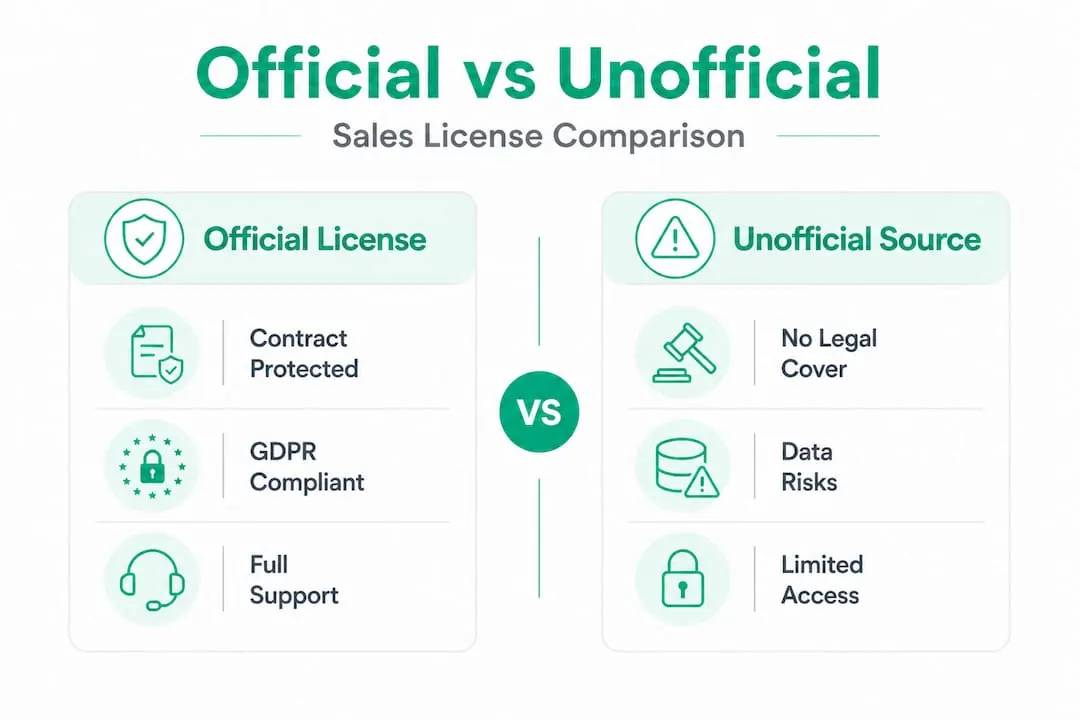
As the LinkedIn Sales Navigator API & compliance research for 2026 makes clear, “many ‘cheaper’ approaches exist, including scraping and grey-market data, but official licensing is often the only defensible way to show scope-limited permission.”
Here is a step-by-step process you can use to verify whether any license you are considering is genuinely official:
- Ask for the reseller’s authorization documentation. A legitimate LinkedIn reseller can show their partnership agreement or partner listing.
- Check the invoice format. Official transactions come with formal invoices, not informal payment links or peer-to-peer transfers.
- Verify payment processing. Reputable providers use recognized processors like Stripe and provide receipts tied to your business email.
- Confirm seat delivery method. Official seats are added to your LinkedIn account directly. You should not be sharing a login with anyone else.
- Review the provider’s terms of service. Look for explicit language about compliance with LinkedIn’s terms and data use policies.
Understanding LinkedIn reseller advantages and reading a thorough breakdown of Sales Navigator pricing will help you separate legitimate discounts from arrangements that put your team at risk.
How official licensing streamlines your B2B sales workflow
The compliance angle is important, but it should not overshadow the operational benefit of official licensing. Day-to-day, official licenses make your sales workflow cleaner, faster, and more reliable.
Here is how a typical workflow looks when you are operating on a legitimate seat:
- Onboarding is fast and clean. Authorized resellers like those powering salesnavsplit.com activate seats within two business hours European time. You get a real seat tied to your LinkedIn account, not a workaround.
- Saved leads and lists persist. Your prospect data stays in your account because your account is stable. No risk of waking up to a locked dashboard.
- CRM integrations work properly. Official Sales Navigator seats connect cleanly to Salesforce, HubSpot, and other major CRMs. Grey-market workarounds often break these integrations or trigger data permission errors.
- InMail and messaging features function as intended. Monthly InMail credits, message tracking, and engagement data all work correctly because LinkedIn is serving them to an authorized seat.
- You can prospect regulated industries without fear. Reaching into financial services, healthcare, or legal sectors often requires demonstrable compliance. Official licensing gives you that foundation.
The workflow impact extends to your team’s confidence. When reps know their tools are legitimate and their data use is defensible, they prospect more boldly. They pitch larger accounts. They follow up without second-guessing whether their contact’s information was gathered legally.
| Workflow step | Official license experience | Unofficial approach experience |
|---|---|---|
| Account setup | Clean, 24-48 hour activation | Delayed, unclear, or credential-sharing |
| Daily prospecting | Reliable, full feature access | Intermittent, risk of access loss |
| CRM sync | Integrated, data flows correctly | Often broken or restricted |
| Compliance documentation | Ready on request | Not available |
| Platform stability | Account in good standing | Flagging risk always present |
As the compliance research reinforces, official licensing is especially critical for cross-border B2B outreach where GDPR lawful-basis requirements demand that your data use be traceable and defensible.
Pairing a compliant license with the right habits, explored in our guide to boosting B2B sales with Navigator, is how you build a sustainable outreach machine. And if you are auditing your entire stack, a sales tools checklist helps you see where compliance gaps might exist beyond just your Navigator seat.
The reality most sales teams miss about licensing and compliance
Here is the uncomfortable truth that most sales leaders do not want to hear: the teams that cut corners on tools are often the same ones wondering why their outreach performance plateaus.
The false economy of grey-market tools is not just about the risk of a ban or a fine. It is about the slow erosion of your team’s capability. When your data source is unreliable, your segmentation suffers. When your account is flagged, you lose momentum at the worst time. When a prospect asks how you got their details and you cannot answer confidently, you lose credibility that took months to build.
The higher seat cost versus lower legal risk trade-off is real, but the framing often misses something. Compliance is not a cost center. It is a competitive advantage. Teams that can say, with documentation, that their outreach process is clean, authorized, and data-compliant close deals with regulated buyers that other teams cannot even get in the door with.
Enterprise procurement teams, especially in finance, healthcare, and the public sector, increasingly audit their vendors’ data practices before signing. Startups that build compliant habits early are positioned to scale into those accounts without having to rebuild their entire process first.
The types of B2B sales tools your team uses signal something about how you operate. Legitimate tools signal a legitimate business. That signal matters more than most sales managers account for.
Compliance is not something you bolt on later. It is the foundation you build outreach on from day one.
Get cost-effective, official Sales Navigator licenses for your team
You do not have to choose between protecting your business and managing your budget. The whole premise of chasing grey-market workarounds is that official licenses are unaffordable. That is simply no longer true.
At salesnavsplit.com, we provide official Sales Navigator licenses at approximately 50% off standard LinkedIn retail pricing, sourced through verified reseller partnerships in the US and Europe. Every seat is genuine, every invoice is official, and every activation happens within two business hours European time through Stripe-processed payments. You get the full feature set, the compliance backing, and the account security that comes with a legitimate seat. No shared credentials, no grey-market risk, no guesswork. Just a real, protected seat at a price that works for small teams and individual reps alike.
Frequently asked questions
What exactly does an official sales license provide?
An official license grants contractually protected access to platform data and features, giving you a legally defensible position for cross-border outreach, and scope-limited permission that satisfies GDPR lawful-basis requirements.
Is it illegal to use scraped or grey-market data for sales prospecting?
Using scraped or unofficial data can expose your business to significant legal liability under GDPR and platform terms of service, and the higher legal and account risk rarely justifies whatever is saved on the seat cost.
How can I check if my Sales Navigator license is official?
Ask your provider for authorization documentation, verify that billing comes through an official processor like Stripe, and confirm that your seat is assigned directly to your LinkedIn account rather than accessed via shared login.
Are official licenses really worth the higher cost?
Yes, because the cost versus risk trade-off consistently favors official licensing once you factor in the potential for account bans, regulatory fines, and lost pipeline that unofficial approaches put at risk.
Recommended
- Sales licenses explained: What B2B sellers need to know - SalesNavSplit Blog
- Sales tools checklist: Build your lean B2B outreach stack - SalesNavSplit Blog
- The best types of B2B sales tools for smarter prospecting - SalesNavSplit Blog
- Proven Steps to Qualify Sales Leads and Boost B2B Results - SalesNavSplit Blog