
What Is Sales Enablement? A 2026 Guide for Sales Teams
What Is Sales Enablement? A 2026 Guide for Sales Teams
TL;DR:
- Effective sales enablement is an ongoing, cross-functional discipline that improves win rates and quota attainment through focused skills, content, tools, process, and coaching. It requires continuous reinforcement, manager involvement, integrated workflows, and measurement of commercial outcomes rather than activity metrics. Successful programs prioritize coaching infrastructure, align content to buyer stages, and embed enablement practices into daily team operations.
Most sales leaders think they’re doing sales enablement when they send reps to a two-day training or drop content into a shared drive. They’re not. True sales enablement is a disciplined, cross-functional function that drives 49% higher win rates and 27% higher quota attainment for organizations that invest in it properly. This guide breaks down the real sales enablement definition, what its core pillars look like in practice, how to measure whether it’s working, and what it takes to implement it in a way that actually changes rep behavior.
Table of Contents
- Key takeaways
- What is sales enablement, really?
- The five pillars of a strong enablement program
- Measuring sales enablement effectiveness
- How to implement sales enablement that actually works
- My take: where most enablement programs quietly fail
- The right tools make your enablement strategy complete
- FAQ
Key takeaways
| Point | Details |
|---|---|
| Enablement is cross-functional | Sales enablement spans sales, marketing, RevOps, and product — not just the training team. |
| Five pillars drive results | Skill development, content, tools, process, and coaching all work together to improve rep performance. |
| Measure commercial impact | Track win rates and quota attainment, not just training completion rates. |
| Coaching is the multiplier | Manager coaching is the most under-invested layer in most enablement programs, yet it determines whether anything sticks. |
| Continuous beats one-time | Treating enablement as an ongoing function rather than a one-off project is what separates high-performing teams from the rest. |
What is sales enablement, really?
The short sales enablement definition: it is the ongoing process of providing your sales team with the skills, content, tools, processes, and coaching they need to consistently engage buyers and close deals.
The word “ongoing” does a lot of work there. Sales enablement is not a one-time training event, a content library someone built in Q1 and forgot about, or a single software platform. It is a cross-functional discipline that sits at the intersection of sales, marketing, revenue operations, and product teams. Each group feeds into it, and each group benefits from it.
Here is what differentiates a mature enablement function from the patchwork most companies settle for:
- Skills: Reps receive structured skill development tied to their specific role, stage of career, and buyer type, not generic best-practices lectures.
- Content and assets: Marketing and sales collaborate to produce materials that actually match how buyers think at each stage of the purchase journey.
- Tools and technology: The tech stack is selected to remove friction, not add complexity. Reps use tools that fit into their daily workflow.
- Process and methodology: A consistent sales process and buyer engagement methodology give reps a shared language and playbook.
- Coaching and reinforcement: Managers and enablement teams provide structured, recurring coaching that reinforces learned behaviors in real deal situations.
The distinction between sales training vs enablement is worth spelling out. Sales training is episodic. It happens at onboarding, at an annual kickoff, maybe after a bad quarter. Sales enablement is continuous. It wraps around training and makes the knowledge stick through reinforcement, real-time support, and feedback loops embedded in how reps work every day.
The five pillars of a strong enablement program
Understanding the five pillars in depth is where the importance of sales enablement really becomes clear. They are not separate programs. They are interdependent levers.
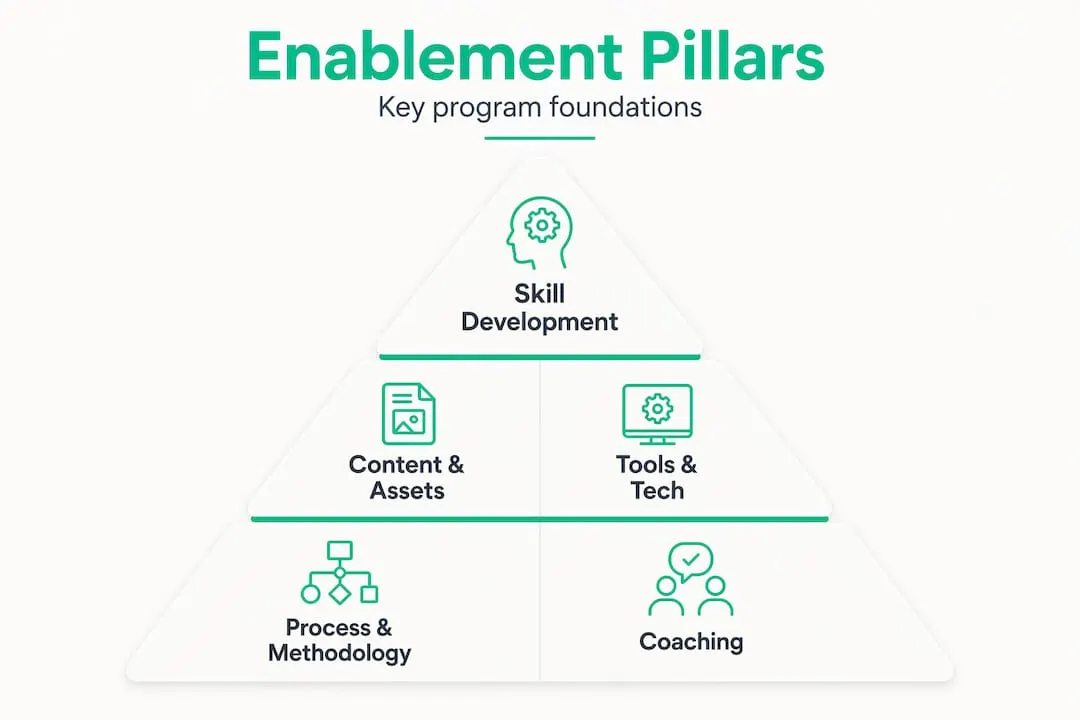
| Pillar | What it includes | Business impact |
|---|---|---|
| Skill development | Role plays, structured learning paths, objection handling practice | Faster ramp time, higher win rates |
| Content and assets | Case studies, battlecards, email sequences, demo scripts | Shorter sales cycles, better buyer conversations |
| Tools and technology | CRM integrations, sales engagement platforms, AI coaching tools | Reduced admin burden, more time selling |
| Process and methodology | Defined sales stages, qualification frameworks, buyer journey maps | Consistent pipeline quality, predictable forecasting |
| Coaching and reinforcement | Manager call reviews, deal coaching, skills gap assessments | Sustained behavior change, reduced attrition |
Skill development
Effective skill development is not a course catalog. It is a learning architecture built around the gaps that actually exist in your team. Start with a skills gap assessment. Map what your top performers do differently. Then build learning paths that close specific gaps for specific rep segments. Onboarding reps need different skill development than a senior enterprise account executive preparing to move upmarket.

Content and assets
Most content libraries fail because they were built for internal comfort rather than buyer relevance. The best enablement programs align content to buying stages and persona-specific concerns. A battlecard that helps a rep respond to a competitor objection in a live call is worth twenty brochures no one reads.
Tools and technology
The right sales enablement tools reduce the distance between a rep and the information or action they need. AI-driven coaching and content intelligence are reshaping how modern teams approach this pillar, cutting ramp times and personalizing skill development at scale. But technology only works when it is adopted. If it is not embedded in the daily workflow, reps will ignore it.
Process and methodology
A consistent methodology gives your team a shared framework for qualifying opportunities, advancing deals, and handling objections. Without it, you get ten different ways to run the same deal, and no way to diagnose why some fail.
Coaching and reinforcement
Manager coaching is the most under-invested layer in most enablement programs. It is also the most critical. Training without coaching is like planting seeds without watering them. The knowledge fades within weeks if managers are not reinforcing it in pipeline reviews, call debriefs, and one-on-ones.
Pro Tip: Build a coaching cadence into your enablement calendar before you design a single training module. The coaching structure determines how much of everything else actually changes behavior.
Measuring sales enablement effectiveness
Here is where most enablement teams get it wrong. They measure activity. Training completion rates, content views, session attendance. These numbers feel good to report. They do not tell you whether enablement is working.
Only about 44% of enablement teams feel proficient in analytics, which explains why the measurement gap persists. Connecting what you do to what it produces commercially is the only way to build credibility with executives and justify your budget.
The metrics that actually matter fall into two categories: leading indicators and lagging indicators.
Leading indicators (enablement-owned):
- Sales readiness scores based on skills gap assessments
- Content adoption rates in active deals
- Coaching session frequency and quality scores
- New hire time-to-first-deal
Lagging indicators (revenue-tied):
- Win rate by segment or rep cohort
- Quota attainment across the team
- Average deal size
- Sales cycle length
Structured enablement programs reduce ramp time by 30 to 42 percent, with top teams getting new hires productive in 60 to 90 days rather than the four to six month industry average. Ramp time is one of the most valuable metrics to track because it shows an immediate return on program investment.
The most dangerous enablement metric is training completion. It measures effort, not outcome. Shift your reporting to sales readiness assessments and commercial results, and you will have a much more honest picture of what is working.
The pitfall to avoid is focusing only on activity metrics without connecting them to revenue performance. Use activity data for diagnosis. Use commercial metrics for decision-making.
How to implement sales enablement that actually works
The biggest mistake organizations make when implementing sales enablement is treating it like a project. They build a content library, run a training series, call it done. Enablement requires integration into daily workflows, not isolated events. Here is how to build it so it sticks.
-
Audit what you already have. Before building anything new, catalog existing content, tools, and training programs. Find the gaps. Find the redundancies. Most organizations over-invest in content and under-invest in coaching.
-
Define your ideal rep profile and skills framework. What does “great” look like for each role? Anchor everything, including learning paths, coaching rubrics, and content selection, to that profile.
-
Start with the highest-impact moment: onboarding. A well-built onboarding program delivers immediate, measurable ROI through faster ramp times. It also gives you a contained environment to test and refine your approach before scaling it.
-
Build manager enablement alongside rep enablement. Managers need coaching skills, not just content access. Train them on how to conduct call reviews, deliver developmental feedback, and reinforce skills in real deal conversations.
-
Create feedback loops between the field and enablement. Reps know what is missing faster than any internal team. Build regular mechanisms for their input: deal win/loss interviews, content feedback ratings, pipeline review observations.
-
Select tools that integrate, not tools that impress. A lean B2B prospecting stack that reps actually use beats a sophisticated platform they ignore. Prioritize CRM integration and workflow fit over feature lists.
-
Report on commercial outcomes from day one. Tie your enablement work to win rates, ramp time, and quota attainment from the start. This builds the executive trust you need to sustain the function.
Pro Tip: Treat your enablement function like a profit center. Assign it a P&L perspective: what did it cost, and what revenue impact did it produce? This framing changes how you prioritize resources and how leadership values the work.
The sales enablement strategy that compounds over time is one where coaching, content, tools, and skills development are embedded in how the team operates daily, not layered on top of existing workflows as extra obligations.
My take: where most enablement programs quietly fail
I have seen a lot of enablement programs built by smart people who genuinely care about their teams. Most of them still fail to move the numbers. Here is what I have learned about why.
The most common problem is a content and tools obsession that crowds out coaching investment. Teams spend months building playbooks, buying platforms, designing training decks. Then they send it all out, report on completion rates, and wonder why win rates did not budge. The uncomfortable truth is that content does not change behavior. Coaching does.
What I have found actually works is building the coaching infrastructure first, then layering content and tools on top of a functioning coaching cadence. When managers are already running weekly call reviews and deal coaching sessions, new content and training land differently. Reps have a context for applying it, and managers have a built-in mechanism for reinforcing it.
I am also skeptical of programs that try to do everything at once. The organizations I have seen succeed started narrow. They picked one rep segment, one skills gap, one measurable outcome. They ran a tight loop of training, coaching, and measurement. Then they expanded. That discipline is rare, but it is what separates enablement programs that build credibility from those that get cut at the next budget cycle.
The future of enablement is continuous, not episodic. AI tools are accelerating that shift by making personalized coaching and content recommendations possible at scale. But technology amplifies what is already there. If your coaching culture is weak, AI tools will not fix it.
— Toinon
The right tools make your enablement strategy complete
Good enablement strategy puts the right skills, content, and process in place. But your reps also need the right prospecting tools to act on that preparation. LinkedIn Sales Navigator is one of the highest-impact tools a B2B sales team can add to their stack, giving reps the ability to identify and engage decision-makers with precision.
The problem is the cost. Full-price Sales Navigator licenses price out smaller teams and individual reps. Salesnavsplit solves that by offering official Sales Navigator seats at up to 50% off standard pricing. These are genuine, LinkedIn-compliant licenses sourced through verified reseller partnerships in the US and Europe. No credential sharing, no compliance risk, just the full platform at a price that fits a real sales budget. Activation happens within two business hours European time, with official invoicing through Stripe.
FAQ
What is the simplest sales enablement definition?
Sales enablement is the ongoing process of giving sales reps the skills, content, tools, and coaching they need to engage buyers effectively and close more deals. It is a continuous, cross-functional function rather than a one-time training event.
How does sales training differ from sales enablement?
Sales training is a single event or series of events. Sales enablement is the broader, continuous system that includes training but also adds coaching, content alignment, technology, and process to make training results stick over time.
What metrics should I use to measure sales enablement success?
Focus on commercial outcomes like win rates, quota attainment, and ramp time rather than activity metrics like training completion. Sales readiness assessments are also strong leading indicators of whether enablement is producing real behavior change.
What are the most important sales enablement tools?
The most impactful tools are those that integrate into daily workflows: your CRM, a sales engagement platform, a content management system, and coaching tools. LinkedIn Sales Navigator also ranks among the highest-value prospecting tools for B2B teams, especially when combined with a strong Sales Navigator setup.
Why do most sales enablement programs fail?
Most programs fail because they treat enablement as a project rather than a continuous function, and because they over-invest in content while under-investing in manager coaching. Without structured coaching reinforcement, even the best training produces no lasting change in rep behavior.
Recommended
- What Is Sales Intelligence? A Guide for Sales Teams - SalesNavSplit Blog
- What is sales engagement? Master multichannel LinkedIn outreach - SalesNavSplit Blog
- Sales team collaboration steps: the sales manager’s guide - SalesNavSplit Blog
- What is a sales seat? Guide to Sales Navigator access - SalesNavSplit Blog