
What Is Sales Intelligence? A Guide for Sales Teams
What Is Sales Intelligence? A Guide for Sales Teams
TL;DR:
- Sales intelligence is a dynamic, data-driven system that guides sales teams on who to contact, when, and why prospects are ready to buy.
- It integrates real-time signals, intent data, and trigger events to improve forecast accuracy and sales efficiency.
Most sales teams assume they already have sales intelligence covered. They have a CRM. They bought a contact database. They run enrichment tools on their lists. That thinking is exactly why so many reps waste hours chasing prospects who will never buy. What is sales intelligence, really? It is not a static list of names and job titles. It is a dynamic, data-driven system that tells you who to contact, when to reach out, and why they are likely to buy right now. This guide will show you what that actually means in practice.
Table of Contents
- Key takeaways
- What is sales intelligence, exactly?
- How sales intelligence works in practice
- Why sales intelligence matters for your revenue goals
- Common pitfalls when implementing sales intelligence
- Applying sales intelligence in your daily workflow
- My take on where most teams get this wrong
- Get access to LinkedIn Sales Navigator at half the price
- FAQ
Key takeaways
| Point | Details |
|---|---|
| Sales intelligence is dynamic | It continuously monitors signals and intent data, not just captures contact information. |
| It differs from related tools | Sales intelligence analyzes data; sales enablement equips reps to use it effectively. |
| Trigger events drive timing | Identifying events like funding rounds or executive hires sharpens outreach timing significantly. |
| Integration is non-negotiable | Fragmented tool stacks create data silos that destroy the value of even great intelligence. |
| Forecast accuracy improves dramatically | Organizations using unified sales intelligence platforms report forecast accuracy jumps from 48% to 94%. |
What is sales intelligence, exactly?
Sales intelligence is the practice of collecting, analyzing, and acting on data about prospects and customers to improve sales decisions. That definition sounds straightforward, but the sales intelligence meaning goes deeper than most people realize.
Raw data tells you a company exists and that someone works there. Sales intelligence tells you that company just raised Series B funding, that their VP of Sales was replaced last month, and that three of their employees have been searching for solutions in your category. Those are the signals that separate a cold outreach from a well-timed, relevant conversation.
Here is how sales intelligence compares to concepts that often get confused with it:
| Concept | What it does | What it does NOT do |
|---|---|---|
| Sales data | Stores contact details and account history | Interpret patterns or predict behavior |
| Lead generation | Identifies potential buyers | Analyze context or buying readiness |
| Data enrichment | Fills in missing fields on known records | Monitor ongoing signals or intent |
| Sales enablement | Equips reps with tools and training | Gather or analyze market and buyer data |
| Sales intelligence | Provides contextual, predictive insights | Replace human judgment or strategy |
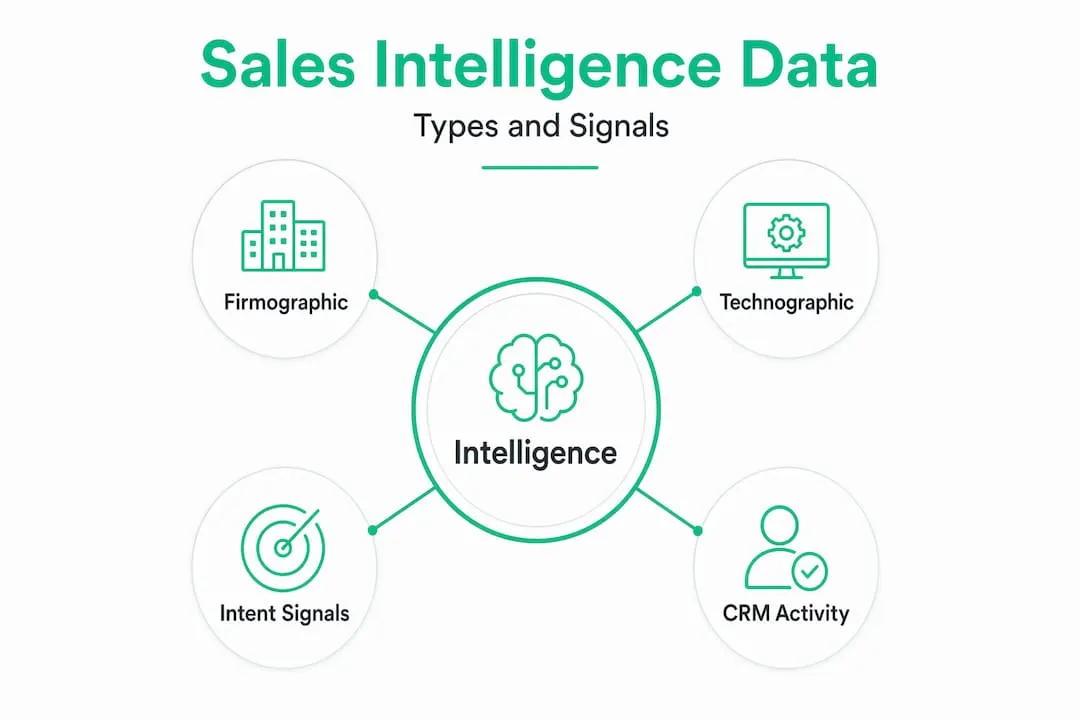
Sales intelligence combines firmographic data (company size, industry, revenue), technographic data (what software a company uses), and behavioral signals into a unified picture of buyer readiness. Think of it the way Salesmotion describes it: a GPS for your sales team, providing real-time guidance rather than leaving reps to navigate by guesswork.
How sales intelligence works in practice
Understanding the mechanics helps you evaluate tools and apply them well. Sales intelligence platforms pull from multiple data sources simultaneously and run analysis that no human team could replicate manually.
The main data types feeding a sales intelligence system include:
- Firmographics: Company size, location, industry, revenue, headcount, and growth trajectory
- Technographics: The technology stack a company currently uses, which signals budget, maturity, and potential fit
- Buying signals: Website visits, content downloads, social interactions, and email engagement patterns
- Trigger events: Executive hires, product launches, funding announcements, and expansion news that explain buyer “why now” timing
- CRM activity: Historical deal data, communication logs, and pipeline movement
The biggest misconception about how sales intelligence works is treating it as a one-time enrichment exercise. You upload your list, fill in the gaps, and move on. That model was outdated years ago. Sales intelligence is best treated as a continuous infrastructure layer that monitors behavioral signals in real time. A prospect who was cold six months ago might be actively researching solutions right now. Static enrichment will never tell you that.
Modern sales intelligence software uses AI to surface patterns across thousands of signals at once. It identifies which accounts show clustering behavior (multiple stakeholders engaging simultaneously), flags accounts that match your best historical customers, and scores leads dynamically as conditions change.
Pro Tip: When evaluating sales intelligence tools, ask specifically about their signal refresh rate. A platform updating firmographic data quarterly is not really doing intelligence. Look for platforms that update behavioral and intent signals weekly or in real time.
Why sales intelligence matters for your revenue goals
The importance of sales intelligence becomes concrete when you look at what it does to core sales metrics. The benefits of sales intelligence are not theoretical.

Start with forecast accuracy. Organizations that embedded sales intelligence into a unified system improved forecast accuracy from 48% to 94%. That is not a marginal improvement. That is the difference between a reliable pipeline and a business running on guesswork every quarter.
Beyond forecasting, the role of sales intelligence in business spans three critical areas:
Prioritization. Not every lead deserves equal attention. Sales intelligence scores accounts by readiness and intent, so reps spend time on prospects most likely to close. Contextual insights throughout the sales process reduce time wasted on leads that will never convert.
Personalization. Generic outreach is noise. When you know a prospect just hired a new CTO and recently evaluated a competing tool, you can craft a message that speaks directly to their situation. That specificity gets responses.
Speed. Markets shift. Competitors move. Deals stall. Contextual intelligence allows teams to course-correct quickly when signals change inside an active deal. Without it, reps often find out too late that a deal was already dead.
“Sales intelligence does not just tell you who to call. It tells you why to call them today, not next quarter.” This distinction is what separates teams closing at industry-leading rates from teams that perpetually miss quota.
The global sales intelligence market is projected to reach $7.68 billion by 2030, driven by AI-powered insights and real-time analytics. That growth reflects how seriously revenue-focused organizations are treating intelligence infrastructure as a competitive requirement, not a nice-to-have add-on.
Common pitfalls when implementing sales intelligence
Knowing what sales intelligence does is only half the battle. Many teams invest in intelligence tools and still fail to see results. Here is where things typically go wrong:
Fragmented stacks. Buying five point solutions that each solve one piece of the puzzle creates more noise than clarity. Fragmented tool stacks create data silos that make it impossible to see a unified picture of any account. An integrated platform that controls the data chain consistently outperforms disconnected tools.
Treating intelligence as enrichment. If your workflow is “enrich the list before a campaign and then forget it,” you are missing most of the value. Real sales intelligence tracks changes over time and alerts you when conditions shift.
Ignoring messy CRM data. Raw CRM data is often messy and administrative-heavy. Teams that rely solely on historical CRM records for prioritization are looking backward. Forward-looking signals like funding rounds, hiring surges, and technology adoption answer the “why now” question far more reliably.
Having data but not using it. Tools do not close deals. Reps do. Even the best sales intelligence software fails if teams are not trained to interpret signals and translate them into specific outreach actions. This is where the line between sales intelligence and sales enablement becomes critical. Sales intelligence gathers and analyzes data; sales enablement helps reps act on it. You need both working together.
Pro Tip: Before buying a new sales intelligence platform, audit how your reps currently use the data they already have. If they are ignoring signals in your existing CRM, adding more signals from a new tool will not help. Fix the workflow first.
Applying sales intelligence in your daily workflow
Knowing the theory is useful. Knowing exactly how to operationalize sales intelligence is what actually moves your numbers. Here is a practical framework:
-
Build your ideal customer profile using intelligence data. Do not rely on assumptions. Pull data from your best closed deals and identify patterns across firmographics, technographics, and the trigger events that preceded each purchase. Use that picture to define who you are targeting and why.
-
Score and prioritize leads by intent, not just fit. Account fit (size, industry) tells you if someone could buy. Intent signals tell you when they are likely to buy. Combine both dimensions for smarter lead qualification and spend your outreach budget where it will convert.
-
Time your outreach to trigger events. When a target account raises funding, hires a VP of Sales, or launches a new product, that is your window. Forward-looking signals like funding rounds answer “why now” far better than any amount of historical data. Set alerts and move fast.
-
Write personalized messages based on specific signals. Reference the actual event that triggered your outreach. “I noticed your team just expanded into three new markets” opens a conversation. “I wanted to reach out about our solution” gets deleted. Specificity is the product.
-
Align your intelligence tools with your CRM and sales enablement stack. Sales intelligence is most powerful when it feeds directly into the tools your reps already live in. Build integrations so insights surface automatically in deal records, not in a separate tab nobody checks. Explore advanced prospecting workflows to see how top teams wire these systems together.
-
Measure and iterate. Track which signals actually correlate with closed deals in your specific market. What works for an enterprise software company may not work for a mid-market services firm. Treat your intelligence layer as something you calibrate over time, not set and forget.
My take on where most teams get this wrong
I have watched sales teams at all levels invest heavily in sales intelligence tools and still underperform. In my experience, the core issue almost never comes down to which platform they chose. It comes down to organizational habit.
Most teams treat intelligence as a launch activity, not an ongoing system. They onboard a new tool, get excited for a quarter, and then slowly drift back to working from spreadsheets and gut feel. The teams that actually pull ahead are the ones that build intelligence review into their weekly rhythm. Pipeline reviews that start with signal data. Account planning sessions driven by recent trigger events. Outreach sequences built around what accounts are doing right now, not who got added to the CRM six months ago.
What I have found genuinely transformative is the combination of AI-driven platforms that surface “why now” signals with sales enablement infrastructure that teaches reps what to do with those signals. Neither works without the other. Intelligence without enablement is data nobody acts on. Enablement without intelligence is training people to work hard in the wrong direction.
The practical lesson is this: before you add another tool to your stack, ask whether your reps could articulate the last three trigger events they acted on. If they cannot, the problem is not the tool. It is the culture around using it.
— Toinon
Get access to LinkedIn Sales Navigator at half the price
LinkedIn Sales Navigator is one of the most widely used sales intelligence tools in B2B sales, giving you access to advanced search filters, real-time lead alerts, and buyer intent signals across LinkedIn’s professional network. The challenge for many sales teams and individual reps is the price.
Salesnavsplit solves that directly. Through verified reseller partnerships in the US and Europe, Salesnavsplit offers official Sales Navigator licenses at up to 50% off standard LinkedIn pricing. Every seat is genuine, compliant with LinkedIn’s terms of service, and activated within two business hours European time. Payments process securely through Stripe, and you get official invoicing from day one. Whether you are a solo rep or managing a growing B2B team, this is a straightforward way to access one of the best sales intelligence platforms without the full retail cost.
FAQ
What does sales intelligence mean?
Sales intelligence refers to the collection, analysis, and application of data about prospects and market conditions to improve sales decisions. It goes beyond contact lists to include behavioral signals, intent data, and trigger events that indicate buyer readiness.
How is sales intelligence different from sales enablement?
Sales intelligence gathers and analyzes data about buyers and markets, while sales enablement focuses on equipping reps with the training and tools to engage effectively. Both are necessary, but they serve different functions in the sales process.
What are the main benefits of sales intelligence?
The core benefits include improved forecast accuracy, better lead prioritization, more personalized outreach, and faster responses to market changes. Organizations using unified sales intelligence systems have reported forecast accuracy improvements from 48% to 94%.
What types of data do sales intelligence tools use?
Sales intelligence software typically uses firmographic data, technographic data, buying intent signals, CRM activity, and trigger events such as executive hires or funding announcements to build a picture of buyer readiness.
How do you get started with sales intelligence?
Start by defining your ideal customer profile using data from past closed deals, then layer in intent signals and trigger event alerts from a sales intelligence platform. Integrate those signals directly into your CRM so reps act on insights in real time rather than chasing static lists.
Recommended
- Sales team collaboration steps: the sales manager’s guide - SalesNavSplit Blog
- What is a sales seat? Guide to Sales Navigator access - SalesNavSplit Blog
- Boost Sales With These Proven Sales Navigator Tips - SalesNavSplit Blog
- What is LinkedIn Sales Navigator? B2B prospecting guide - SalesNavSplit Blog