
9 Proven Ways to Reduce Sales Costs for Small Teams
9 Proven Ways to Reduce Sales Costs for Small Teams
TL;DR:
- Reducing sales costs involves auditing your tech stack, consolidating tools, and managing contracts proactively. Implementing these strategies can lower expenses without sacrificing revenue or performance.
Sales cost reduction is the practice of cutting expenses across your sales technology, lead generation, and operations without shrinking revenue. The most effective ways to reduce sales costs combine a disciplined tech stack audit, smarter lead sourcing, and proactive contract management. Sales teams average 8.3 tools per SDR at $187 per rep per month, and that figure excludes management overhead. That number alone tells you where the waste lives. This guide gives you a concrete, prioritized path to cutting sales expenses without cutting performance.

1. Ways to reduce sales costs: audit your tech stack first
The single fastest way to find savings is a structured tool audit. Most sales teams carry redundant subscriptions they no longer use at full capacity. A sales tool audit scores each tool on three dimensions: actual usage, cost-to-value ratio, and integration risk. Tools scoring below 6 out of 12 on that framework should be cut immediately. Tools scoring 6–8 are candidates for consolidation.
Start by pulling seat utilization data for every active subscription. If fewer than 70% of licensed seats log in weekly, that tool is a candidate for reduction. Organizations waste nearly $19.8 million yearly on SaaS due to seat-based billing that ignores actual usage. That figure reflects a systemic problem, not a one-time oversight.
What to look for in your audit:
- Duplicate sequencing tools running in parallel
- Conversation intelligence platforms with overlapping features
- Standalone enrichment tools that your CRM already covers natively
- Reporting dashboards that replicate data from your primary CRM
Pro Tip: Export a full list of every active subscription from your finance team before you start. You will almost always find tools the sales team stopped using months ago but never formally canceled.
Mid-market sales organizations that consolidate their stacks reduce SaaS spend by 25–50% within 12 months. That range is wide because the savings depend on how bloated the original stack was. The highest recovery typically comes from cutting duplicate sequencing tools and conversation intelligence platforms, where teams often run two products doing the same job.
2. Consolidate around one anchor tool
Cutting the most expensive tool is not always the right move. Cutting multiple tools that serve the same job is more cost-effective than targeting price alone. Consolidating workflows under a single anchor tool minimizes disruption and reduces the hidden costs of migration.
Your CRM is the natural anchor. Build your stack outward from it, keeping only tools that integrate natively. A $99 per seat tool that requires manual data entry between systems can cost triple its sticker price when you account for toggle tax and manual errors. Toggle tax is the time and cognitive load your reps lose switching between apps. It multiplies the real cost of every disconnected tool in your stack.
Teams that have consolidated sales engagement tools alone report savings of $60,000–$120,000 per year. That is not a rounding error. It is a budget line that could fund a full-time SDR or a meaningful increase in your paid acquisition budget.
3. Lower cost per lead with live web prospecting
Traditional static databases are one of the most expensive ways to source leads. Switching to live web search-based prospecting lowers cost per qualified lead by 50–70%. Cost per lead drops from the $100–$150 range down to $30–$50 when you consolidate workflows with AI agents. That shift does not just save money. It also improves lead quality because the data is current rather than months old.
The key change is replacing manual list-building with AI agents that pull live signals from the web and feed them directly into your CRM. This removes three manual steps: research, data entry, and list formatting. Fewer steps mean fewer errors and faster follow-up. Faster follow-up means higher conversion rates, which lowers your effective cost per closed deal.
What this workflow looks like in practice:
- AI agent monitors job change signals, funding announcements, and intent data in real time
- Qualified leads flow automatically into your CRM with enriched contact data
- Reps receive prioritized call lists instead of raw, unfiltered databases
- Outreach sequences trigger without manual intervention
For teams building this kind of workflow, a B2B lead generation guide that covers AI-enabled prospecting is worth reviewing before you choose your tooling.
4. Renegotiate contracts before auto-renewal
Auto-renewal clauses are the most overlooked cost driver in sales technology budgets. Vendors build in 8–12% annual price increases that compound quietly year over year. Teams that fail to act before renewal lock in those increases by default.
The fix is simple: calendarize every renewal date 90 days in advance. That window gives you time to pull usage data, benchmark market pricing, and prepare a negotiation position before the vendor’s sales team contacts you.
Negotiation steps that work:
- Pull your actual seat utilization for the past 90 days
- Get competing quotes from alternative tools in the same category
- Request a downgrade option or a reduced seat count at the same per-seat price
- Ask for an exit clause or a 30-day cancellation window after the first year
- Negotiate payment terms: annual upfront in exchange for a 15–20% discount
Vendors prefer retaining your account at a lower tier over losing it entirely. Proactive negotiation using the credible threat of switching is your strongest lever. Use it.
Pro Tip: Never negotiate a renewal in the final two weeks before the contract ends. You lose all leverage. Start the conversation at 90 days out, and let the vendor know you are actively evaluating alternatives.
5. Switch cut-list tools to month-to-month billing
Subscription inertia is what keeps unused tools on the books. When a tool is on an annual contract, canceling it feels like wasting money you already spent. That psychology keeps bad tools alive for 12 months longer than they should be. Switching tools on your cut list to month-to-month billing breaks that cycle. The monthly rate is slightly higher, but the ability to cancel without penalty is worth the premium.
Apply this rule at renewal time. If a tool is under review, do not renew annually. Move it to monthly, run a 60-day evaluation, and cut it if it does not pass. This approach turns your stack into a living system rather than a locked-in cost structure.
6. Automate repetitive sales tasks to cut labor costs
Manual tasks in the sales process are a direct cost. Every hour a rep spends on data entry, scheduling, or report formatting is an hour not spent selling. Automating those tasks does not require a large technology investment. Most CRMs include workflow automation features that go unused because no one has mapped the process first.
Start by documenting your current sales workflow step by step. Identify every task that follows a predictable rule. If a task can be described as “when X happens, do Y,” it can be automated. Common candidates include lead assignment, follow-up reminders, deal stage updates, and activity logging. A well-built customer engagement workflow can eliminate hours of manual work per rep per week.
“Sales cost reduction requires systemic shifts that treat native CRM integration and automated workflows as productivity multipliers, not cost centers.” — Revenue Operations principle
The teams that see the biggest long-term savings from automation are those that build it into their CRM natively rather than adding a separate automation tool. Adding another tool to automate your existing tools defeats the purpose.
7. Build a lean, purpose-built outreach stack
A lean stack is not a minimal stack. It is a stack where every tool earns its place by doing a job no other tool in the stack already does. The lean B2B outreach stack principle is simple: one tool per job, integrated with your CRM, with measurable ROI.
Most small sales teams need four categories of tooling: prospecting and data enrichment, outreach sequencing, CRM, and reporting. Everything else is optional. Before adding any new tool, ask whether your current stack already covers that function. If it does, the new tool is a cost, not an investment.
8. Qualify leads more rigorously to reduce wasted spend
Unqualified leads are expensive. Every hour a rep spends on a prospect who was never going to buy is a direct cost with no return. Tightening your lead qualification criteria is one of the fastest ways to lower sales costs without changing your tooling at all.
Define your ideal customer profile in writing, with specific firmographic and behavioral criteria. Score inbound leads against that profile before they reach a rep. Disqualify aggressively at the top of the funnel. A smaller pipeline of well-qualified leads closes faster and at lower cost than a large pipeline of mixed-quality prospects.
9. Reduce LinkedIn Sales Navigator costs with verified licensing
LinkedIn Sales Navigator is one of the highest-value prospecting tools for B2B sales, and also one of the most expensive line items for small teams. Full retail pricing puts it out of reach for many individual reps and small businesses. Salesnavsplit provides authorized Sales Navigator seats at approximately 50% below standard pricing through verified reseller partnerships in the US and Europe. The seats are genuine, compliant with LinkedIn’s terms of service, and activate within 24–48 hours. For teams already using Sales Navigator, or considering it, this is a direct way to cut a major tool cost without losing any functionality.
Key takeaways
The most effective sales cost reduction strategy combines a structured tech stack audit, AI-powered lead sourcing, and proactive contract management to cut expenses without reducing sales output.
| Point | Details |
|---|---|
| Audit before cutting | Score every tool on usage, cost-to-value, and integration risk before making cuts. |
| Consolidate around your CRM | Build your stack outward from one anchor tool to eliminate toggle tax and redundant costs. |
| Renegotiate 90 days early | Calendarize renewals and use competing quotes as leverage to avoid automatic price increases. |
| Automate repetitive tasks | Map your workflow and use native CRM automation to free up rep time without adding new tools. |
| Cut lead waste at the top | Tighten your ideal customer profile criteria to reduce time spent on unqualified prospects. |
The real reason most sales cost audits fail
I have seen sales managers run a tool audit, cut three subscriptions, and declare victory. Six months later, the stack is just as bloated because the underlying behavior never changed. The audit was a one-time event, not a system.
The teams that actually sustain lower sales costs treat the audit as a quarterly practice, not a project. They track seat utilization in a shared dashboard. They review renewal calendars in their monthly ops meeting. They have a written rule that no new tool gets added without a 30-day trial and a defined success metric.
The other thing I see consistently is teams underestimating the cost of tools that lack native CRM integration. A tool that costs $50 per seat per month looks cheap until you realize your reps are spending 45 minutes a day copying data between systems. That toggle tax is invisible on a budget spreadsheet, but it shows up in quota attainment. The $50 tool is actually your most expensive tool.
My honest advice: start with your CRM as the anchor and work outward. Cut anything that does not integrate natively and does not have a measurable impact on pipeline. Do not keep a tool because a rep likes it. Keep it because the data shows it works.
— Toinon
How Salesnavsplit cuts your LinkedIn Sales Navigator bill in half
LinkedIn Sales Navigator is a core prospecting tool for B2B teams, but its full retail price makes it hard to justify for smaller teams or individual reps. Salesnavsplit offers official Sales Navigator seats at roughly 50% off standard pricing, sourced through verified reseller partnerships in the US and Europe.
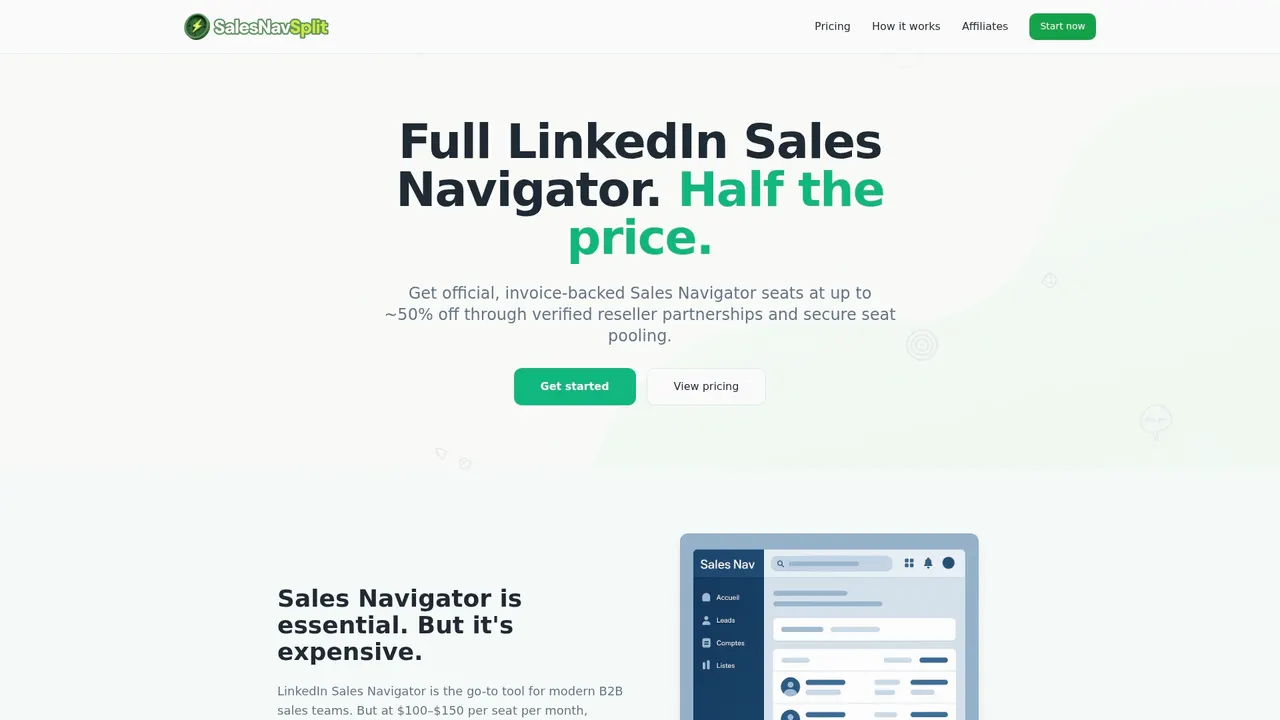
Every seat is genuine, LinkedIn-compliant, and activates within 24–48 hours. Billing runs through Stripe with official invoicing. If Sales Navigator is already in your stack, or you have been holding off because of the price, Salesnavsplit is a direct path to a significant licensing discount without any compromise on features or security.
FAQ
What is the fastest way to reduce sales software costs?
Run a seat utilization audit on every active subscription and cut tools where fewer than 70% of licensed seats are active weekly. This single step typically surfaces the largest immediate savings.
How much can sales teams save by consolidating their tech stack?
Mid-market teams that consolidate overlapping tools reduce SaaS spend by 25–50% within 12 months. The highest savings come from cutting duplicate sequencing and conversation intelligence tools.
When should I start negotiating a software contract renewal?
Start 90 days before the renewal date. That window gives you time to benchmark pricing, pull usage data, and present a credible alternative before the vendor’s renewal team contacts you.
What is toggle tax and why does it matter for sales costs?
Toggle tax is the time and cognitive load reps lose switching between disconnected apps. A tool with no native CRM integration can cost triple its sticker price when you account for manual errors and lost productivity.
How does better lead qualification reduce sales costs?
Tighter qualification criteria reduce the number of unqualified prospects entering your pipeline. Fewer bad-fit leads mean less rep time wasted, lower cost per closed deal, and higher overall conversion rates without any change to your tooling.
Recommended
- How to streamline sales operations: A small business guide - SalesNavSplit Blog
- Sales Team Growth Tips That Actually Move the Needle - SalesNavSplit Blog
- Cost-effective sales outreach strategies that actually work - SalesNavSplit Blog
- Small business sales solutions for smarter B2B growth - SalesNavSplit Blog