
LinkedIn prospecting strategies to win more B2B clients
LinkedIn prospecting strategies to win more B2B clients
TL;DR:
- Effective LinkedIn prospecting focuses on high-quality, personalized outreach within weekly request limits.
- Building relationships through pre-engagement and multi-threading enhances response and conversion rates.
- Automation and excessive volume increase risk of account bans and damage credibility.
Most LinkedIn outreach gets ignored. Not because the product is bad or the timing is off, but because the approach itself is broken. Sales reps blast out dozens of connection requests every day, paste the same message into every inbox, and wonder why response rates stay flat. Low-volume, high-quality outreach of fewer than 25 requests per week, combined with pre-warming and trigger-event timing, consistently outperforms mass tactics. This guide breaks down exactly what LinkedIn prospecting looks like when it works, what kills results, and how B2B teams can build a process that generates real pipeline in 2026.
Table of Contents
- What is LinkedIn prospecting and why does it matter?
- Core strategies: How modern teams succeed with LinkedIn prospecting
- Common pitfalls: Automation risks, bans, and what NOT to do
- Applying LinkedIn prospecting: Workflow for modern B2B teams
- Our take: Why most B2B teams still struggle and what actually works
- Ready to scale your LinkedIn prospecting?
- Frequently asked questions
Key Takeaways
| Point | Details |
|---|---|
| Quality beats quantity | Limiting outreach to under 25 connection requests per week improves effectiveness and keeps you safe from bans. |
| Pre-engagement matters | Warming prospects with comments or follows before messaging leads to higher acceptance rates. |
| Avoid risky automation | Using automation for high-volume or identical messages can quickly result in a blocked account. |
| Personalize to win C-suite | C-suite decision makers respond best to InMail and personalized touchpoints, not generic cold requests. |
| Team workflows amplify results | Coordinating multi-touch outreach across your team drives better engagement for B2B prospecting. |
What is LinkedIn prospecting and why does it matter?
LinkedIn prospecting is the practice of identifying, researching, and initiating contact with potential buyers on LinkedIn with the goal of starting a sales conversation. Unlike cold calling, where you interrupt someone’s day with no prior context, LinkedIn gives you access to a prospect’s professional history, recent activity, company updates, and mutual connections before you ever say a word. That context changes everything.
For B2B sales teams, LinkedIn is not just a social platform. It is a live database of decision makers that updates itself. People post about new roles, share company wins, comment on industry trends, and signal buying intent through their own behavior. No CRM keeps up with that kind of real-time signal.
Here are the core reasons B2B teams treat LinkedIn prospecting as a primary channel:
- Access to verified decision makers: Executives, procurement leads, and department heads maintain active profiles, often more current than anything in a purchased contact list.
- Intent signals you can read: Job changes, content engagement, company announcements, and posted questions all reveal where a buyer is in their thinking.
- Natural credibility building: Shared connections, mutual group memberships, and commented content create social proof before you even send a message.
- Cost efficiency at scale: Compared to paid advertising or conference-based prospecting, LinkedIn outreach costs very little per qualified conversation.
- Integration with other channels: LinkedIn fits cleanly alongside email sequences and phone follow-ups, giving reps multiple touchpoints per account.
The shift that separates modern prospecting from outdated tactics comes down to one principle: quality over volume outreach is not just a best practice. It is a survival strategy. LinkedIn’s algorithm actively penalizes accounts that behave like bots. High volume, low relevance, and no engagement before a connection request all signal spam. Teams still running 2019 playbooks are not just getting ignored. They are getting flagged.
As one framework puts it about effective B2B sales prospecting strategies, the goal is not to fill a funnel. It is to build a pipeline of relationships where the buyer already knows who you are before the pitch happens.
“The most effective LinkedIn prospecting in 2026 is not about reaching more people. It is about reaching the right people at the right moment with enough context to make the conversation feel inevitable.”
Core strategies: How modern teams succeed with LinkedIn prospecting
Understanding why LinkedIn prospecting matters is the easy part. Knowing exactly how to execute it without triggering account restrictions or wasting hours on tire-kickers is where most teams fall short. Here is what the evidence actually supports.
The Volume Tax problem
LinkedIn imposes what practitioners call the “Volume Tax.” Send too many requests, too fast, with too little engagement history, and your account gets throttled or restricted. Fewer than 25 requests weekly is the ceiling most experienced practitioners stay under. That number feels uncomfortable to sales managers used to high-activity KPIs, but it forces a discipline that actually improves results.
When you can only send 25 requests per week, you spend more time qualifying each prospect. That leads to better conversations, higher reply rates, and less time chasing dead ends.
The modern prospecting sequence
A sustainable LinkedIn prospecting process follows five stages:
- Research: Before any contact, build a detailed picture of the prospect. What have they posted recently? What is happening at their company? Is there a trigger event, like a funding round, a new hire, or a product launch, that makes your solution timely?
- Pre-engage: Follow the prospect, comment thoughtfully on their posts, and react to their content over one to two weeks. This is called warming the connection, and it works because the prospect sees your name multiple times before you ever reach out.
- Connect: Send a personalized connection request that references something real. Mention a post they wrote, a shared connection, or a specific challenge you noticed in their content. Do not pitch in the request.
- Converse: Once connected, open with curiosity. Ask a question that shows you did your homework. The goal of the first message is not to book a meeting. It is to start a dialogue.
- Convert: Only after establishing context and value do you introduce what you offer, framed around their specific situation.
These lead generation tips apply whether you are an individual rep or a full sales team, and they scale when you build them into a repeatable system.
Multi-threading: One contact is never enough
Modern B2B deals involve multiple stakeholders. Relying on a single champion inside an account is a fragile strategy. Multi-threading means engaging two or three contacts within the same target company, often at different levels, so that your outreach does not collapse if one person goes quiet or changes roles.

Pro Tip: Assign different team members to different contacts within the same account. One rep builds rapport with the department head while another nurtures a relationship with a senior individual contributor. When those conversations eventually surface in internal discussions, your brand gets mentioned twice.
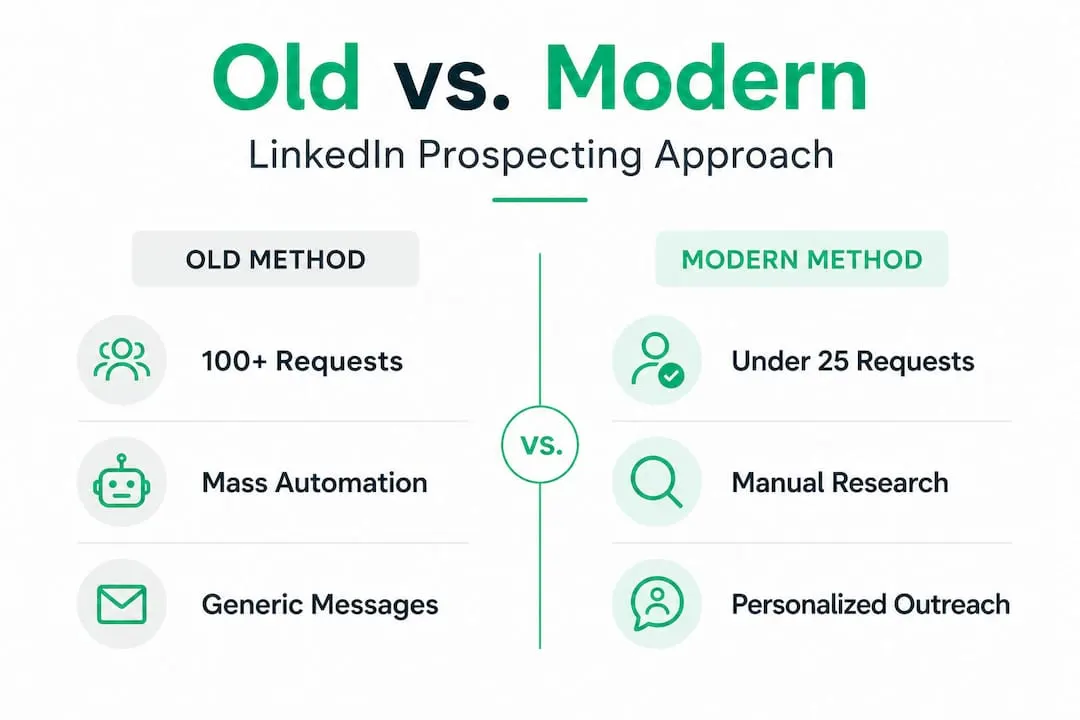
Old vs. modern LinkedIn prospecting
| Approach | Old method | Modern method |
|---|---|---|
| Volume | 50 to 100+ requests/week | Under 25 requests/week |
| Message style | Template blast | Personalized to trigger event |
| Pre-engagement | None | 1 to 2 weeks of comments/likes |
| Timing | Random | Based on intent signals |
| Stakeholder coverage | Single contact | Multi-threaded across roles |
| Goal of first message | Book a meeting | Start a conversation |
Good sales engagement on LinkedIn looks less like sales and more like professional networking with a purpose. The reps who internalize that distinction consistently outperform those who do not.
Common pitfalls: Automation risks, bans, and what NOT to do
Even teams with the best intentions make mistakes that damage their LinkedIn credibility. Some are obvious. Others are subtle enough that reps do not realize the damage until it is too late.
Automation: The fastest way to lose your account
Automation tools that view hundreds of profiles, send identical messages, or flood connection queues are tempting because they feel like efficiency. They are not. Automation risks account bans when they exceed 100 profile views per day or rely on identical message templates. LinkedIn’s detection systems are sophisticated enough to flag behavioral patterns that look non-human.
A temporary restriction is recoverable. A permanent ban means losing years of connections, content history, and social proof. That is not a recoverable situation for most sales professionals. Read more about the specific automation risks in LinkedIn outreach before you run any tool at scale.
InMail vs. connection requests: What the data shows
| Outreach type | Acceptance/response rate | Cost | Best for |
|---|---|---|---|
| Connection request | 44% acceptance rate | Free (standard) | Mid-level managers, warm prospects |
| InMail | 22% response rate | Credits required | C-suite, cold outreach |
The numbers look like connection requests win outright, but context matters. A 44% acceptance rate does not mean a 44% reply rate. Many people accept connections and never respond. InMail, used selectively for senior executives, reaches inboxes directly without requiring the prospect to accept a request first. For compliant LinkedIn prospecting at the C-suite level, a thoughtful InMail often performs better than a connection request that gets accepted and then ignored.
Mistakes that kill results
- Pitch-slapping: Sending a sales pitch in the first or second message after connecting. Post-connection pitches cause blocks at a high rate and damage your sender reputation.
- Dormant profiles: A LinkedIn profile with no recent activity, no photo, and no engagement history is a credibility killer. Prospects check your profile before they reply.
- Generic personalization: Using someone’s first name and company name does not count as personalization. It signals that you are using a template.
- Ignoring the comment thread: If a prospect engages with your content or comments on a mutual post, not responding is a missed opportunity most reps overlook.
- Over-messaging: Following up three times in a week makes you memorable for the wrong reasons.
Pro Tip: Before sending any outreach, Google the prospect’s name plus their company to find recent press, interviews, or social mentions you can reference naturally. It takes two minutes and makes your message feel researched rather than robotic.
Applying LinkedIn prospecting: Workflow for modern B2B teams
Knowing the right strategy is one thing. Building it into a team workflow that runs consistently without burning out your reps is another challenge entirely.
The weekly B2B prospecting sequence
Here is a practical workflow that distributes effort across the full week:
- Monday: Build the target list. Using Sales Navigator or manual filters, identify 20 to 25 high-fit prospects for the week. Prioritize accounts with recent trigger events.
- Tuesday and Wednesday: Pre-engage. Follow target accounts, react to or comment on recent posts from decision makers. Do not send any connection requests yet.
- Thursday: Send connection requests. Now that the prospect has seen your name at least once, send a brief, personalized request. Reference the content, the trigger event, or the shared connection.
- Friday: Track and respond. Check accepted requests, reply to any responses, and update your CRM with engagement notes.
- Ongoing: Nurture before converting. For newly connected prospects, continue engaging with their content for one to two more weeks before introducing any commercial context.
Role assignment for teams
For larger B2B teams, assigning distinct responsibilities makes this more manageable. Designate one person as the research and list-building owner, another as the pre-engagement lead, and a third as the conversion specialist who handles conversations once the connection is warm. This structure also helps boost B2B engagement because different team members bring different communication styles, which benefits multi-threaded account coverage.
Measuring what matters
Track these metrics weekly to understand what is actually working:
- Connection acceptance rate: Below 30% means your targeting or request message needs work.
- Reply rate on first message: Below 15% signals the opener is not compelling.
- Conversation to meeting rate: This reveals whether your value framing is landing.
- Account coverage depth: Are you reaching more than one contact per priority account?
Low-volume, high-quality prospecting with multi-threading shows its value in these metrics over four to six weeks. Give the process time before declaring it effective or not.
Pro Tip: Create a shared CRM field specifically for LinkedIn engagement stage so the whole team can see at a glance who is pre-engaged, connected, in conversation, or converted. Visibility prevents double-outreach to the same contact and creates natural handoff points between team members.
Our take: Why most B2B teams still struggle and what actually works
Here is something most LinkedIn prospecting guides will not say directly: the teams getting the best results are not the ones with the cleverest templates. They are the ones who have built patience into their process.
The uncomfortable truth is that LinkedIn rewards consistency over cleverness. A rep who shows up in a prospect’s feed twice a week through genuine comments, shares something useful once a month, and sends a single thoughtful request converts at a far higher rate than a rep who runs a sequence tool and calls it strategy. Yet most teams default to the sequence tool because it feels like leverage.
What even advanced teams keep missing is how much LinkedIn’s algorithm pays attention to behavioral patterns. If your engagement spikes on Monday mornings and goes cold the rest of the week, the platform treats your activity differently than someone who engages steadily throughout the day. LinkedIn is not just showing your messages to prospects. It is deciding whether to show your profile in search results, whether to recommend your posts, and whether your account looks credible based on everything you do on the platform.
The smart LinkedIn sales strategies that hold up over time share one trait: they treat the platform as a relationship-building environment first and a lead generation tool second. That mental shift sounds small, but it changes every decision you make, from how you write a connection request to how long you wait before mentioning your product.
Teams that chase engagement hacks burn through their credibility fast. Teams that build a reputation over months by contributing genuine insight, being helpful, and staying consistent find that outreach gets easier the longer they do it. That is the compounding effect nobody talks about, and it is the biggest advantage you can build on LinkedIn today.
Ready to scale your LinkedIn prospecting?
Refining your prospecting strategy is only part of the equation. Having access to the right tools without paying full retail price makes the difference between a strategy that stays in the planning doc and one that actually gets executed.
At salesnavsplit.com, we offer authorized LinkedIn Sales Navigator seats at roughly half the standard cost, sourced through verified reseller partnerships in the US and Europe. Seats activate within two business hours European time, billing runs through Stripe, and every license is fully compliant with LinkedIn’s terms. If you are a small team, a solo rep, or a startup that cannot justify the full Sales Navigator price tag, you can save on Sales Navigator seats without sacrificing access to the advanced filters, lead alerts, and InMail credits that make prospecting at this level possible. Reach out to explore which plan fits your team size and outreach goals.
Frequently asked questions
How many LinkedIn connections can I request per week without risk?
Best practice is fewer than 25 requests per week to stay within LinkedIn’s limits and avoid the account penalties that come from high-volume behavior.
What are the risks of using automation for LinkedIn prospecting?
Automation that exceeds 100 profile views per day or sends identical messages triggers LinkedIn’s detection systems and can result in a permanent account ban.
Does InMail or direct connection requests work better for the C-suite?
Connection requests have a 44% acceptance rate overall, but C-suite executives respond better to InMail, which reaches their inbox directly without requiring them to accept a request first.
What behaviors can get my LinkedIn account blocked?
Pitch-slaps after connecting, mass identical messages, and heavy automation are the fastest paths to blocks, restricted reach, and account suspension on LinkedIn.
Can LinkedIn prospecting be used for account-based marketing (ABM)?
Yes. LinkedIn is particularly effective for ABM because multi-threading buying committees lets you engage multiple decision makers at the same target company through coordinated, personalized outreach.