
LinkedIn lead generation: proven methods for B2B success
LinkedIn lead generation: proven methods for B2B success
TL;DR:
- LinkedIn is the most powerful platform for targeted B2B lead generation through precise filtering and relationship-building.
- Authentic engagement and personalized outreach yield higher quality leads and faster deal closures than automation.
- Building a clear ICP, optimizing your profile, consistent content, and timing are key to a successful LinkedIn lead system.
Most sales professionals know LinkedIn exists. Far fewer realize it’s the single most powerful B2B prospecting platform on the planet. While competitors chase cold email open rates and pay-per-click costs, LinkedIn gives you direct access to verified decision-makers, their job titles, their companies, and their real-time professional activity. This guide cuts through the noise and shows you exactly how lead generation on LinkedIn works, which tools actually deliver, and how to build a repeatable system that fills your pipeline without burning your budget.
Table of Contents
- Demystifying lead generation on LinkedIn
- Key tools and features for LinkedIn lead generation
- Manual outreach vs. automation: What really works?
- Practical steps to build your LinkedIn lead engine
- Why true LinkedIn lead generation is about trust and timing
- Supercharge your LinkedIn sales results
- Frequently asked questions
Key Takeaways
| Point | Details |
|---|---|
| Define your ideal client | Narrow your focus by industry, job title, and company size for higher-quality outreach. |
| Optimize profiles and posts | Treat your LinkedIn profile as a landing page and share niche content to attract the right leads. |
| Personalization wins | Warm, authentic engagement and tailored messages dramatically outperform spam or automation. |
| Be compliant and strategic | Stay on top of LinkedIn policies and leverage tools and content wisely for lasting results. |
Demystifying lead generation on LinkedIn
Lead generation on LinkedIn means identifying the right decision-makers, building enough trust to start a conversation, and moving them toward a buying decision. That’s it. No magic. But the mechanics matter enormously.
LinkedIn’s biggest advantage over every other platform is deterministic targeting. You’re not guessing at demographics. You can filter by exact job title, company size, industry, seniority level, and even recent job changes. That precision is why LinkedIn drives over 80% of B2B social media leads despite having a fraction of Facebook’s user base.
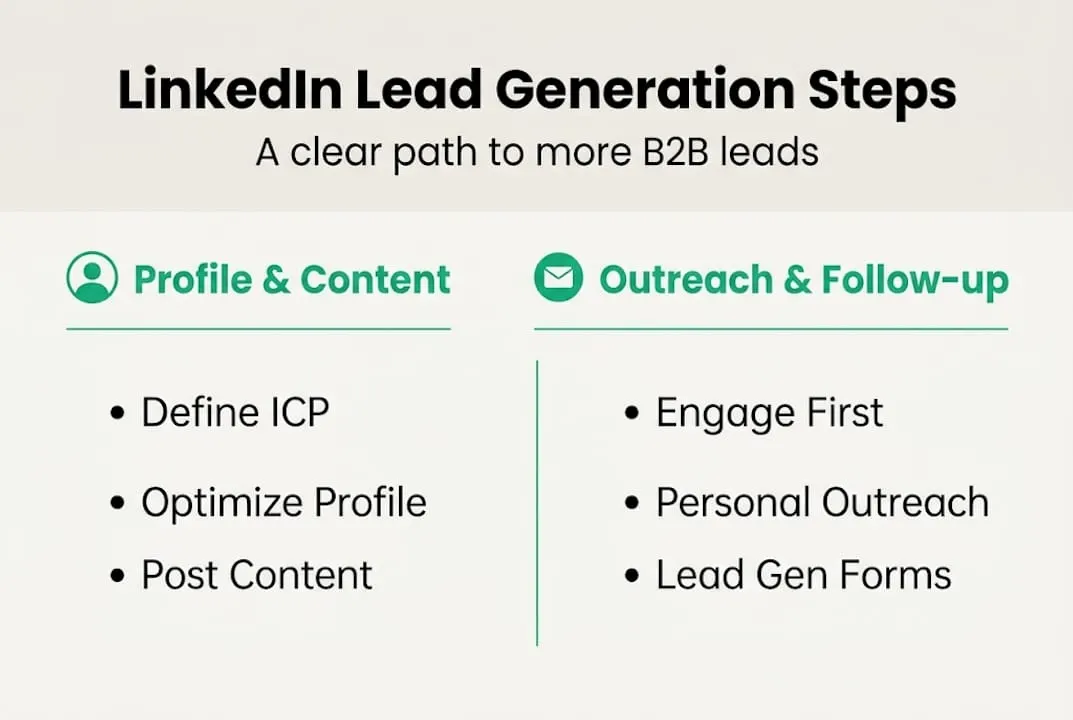
The core mechanics of LinkedIn lead generation follow a clear sequence:
- Define your Ideal Client Profile (ICP) by job title, company size, and industry
- Optimize your LinkedIn profile to function as a landing page for that ICP
- Publish niche, value-driven content three to five times per week
- Engage with prospects’ content before sending any outreach
- Send personalized warm messages that reference earlier interactions
- Use Lead Gen Forms in paid ads for frictionless lead capture at scale
Most people skip steps two through four and go straight to cold connection requests. That’s why their response rates are terrible.
Inbound vs. outbound on LinkedIn
| Approach | Effort | Cost | Lead quality | Best for |
|---|---|---|---|---|
| Organic content + engagement | High | Low | Very high | Small businesses, consultants |
| Manual personalized outreach | Medium | Low | High | SDRs, account executives |
| Sponsored content/ads | Low | High | Medium | Scaling teams, enterprise |
| Lead Gen Forms (paid) | Low | High | Medium-low | Volume campaigns |
The table above shows something counterintuitive: the cheapest approaches often produce the highest quality leads. That’s because trust is baked into the process from the start.
“LinkedIn’s targeting precision makes it uniquely powerful for B2B, but the platform rewards genuine relationship-building over broadcast messaging every single time.”
Before you run any outreach, spend time on LinkedIn lead generation tips that help you define your ICP and sharpen your profile. A weak profile kills conversions before a conversation even starts. And if you’re thinking about managing your B2B pipeline more systematically, LinkedIn is where that pipeline gets filled.
Need inspiration for what to post? A structured approach to LinkedIn content ideas can help you generate 30 topic ideas in under an hour, which removes the biggest excuse for inconsistent posting.
Key tools and features for LinkedIn lead generation
Understanding the mechanics is one thing. Knowing which tools to actually use is where most people get stuck. LinkedIn offers a wide range of options, from completely free organic tactics to paid advertising and premium subscriptions.
Organic tools (free)
- Profile optimization: Your headline, about section, and featured content should speak directly to your ICP’s pain points, not your resume
- Content publishing: LinkedIn’s native algorithm still heavily favors text posts with strong engagement in the first 60 minutes
- Personalized messaging: Direct messages and connection requests with custom notes remain one of the highest-ROI tactics available
- Commenting strategically: Thoughtful comments on prospects’ posts build visibility before any direct outreach
Paid tools and their tradeoffs
LinkedIn’s paid options include Sponsored Content, Message Ads, and Lead Gen Forms. The data on Lead Gen Forms is worth understanding carefully. Lead Gen Forms yield volume but produce lower sales-qualified lead rates, typically 15 to 25%, compared to 25 to 40% for traditional landing pages. They’re great for top-of-funnel awareness campaigns, but don’t expect those leads to close quickly.
There are also audience size constraints. Small audiences under 50,000 fail to give LinkedIn’s ad algorithm enough data to optimize delivery, which means your cost-per-lead spikes and your results become inconsistent. Mobile-only users also miss certain ad formats entirely, which limits reach in some industries.
| Tool | Monthly cost | Best for | Lead quality | Audience needed |
|---|---|---|---|---|
| Organic profile + content | $0 | Solopreneurs, SMBs | Very high | Any size |
| Sales Navigator | ~$99/seat | SDRs, account execs | High | Any size |
| Sponsored content | $500+ | Brand awareness | Medium | 50,000+ |
| Lead Gen Forms | $500+ | Volume campaigns | Medium-low | 50,000+ |
Sales Navigator deserves its own mention. It unlocks advanced search filters, lead and account lists, real-time alerts on job changes, and InMail credits. For anyone doing serious B2B prospecting, it’s not optional. The challenge is cost. A single seat runs close to $100 per month at retail, which adds up fast for small teams. That’s exactly why Sales Navigator strategies matter, and why finding cost-effective access to the tool is worth exploring.
For smaller teams and startups, check out smart SMB LinkedIn strategies that show you how to get outsized results without enterprise budgets.
Pro Tip: Before investing in paid ads, max out your organic reach first. If you can’t get responses on personalized manual outreach, paid volume won’t fix the problem. It’ll just amplify it.
Understanding the different types of lead capture forms and how they compare to LinkedIn’s native options can help you decide whether to keep leads on-platform or drive them to your own site.
Manual outreach vs. automation: What really works?
This is where most LinkedIn advice gets either naively optimistic or dangerously reckless. Let’s be direct.
Manual outreach wins on quality. Automation can win on volume. But volume without quality is just noise, and on LinkedIn, noise gets you banned.

Automation risks account bans unless you use signal-based, human-approved systems. LinkedIn actively monitors for bot-like behavior: too many connection requests per day, identical messages sent in bulk, rapid-fire profile views. Crossing those thresholds can result in account restrictions or permanent suspension. For a sales professional, losing your LinkedIn account means losing your entire network and pipeline. That’s a catastrophic risk for marginal time savings.
The conversion data strongly favors inbound and manual approaches. Inbound outreach produces an 8.6x higher close rate than cold outbound. That’s not a small difference. That’s the difference between a 2% close rate and a 17% close rate on the same number of conversations.
“The fastest path to a closed deal on LinkedIn is not the most messages sent. It’s the most relevant conversation started at exactly the right moment.”
Here’s a compliant, effective outreach sequence that works:
- Follow your target prospect and note their recent activity
- Like or comment meaningfully on one to two of their posts over one to two weeks
- Send a connection request with a short, specific note referencing their content
- After connecting, wait two to three days before sending a first message
- Reference a specific post, shared interest, or mutual connection in your opening line
- Ask a question rather than pitching. Curiosity opens more doors than offers
- Follow up once, respectfully, if there’s no response after five to seven days
This sequence takes more time per prospect than automation. But it produces warmer conversations, higher reply rates, and deals that close faster because trust was built first.
For teams exploring automation in B2B prospecting, the key is keeping humans in the approval loop. Signal-based automation, where a tool identifies the trigger but a human reviews and approves the message, is the safest middle ground.
If you want a detailed breakdown of staying within LinkedIn’s rules while still scaling your outreach, the compliant prospecting process guide covers exactly that.
Optimizing your own profile is also part of the outreach equation. Prospects check your profile before they reply. Tips on executive profile optimization apply equally well to sales professionals who want their profile to build instant credibility.
Pro Tip: Track your connection acceptance rate and reply rate separately. A low acceptance rate means your request note needs work. A low reply rate means your first message needs work. They’re different problems with different fixes.
Practical steps to build your LinkedIn lead engine
Theory is useful. A repeatable system is better. Here’s how to build one from scratch, whether you’re a solo sales rep or a small business owner with limited time.
Step 1: Define your ICP with precision
Don’t say “marketing managers at tech companies.” Say “VP of Marketing at B2B SaaS companies with 50 to 200 employees, Series A to C funded, based in North America.” The more specific your ICP, the more relevant your content and outreach will be. Relevant outreach gets replies. Generic outreach gets ignored.
Step 2: Optimize your profile as a landing page
Your headline should not say “Sales Manager at XYZ Corp.” It should say what you help people achieve. Example: “I help SaaS founders build outbound pipelines that close enterprise deals.” Your about section should speak to your ICP’s pain points in the first two lines, before the “see more” cutoff. Add a featured section with a case study, a lead magnet, or a booking link.
Step 3: Build a content calendar
Following the core mechanics of consistent posting, publish three to five times per week. Mix formats: short observations, longer lessons, client wins (anonymized), and direct questions to your audience. Content does two things simultaneously: it builds credibility with prospects who find you, and it keeps you top-of-mind with your existing network.
Step 4: Engage before you outreach
Spend 20 to 30 minutes per day commenting on posts from your target prospects. Not generic comments like “Great post!” Write something that adds to the conversation. This positions you as a peer, not a vendor, before you ever send a message.
Step 5: Execute personalized outreach
Use the sequence from the previous section. Keep messages short. Reference something specific. Ask one clear question. Never pitch in the first message. Ever.
Step 6: Layer in Lead Gen Forms only when ready
If you have a budget and an audience of 50,000 or more, Lead Gen Forms can add volume to your pipeline. But treat those leads as top-of-funnel and build a follow-up sequence to warm them before any sales conversation.
To engage B2B customers effectively at each stage of this process, you need to think beyond the first message. Engagement is a continuous loop, not a one-time event. For broader context on using LinkedIn for B2B growth for small business, these steps scale well even with limited resources.
Why true LinkedIn lead generation is about trust and timing
Here’s the uncomfortable truth most LinkedIn “growth hackers” won’t tell you: the tactics that generate the most noise produce the least revenue.
Sending 200 connection requests per week with a generic pitch attached might get you 20 new connections. But those 20 people didn’t want to hear from you. They accepted out of habit or politeness. When you follow up, they ignore you or mark you as spam. Your account health drops. Your reputation suffers. And you’ve burned 200 potential relationships in the process.
The highest performers on LinkedIn aren’t the ones with the biggest follower counts or the most automated sequences running. They’re the ones who focus on authentic engagement and build genuine buying group awareness over time. They show up consistently, contribute real value, and reach out when the timing is right because they’ve been paying attention to signals.
What does good timing look like? A prospect just posted about a challenge your product solves. A contact just changed jobs and moved into a buying role. A company just announced a funding round that signals growth and new budget. These are the moments when outreach lands because it’s relevant, not because it’s relentless.
Organic, manual relationship-building is also future-proof in a way that automation is not. LinkedIn’s algorithm keeps evolving to penalize inauthentic behavior. User sophistication keeps increasing as professionals get better at spotting templated outreach. The only strategy that holds up over time is one built on real conversations and genuine value.
For a deeper look at what separates average from exceptional results, the advanced lead generation tips guide covers the nuances that most practitioners miss.
Supercharge your LinkedIn sales results
Ready to accelerate your results? Here’s how you can turn these insights into action.
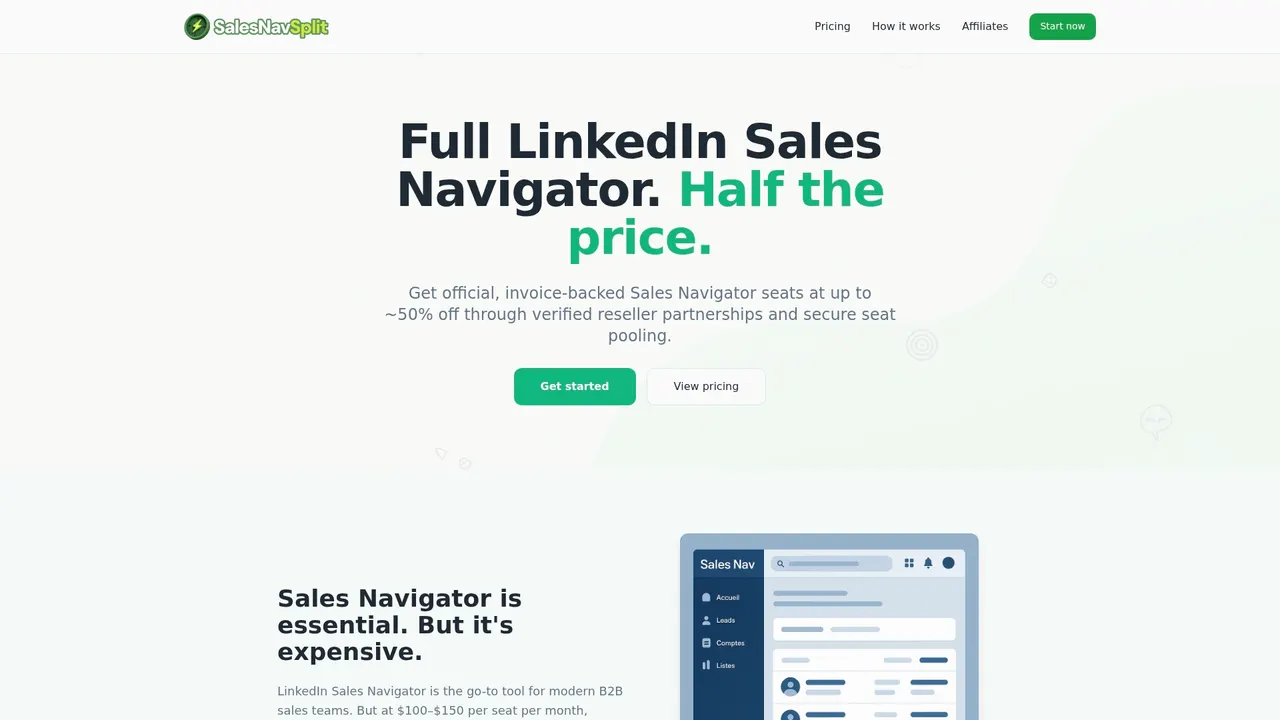
The strategies in this guide work. They work even faster when you have access to professional-grade tools that let you find, track, and reach the right prospects at scale. LinkedIn Sales Navigator is the most powerful prospecting tool on the platform, but its retail price puts it out of reach for many small teams and individual reps.
That’s exactly the problem we solve at SalesNavSplit. We provide official Sales Navigator seats at roughly 50% off standard pricing, sourced through verified reseller partnerships in the US and Europe. Every seat is genuine, compliant with LinkedIn’s terms of service, and activated within two business hours European time. You get full Sales Navigator functionality, official invoicing through Stripe, and none of the risks that come with credential sharing or gray-market tools. More pipeline, less overhead.
Frequently asked questions
What exactly counts as a lead on LinkedIn?
A LinkedIn lead is a relevant contact, usually a business decision-maker, who expresses interest in your offerings via connection, message reply, or form submission. Interest signals matter more than contact volume.
Do LinkedIn ads work for small businesses?
LinkedIn ads can work, but organic outreach and content are often more cost-effective for small businesses with tight budgets, delivering warmer leads at a fraction of the cost-per-lead.
Are LinkedIn automation tools safe?
Many automation tools carry real account risk. Signal-based, human-approved systems are the safest option, but authentic personalized outreach is always the most reliable approach.
How do I make my LinkedIn profile convert leads better?
Treat your profile like a landing page focused on your ideal customer profile, state your value clearly in the headline and about section, and include a direct call to action in your featured section.