
How to engage prospects effectively with LinkedIn tactics
How to engage prospects effectively with LinkedIn tactics
TL;DR:
- Most cold outreach fails because it relies on generic messages, single touches, and poor timing rather than building familiarity and relevance.
- Using structured, multi-step sequences, discovery frameworks like SPIN, and insights-driven engagement on LinkedIn significantly increases reply rates and builds stronger prospect relationships.
Most cold outreach gets ignored. Not because your product is wrong or your timing is off, but because the approach itself is broken. Sales reps send a generic connection request, follow up with a pitch-heavy message, and then wonder why nobody responds. The good news is that B2B reply rates jump significantly when you replace spray-and-pray tactics with structured, insight-driven engagement. This article gives you a step-by-step playbook for using LinkedIn Sales Navigator to build real prospect conversations, not just send messages into the void.
Table of Contents
- Understanding the common barriers to prospect engagement
- Preparing your engagement plan: tools and frameworks
- Executing multi-step LinkedIn outreach that stands out
- Troubleshooting and optimizing your prospect engagement
- Our perspective: Why challenger and insight-driven engagement outperforms traditional outreach
- Affordable LinkedIn Sales Navigator access: Unlock your prospecting success
- Frequently asked questions
Key Takeaways
| Point | Details |
|---|---|
| Multi-step outreach wins | Sequences of 4–6 messages with thoughtful follow-up perform better than single-touch outreach. |
| Frameworks drive results | Using discovery frameworks like SPIN ensures you qualify prospects effectively and respectfully. |
| Reply rates are low | Expect cold outreach replies around 2–3%, but demand-warming lifts this to 5–8% or higher. |
| LinkedIn behaviors matter | Engaging with prospect content and using permission-based asks helps avoid spam and boosts conversions. |
Understanding the common barriers to prospect engagement
After previewing the impact of improved prospect engagement, we first need to understand why traditional outreach often fails.
Most sales reps approach prospecting like a numbers game. Send enough messages, and eventually someone will respond. The problem is that buyers have gotten very good at ignoring noise. Inboxes are crowded, attention spans are short, and a generic “I’d love to connect” message reads like spam before the prospect even finishes the first sentence.
The numbers back this up. Cold outreach reply rates average between 1.9% and 3.4% for purely cold approaches. But when you warm up demand first, those rates climb to 5% to 8%. That difference is not trivial. For a rep sending 200 messages per week, that gap means the difference between 4 replies and 16. Over a quarter, that compounds into a completely different pipeline.
Here is what actually breaks most outreach:
- Generic messaging. Copy-paste templates that could be sent to anyone signal to the prospect that you did not bother to learn anything about them.
- Single-touch outreach. One message and done. Most buyers need multiple touchpoints before they feel comfortable engaging.
- No demand-warming. Jumping straight to a pitch before the prospect has any familiarity with you or your brand.
- Poor timing. Sending connection requests on Sunday evenings or follow-ups during industry conference weeks when inboxes are chaos.
Understanding sales prospecting basics helps you see that engagement is not just about volume. It is about building enough familiarity and relevance that the prospect feels responding is worth their time. The reps who crack this shift from “sending messages” to “building micro-relationships before the first ask.”
| Outreach type | Average reply rate | Key driver |
|---|---|---|
| Cold, single-touch | 1.9% to 3.4% | Volume only |
| Demand-warmed, multi-touch | 5% to 8% | Familiarity and timing |
| Top-performer benchmark | Above 10% | Relevance plus sequencing |
The table above shows a clear pattern. Relevance and sequencing, not raw volume, are what separate average reps from top performers. Once you accept that, your entire approach to LinkedIn prospecting strategies changes.
Preparing your engagement plan: tools and frameworks
Having mapped the barriers to engagement, we can now lay out the key tools and frameworks needed to overcome them.
The biggest mistake reps make when they decide to “get more strategic” is adding complexity without structure. They start using LinkedIn Sales Navigator but still send single-touch messages. They research prospects but never reference that research in their outreach. Tools only work when paired with a repeatable framework.
The first framework worth knowing is SPIN. SPIN stands for Situation, Problem, Implication, and Need-Payoff. It is a discovery methodology built around asking the right questions in the right order. The goal is not to pitch your solution. The goal is to help the prospect articulate a problem they may not have fully recognized yet. According to SPIN selling research, this framework is especially powerful in complex B2B environments where buyers often do not yet realize the full scope of their problem. When you guide someone to that realization themselves, they are far more open to a conversation about solutions.
The second structural requirement is sequencing. Multi-step sequences of four to six touches consistently outperform single-message outreach. Each touch should serve a different purpose: awareness, familiarity, connection, conversation, qualification, and follow-up. Treating these as separate steps rather than one long pitch prevents you from overwhelming prospects too early.
LinkedIn Sales Navigator is the tool that makes all of this scalable. Here is what it gives you that standard LinkedIn does not:
- Advanced search filters. Target by seniority, function, company size, geography, and even recent job changes.
- Lead and account alerts. Get notified when a prospect posts content, changes roles, or their company hits a funding milestone.
- InMail credits. Reach prospects you are not yet connected to directly.
- CRM integration. Sync your outreach activity with your existing pipeline tools.
- Saved leads and lists. Build organized prospect lists and track engagement history.
Pro Tip: Set up lead alerts for your top 50 prospects in Sales Navigator. When someone posts new content or changes jobs, that is your warm outreach trigger. A message referencing a real event in their professional life is ten times more likely to get a reply than a cold template.
| Framework | Best use case | Key benefit |
|---|---|---|
| SPIN | Complex B2B discovery | Helps buyers recognize their own needs |
| Multi-touch sequencing | All cold and warm outreach | Builds familiarity before the ask |
| LinkedIn Sales Navigator | Contact targeting and tracking | Scales relevance across large prospect lists |
Pairing these tools with LinkedIn lead generation tips gives you a complete system, not just a collection of tactics.
Executing multi-step LinkedIn outreach that stands out
With frameworks and tools in hand, it is time to execute your outreach for maximum impact.
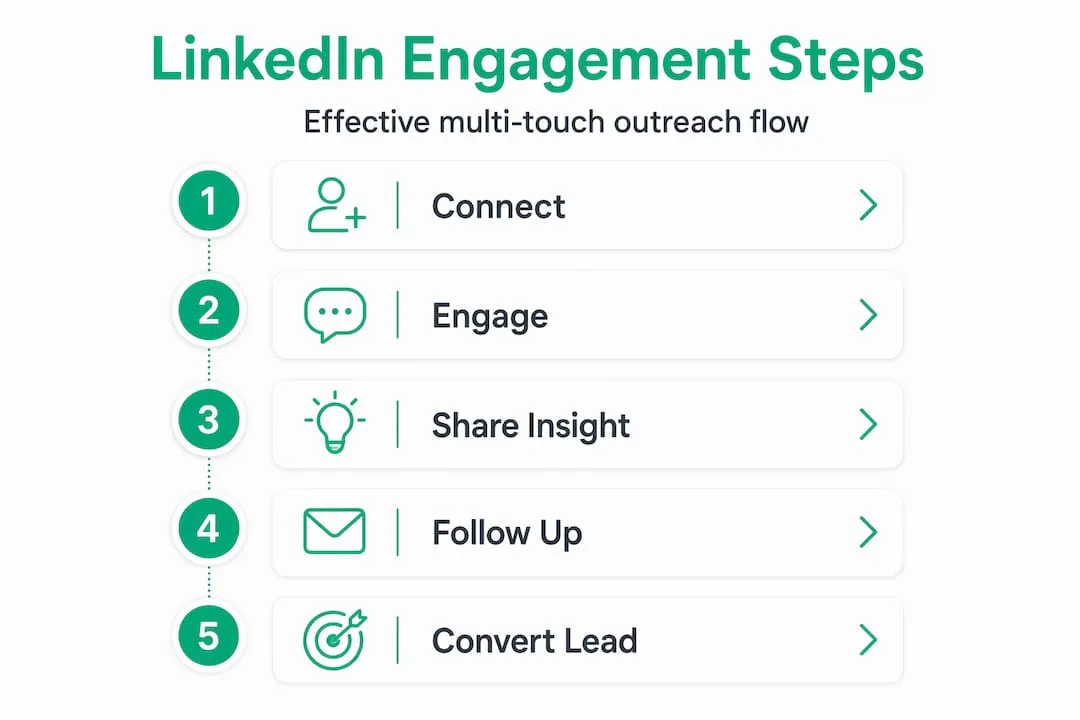
The biggest shift in effective LinkedIn outreach is moving from a “send and hope” mindset to a deliberate sequence of small, low-friction interactions. Each step earns the right to the next one. Here is a proven structure that works:
- Engage with their content first. Like or comment on a recent post from your target prospect. Make your comment substantive, not just “Great post!” Reference a specific point they made. This creates a visible interaction before you ever send a message.
- Send a connection request with a specific reference. Mention the post you commented on, a shared connection, or something specific about their role or company. Keep it to two sentences. No pitch.
- After connection, open with a conversational question. Not “Can I show you our product?” but something like “I saw you’re scaling your sales team this year. Are you finding outbound or inbound is driving more of your pipeline right now?” This is low-friction and invites a natural reply.
- Earn permission before qualifying. According to LinkedIn prospecting best practices, you should earn a small “yes” before asking deeper qualification questions. Ask something easy first. Once they respond, you have implicit permission to go a layer deeper.
- Keep qualification questions thread-safe. Short, easy-to-answer questions work best in LinkedIn DMs. Long multi-part questions kill conversations. One question per message.
- Align across channels. Multichannel alignment means coordinating your LinkedIn activity with email or phone outreach, but never repeating the same message across channels. Use LinkedIn to warm, email to qualify, and calls to close.
“The goal of early outreach is not to sell. It is to earn the right to a real conversation. Every message should make the next message easier to send and easier to receive.”
LinkedIn outreach mechanics that consistently improve acceptance and response rates include engaging with content before pitching, using specific references in connection notes, and progressing to a conversational question in DMs after connection. These are not tricks. They are signals that you are a real person with a genuine reason to connect.
Pro Tip: Never send a pitch in your connection request. The acceptance rate for pitch-free requests is significantly higher. Save the business context for your first DM after they accept.

When you boost LinkedIn engagement through this kind of structured approach, you are not just improving reply rates. You are building a reputation as someone worth talking to. That reputation compounds over time, especially in tight-knit industries where decision-makers know each other.
Understanding LinkedIn customer engagement at a deeper level also means recognizing when to slow down. If a prospect goes quiet after step three, do not immediately escalate to a harder ask. Wait a week, then re-engage with a new piece of relevant content or a light-touch check-in.
Troubleshooting and optimizing your prospect engagement
Once your outreach is running, optimizing results and troubleshooting issues is the final step to mastering engagement.
Even well-structured sequences break down. The most common reasons are easy to fix once you know what to look for.
Common mistakes that kill reply rates:
- Not following up. A single message that goes unanswered is not a rejection. Most replies come from follow-up touches, not the first message. Reps who stop after one attempt leave the majority of potential conversations on the table.
- Poorly timed outreach. Tuesday through Thursday mornings tend to see higher engagement. Avoid Mondays (inbox overload) and Fridays (checked-out mode).
- Generic DMs. Even in a sequence, each message should feel like it was written for that specific person. Reference their industry, their recent activity, or a challenge specific to their role.
- Sequences that are too short or too long. Four to six touches is the sweet spot. Fewer than four and you have not given the relationship enough time to warm. More than eight and you risk irritating prospects who are simply not interested.
- Ignoring engagement signals. If someone views your profile after your first message, that is a warm signal. Follow up sooner. Sales Navigator shows you who viewed your profile, which is a feature most reps underuse.
| Performance level | Reply rate | Key differentiator |
|---|---|---|
| Below average | Under 2% | Single-touch, generic messaging |
| Average | 1.9% to 3.4% | Some follow-up, limited personalization |
| Above average | 5% to 8% | Demand-warmed, multi-touch sequences |
| Top performer | Above 10% | Relevance, timing, and insight-driven messaging |
The State of B2B Outbound 2026 makes clear that the gap between average and top performers is not talent. It is process. Top performers have a repeatable system they test and refine. They track which messages get replies, which subject lines get opens, and which follow-up timing windows work best for their specific audience.
For reps focused on staying compliant with LinkedIn prospecting norms, optimization also means respecting platform limits. Sending too many connection requests in a short window can trigger LinkedIn’s anti-spam filters. Keep your daily connection volume reasonable and vary your message templates to avoid pattern detection.
When you qualify sales leads more effectively through better engagement, you also reduce wasted time. A well-run sequence surfaces the prospects who are genuinely interested faster, so you spend less time chasing dead ends and more time on conversations that can actually close.
Our perspective: Why challenger and insight-driven engagement outperforms traditional outreach
There is a version of the multi-touch sequence playbook that every rep eventually learns. And then there is the version that actually separates the top 5% from everyone else.
The conventional wisdom says: be helpful, build relationships, and the sales will follow. That is true in many situations. But we have seen a specific edge case where it falls short. When prospects are already doing independent research, or when they are resistant to change because they have invested heavily in a current solution, purely relationship-based engagement often stalls. The prospect is polite but never moves forward.
This is where insight-driven approaches, specifically the Challenger framework, can outperform. The Challenger model involves teaching prospects something they did not know, tailoring that insight to their specific situation, and then taking control of the conversation to guide them toward a decision. It is more assertive than SPIN and more provocative than relationship selling.
The catch is credibility. Challenger-style engagement only works when you actually have insight worth sharing. If you lead with a “reframe” that the prospect has already considered, you come across as presumptuous. If your teaching moment is generic industry data they have already read, you lose them immediately. The insight has to be genuinely surprising or counterintuitive to create the pattern interrupt that makes Challenger effective.
Our view is that the best reps use SPIN to open and qualify, then shift to Challenger-style insight sharing once they understand the prospect’s situation well enough to say something genuinely useful. That combination, discovery first and then teaching, avoids the arrogance trap that kills so many Challenger attempts. It also respects the prospect’s intelligence while still moving the conversation forward with purpose.
The LinkedIn sales strategies for SMBs that work best in 2026 are the ones that treat prospects as smart people who need a reason to engage, not a target to convert. When your outreach teaches something real, it earns attention that no amount of follow-up volume can buy.
Affordable LinkedIn Sales Navigator access: Unlock your prospecting success
Now that you have the strategy and tips, here is how you can put them into action cost-effectively.
Running a multi-touch, insight-driven LinkedIn outreach program requires the right tools. LinkedIn Sales Navigator is the engine behind everything described in this article: the lead alerts, the advanced filters, the InMail credits, and the CRM sync. But the standard retail price puts it out of reach for many individual reps, small teams, and early-stage startups.
That is exactly the problem SalesNavSplit was built to solve. We provide discounted Sales Navigator seats sourced through verified reseller partnerships in the US and Europe. These are official, licensed seats at approximately 50% off standard pricing. Activation takes 24 to 48 hours, invoicing runs through Stripe, and every seat is compliant with LinkedIn’s terms of service. No credential sharing, no gray-market workarounds, just legitimate access at a price that makes sense for teams who want to prospect smarter without overspending on tools.
Frequently asked questions
What is the optimal sequence length for prospect engagement?
Studies show that sequences of four to six touches deliver the highest reply rates for cold outreach, balancing persistence with respect for the prospect’s attention.
What kind of reply rates should I expect with cold LinkedIn outreach?
Average cold outreach reply rates fall between 1.9% and 3.4%, but demand-warming strategies and multi-touch sequencing can push those rates to 5% to 8% or higher.
What is the SPIN framework and why is it effective?
SPIN uses four question types, Situation, Problem, Implication, and Need-Payoff, to guide buyer discovery. According to SPIN selling research, it is especially effective in complex B2B environments where buyers have not yet fully recognized their own problem.
How can I avoid sounding spammy or pushy in LinkedIn outreach?
Engage with prospect content before connecting, use specific references in your connection note, and earn permission with a small, easy-to-answer question before moving to deeper qualification asks.