
Sales Outreach Trends 2026: What Actually Drives Results
Sales Outreach Trends 2026: What Actually Drives Results
TL;DR:
- Cold email reply rates in 2026 average just 3.43%, but top teams surpass 10% using personalized, signal-based outreach.
- Effective strategies include leveraging AI workflows, optimizing deliverability, multi-threading, and timing to improve response and meeting rates.
The numbers tell a blunt story. The average cold email reply rate sits at just 3.43% in 2026, yet top-performing teams consistently clear 10%. That gap is not luck. It reflects a fundamental split between teams treating outreach as a volume game and those using signal-based personalization, AI-enabled workflows, and disciplined deliverability practices. If you are a B2B sales professional trying to understand which sales outreach trends 2026 actually move the needle, this article breaks down what the data shows and what separates the elite from everyone else.
Table of Contents
- Key takeaways
- Sales outreach trends 2026: how to evaluate what works
- 1. Signal-based, highly personalized outbound messaging
- 2. AI-enabled next-best-action workflows transforming seller roles
- 3. Mastering email deliverability and compliance as foundational prerequisites
- 4. Strategic cadence, multi-threading, and timing optimized by data
- My honest take on AI and human judgment in sales outreach
- Use LinkedIn Sales Navigator to execute these trends
- FAQ
Key takeaways
| Point | Details |
|---|---|
| Signal-based outreach wins | Campaigns anchored to buying triggers produce 5–18% reply rates versus 1–3% for generic lists. |
| AI needs a reinvestment plan | 72% of sellers save time with AI but do not redirect it toward high-value activities. |
| Deliverability is a prerequisite | SPF, DKIM, and DMARC authentication determine inbox placement before subject lines matter. |
| Follow-up sweet spot exists | Two to three follow-ups spaced 3–5 days apart increase reply rates without triggering spam filters. |
| Multi-threading multiplies results | Contacting multiple stakeholders at one company boosts response rates by up to 93%. |
Sales outreach trends 2026: how to evaluate what works
Before chasing any single tactic, you need a framework for judging whether your outreach is actually performing or just producing activity. The most effective approach treats outreach as a closed-loop system that tracks deliverability, relevance, and message-to-meeting conversion together. If you only watch reply rates, you will miss the bottleneck that is actually limiting your pipeline.
Four criteria should guide your evaluation:
- Contact data quality: Are you targeting verified, current contacts or stale list exports? Bad data poisons every downstream metric.
- Intent signal integration: Are your messages triggered by real buying signals or sent on a fixed schedule regardless of prospect context?
- Technical deliverability: Have you configured SPF, DKIM, and DMARC correctly? Inbox placement depends far more on authentication setup than on subject line optimization.
- Conversion funnel depth: Measure reply rate, meeting booked rate, and opportunity creation together. A high reply rate that produces no meetings signals a messaging problem, not a volume problem.
Pro Tip: Set up separate sending domains for cold outreach and transactional email. Protecting your primary domain from complaint rate damage is one of the fastest ways to preserve deliverability without changing a single word of your copy.
1. Signal-based, highly personalized outbound messaging
Generic outreach is statistically dead. Signal-based campaigns produce reply rates between 5% and 18%, while static list outreach sits between 1% and 3%. That is a difference that changes pipeline math entirely.
The concept is simple: you reach out to a prospect at the moment a buying trigger makes your solution relevant. Common triggers include:
- A new VP of Sales or CRO joining the company
- A recently closed funding round
- A competitor tool being deprecated or replaced
- Expansion signals such as new job postings in a specific department
- Regulatory changes that affect the prospect’s industry
The message you write is not about you. It references the trigger directly. “I saw you recently brought on a new revenue leader” lands entirely differently than “We help companies like yours improve sales efficiency.” One feels like a conversation. The other feels like a mail merge.
Scaling this without sacrificing quality is where AI-enhanced prospecting tools earn their place. AI can surface buying signals, enrich contact records, and draft initial message frameworks. Your job is to apply judgment to what the AI finds, not to write every message from scratch.
Pro Tip: Combine trigger timing with cadence logic. A prospect who just raised a Series B is most receptive in the first 30 days after the announcement. Build trigger-specific sequences that fire within that window, not six weeks later when the moment has passed.
2. AI-enabled next-best-action workflows transforming seller roles
This is the trend with the most measurable commercial impact. Sales organizations using AI-enabled next-best-actions are 2.6 times more likely to achieve commercial growth than those that do not. That figure comes from a Gartner survey of 227 chief sales officers and it is not a marginal difference.
Here is what that looks like in practice:
- AI handles research and sequencing. For top teams, AI manages roughly 80% of research and sequencing work, freeing sellers to focus on message quality and live conversations.
- Next-best-action logic routes effort correctly. Instead of sellers deciding intuitively who to contact and when, AI surfaces the highest-priority accounts based on engagement signals, deal stage, and trigger data.
- Workflow redesign is the actual work. The technology is available to most teams. What separates growth leaders is the operational discipline to redesign how sellers spend their hours around the AI’s output.
The reinvestment gap is where most teams stall. AI saves sellers an average of 4.8 hours per week, but 72% of sales organizations fail to redirect those hours into high-value activities. The organizations that do reinvest are 2.2 times more likely to exceed growth goals. Saving time is not the same as using time better. That distinction matters enormously.
Pro Tip: When you roll out an AI-enabled workflow, assign explicit new tasks to fill the time savings. If a rep gains 5 hours per week, define upfront what those 5 hours will now go toward: more discovery calls, account research reviews, or relationship-building outreach. Without a prescription, the hours disappear into email and Slack.

3. Mastering email deliverability and compliance as foundational prerequisites
Most outreach fails before anyone reads the subject line. Authentication failures, high complaint rates, and missing one-click unsubscribe links route messages directly to spam. Deliverability is not a nice-to-have. It is the floor beneath every other outreach strategy.
The 2026 compliance baseline for bulk email senders looks like this:
| Requirement | Description | Priority |
|---|---|---|
| SPF record | Authorizes sending servers for your domain | Critical |
| DKIM signature | Cryptographically signs outgoing messages | Critical |
| DMARC policy | Specifies handling of messages failing SPF/DKIM | Critical |
| One-click unsubscribe | Required for senders above 5,000 messages per day | Required |
| Complaint rate | Must stay below 0.10%; above 0.30% triggers filtering | Mandatory |
Major inbox providers enforce these authentication requirements strictly. If your DMARC policy is still set to “none,” you are flying blind. Roll out enforcement in stages: start with monitoring mode, review reports for two to four weeks, then move to quarantine before enforcing full rejection. Jumping straight to rejection without reviewing reports is how you accidentally block your own legitimate email.
Pro Tip: Segment your list by engagement before large sends. Contacts who have not opened anything in 90 days should move to a separate re-engagement sequence, not sit in your main sending pool. Engagement-based segmentation is one of the fastest ways to drop complaint rates and improve sender reputation.
Check out the compliance guidance at Salesnavsplit’s outreach compliance blog for specifics on setting up authentication across multi-channel B2B tools.
4. Strategic cadence, multi-threading, and timing optimized by data
How you sequence outreach matters as much as what you write. Optimal follow-up cadence calls for two to three follow-ups spaced three to five days apart, with each message taking a different angle. Follow-ups can increase total reply rates by up to 49%, but sending more than four follow-ups increases spam complaints and unsubscribe rates noticeably.
A few data-backed principles to shape your cadence:
- Vary the message angle per follow-up. The first email leads with the buying trigger. The second might share a relevant case study. The third can offer a direct ask or an easy exit. Repeating the same pitch in three different wording variations does not work.
- Multi-thread by default. Emailing multiple contacts at the same company increases response rates by 93% compared to targeting a single contact. B2B purchase decisions involve an average of six to ten stakeholders. Focusing on one person is a structural disadvantage.
- Timing still matters. Tuesday through Thursday mornings, specifically between 8 a.m. and 10 a.m. in the prospect’s local time zone, continue to outperform other windows in 2026 benchmarks. This is not revolutionary, but most teams still send at default times that ignore time zones entirely.
- Build in exit logic. If a prospect clicks a link but never replies, treat them differently than someone who has never engaged. Behavioral signals should route contacts into different follow-up tracks.
The most overlooked multi-threading tactic is coordinating messaging across contacts rather than sending identical emails to five people at the same company. Each contact gets a version tailored to their role and likely priorities. The VP of Sales gets the revenue angle. The Sales Ops contact gets the efficiency angle. Same campaign, different lens.
For teams using LinkedIn alongside email, advanced Sales Navigator prospecting makes it significantly easier to identify all decision-makers at a target account, map their roles, and coordinate multi-channel sequences without duplicating effort.
My honest take on AI and human judgment in sales outreach
I’ve watched a lot of sales teams adopt AI tools over the past few years, and the pattern I keep seeing is the same. Teams buy the technology, automate the obvious tasks, and then wait for results to improve. When results do not improve fast enough, they add more automation. The problem is never the tool. It’s the gap between what the tool does and what the seller is now supposed to do differently.
What I’ve learned is that AI genuinely works best when it handles the repeatable parts of outreach so that sellers can spend more time on the things AI cannot do: reading a conversation’s emotional register, knowing when to push and when to step back, building the kind of rapport that turns a cold prospect into a referral source. Those skills do not develop on their own. They require deliberate practice, coaching, and time. Successful AI adoption pairs tool use with real behavioral change.
The teams I’ve seen grow fastest in 2026 are not the ones with the most sophisticated tech stack. They are the ones who figured out what their sellers should be spending time on, and then used AI to protect that time aggressively. That is a management decision as much as a technology decision. If your sellers are still spending most of their day on research and sequence building after adopting AI tools, something went wrong in the implementation, not the purchase.
— Toinon
Use LinkedIn Sales Navigator to execute these trends
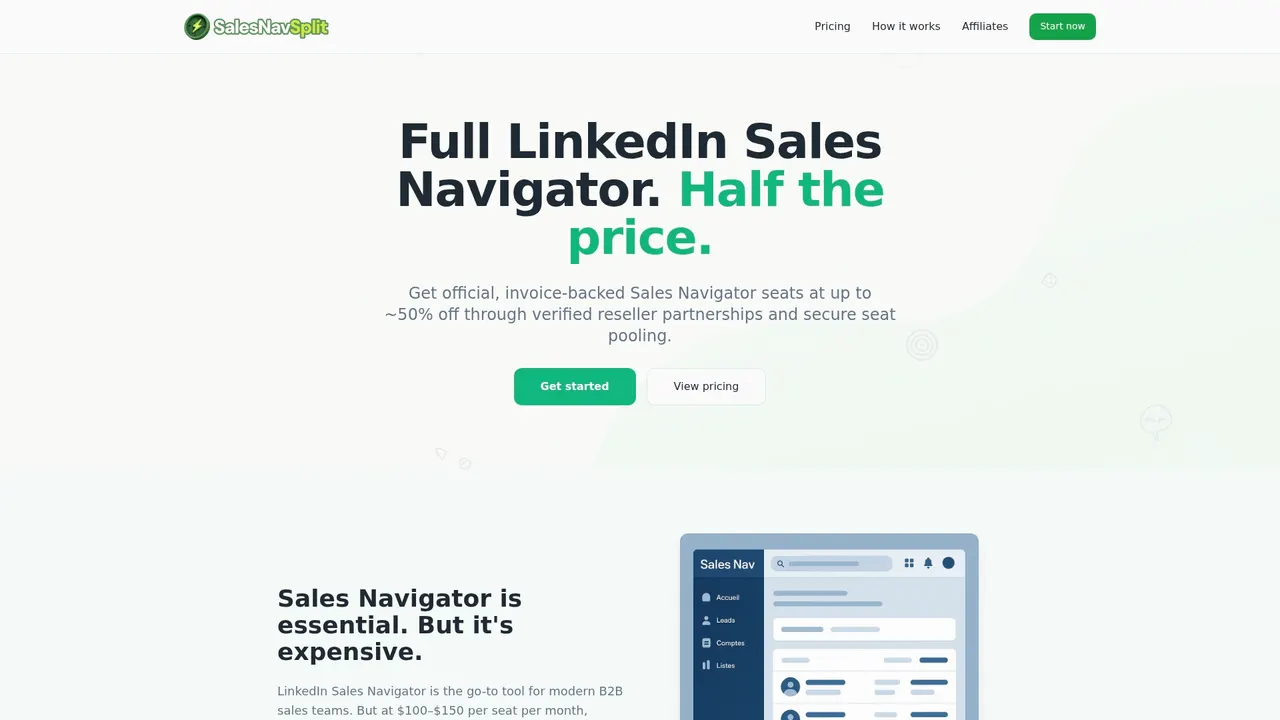
LinkedIn Sales Navigator is one of the most practical tools for putting the trends in this article into practice. Its buyer intent signals, job change alerts, and account mapping features align directly with signal-based outreach and multi-threading strategies. For teams that need to identify buying triggers in real time and reach verified contacts at scale, Sales Navigator removes a significant amount of manual research work from the equation.
Salesnavsplit offers official Sales Navigator seats at up to 50% off standard LinkedIn pricing, sourced through verified reseller partnerships in the US and Europe. Seats activate within two business hours European time, and licenses are fully compliant with LinkedIn’s terms of service. It is a practical way to access a premium prospecting tool without paying full retail, especially for smaller teams building out their 2026 outreach strategy.
FAQ
What is the average cold email reply rate in 2026?
The average B2B cold email reply rate in 2026 is approximately 3.43%, though top-performing teams achieve rates above 10% by using signal-based personalization and verified contact data.
How many follow-ups should I send in a sales cadence?
Two to three follow-ups spaced three to five days apart is the data-backed sweet spot. More than four follow-ups significantly increases spam complaint risk without proportional gains in reply rate.
What are buying triggers in signal-based outreach?
Buying triggers are real-world events that indicate a prospect may have an active need, such as a new executive hire, a funding announcement, or a technology change. Messaging anchored to these events produces reply rates of 5–18% compared to 1–3% for generic outreach.
Why does email deliverability depend on authentication, not subject lines?
Inbox placement is determined primarily by SPF, DKIM, and DMARC configuration along with sender reputation and complaint rates. A perfectly written subject line will not save a message that fails authentication checks before it reaches the inbox.
What does AI-enabled next-best-action mean for sales teams?
It means AI surfaces which accounts to prioritize, what action to take next, and when, based on engagement signals and deal data. Organizations using this approach are 2.6 times more likely to achieve commercial growth than those relying on intuition-based seller decisions.