
What Is Secure Sales Tech? A 2026 Guide for Sales Pros
What Is Secure Sales Tech? A 2026 Guide for Sales Pros
TL;DR:
- Secure sales technology employs integrated security controls, including certifications like SOC 2 and ISO 27001, to safeguard sensitive data throughout the sales process. AI sales agents introduce new risks requiring unique protections such as input sanitization and automated data deletion, emphasizing the need for proactive security measures. Sales leaders must own and regularly review their tech stack’s security to accelerate enterprise deals and ensure compliance, focusing on transparent documentation and proper ownership.
Secure sales technology is defined as sales software and systems built with integrated security controls that protect sensitive customer data, business intelligence, and sales workflows throughout the entire sales lifecycle. As enterprise procurement in 2026 now treats SOC 2 and ISO 27001 certification as front-line vendor filters, understanding what is secure sales tech is no longer optional for sales professionals. Tools that fail security audits get disqualified before a single demo. Security is the new entry ticket to enterprise deals, and the sales teams who understand this win faster.
What is secure sales tech and why it matters in 2026
Secure sales technology refers to any sales tool, platform, or system that embeds security by design rather than bolting it on as an afterthought. The recognized industry term for this broader category is secure-by-design software, and it covers everything from CRM platforms like Salesforce and HubSpot to AI-powered sales agents, email sequencers, and prospecting tools like LinkedIn Sales Navigator.

The stakes are concrete. Sales tools sit at the intersection of your most sensitive data: prospect contact records, deal values, communication histories, and payment information. A breach in your sales stack does not just expose customer data. It exposes your entire pipeline and competitive strategy. That is why security documentation has shifted from a legal formality to a distinguishing sales narrative that accelerates procurement approvals.
For small businesses and startups, this shift creates an asymmetric opportunity. Teams that proactively adopt certified, secure sales tools close enterprise deals that their less-prepared competitors cannot even enter. The benefits of secure sales tech extend beyond protection. They include faster procurement cycles, stronger buyer trust, and access to larger deal sizes.
What are the core security features of secure sales tools?
The foundation of sales technology safety rests on a set of specific, verifiable controls. Knowing these features lets you evaluate any vendor with precision rather than relying on marketing language.
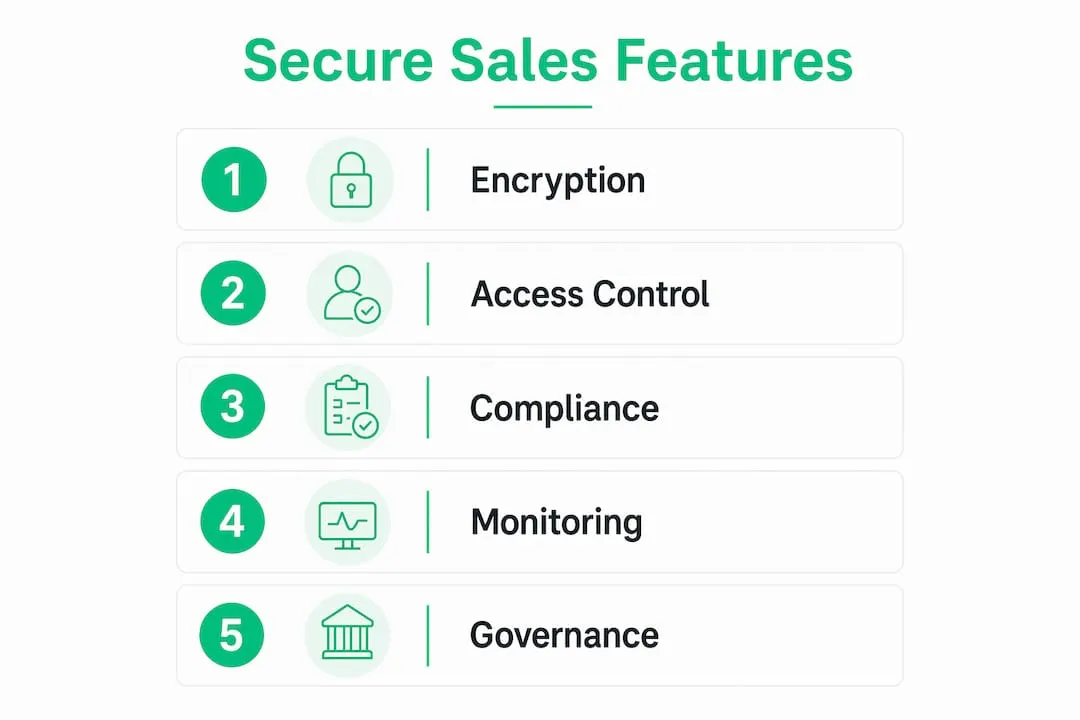
Zero Trust architecture is the most significant shift in how modern sales tools are secured. Zero Trust for CRM systems enforces least-privilege access and just-in-time credential issuance, meaning no user or system component is trusted by default, even inside your own network. Every access request is verified continuously, not just at login.
The core security features to look for in any secure sales platform include:
- Multi-factor authentication (MFA): Requires a second verification step beyond passwords, blocking credential-stuffing attacks that target sales accounts.
- Role-based access control (RBAC): Limits each rep, manager, or integration to only the data they need. A sales development rep should not have access to closed-won deal financials.
- Data encryption in transit and at rest: All data moving between your browser and the server, and all data stored on disk, must be encrypted using AES-256 or equivalent standards.
- Audit trails and logging: Every data access, export, or modification is recorded with timestamps and user identities, enabling forensic review if something goes wrong.
- Prompt injection defenses: For AI-enabled tools, input sanitization prevents malicious content from hijacking agent behavior. This is a newer but critical control.
Pro Tip: When evaluating a vendor, ask specifically for their SOC 2 Type II report, not just Type I. Type II covers a period of operational compliance, not just a point-in-time snapshot. Any vendor hesitant to share this document is a red flag.
How do AI sales agents differ from traditional tools in security risk?
Traditional sales software like email sequencers or static CRM platforms operate on fixed, rule-based logic. They read and write data based on explicit user commands. AI sales agents are fundamentally different. They make dynamic decisions, access multiple data sources autonomously, and take actions on behalf of users without step-by-step human approval.
This distinction creates an entirely new attack surface. The ForcedLeak vulnerability in Salesforce Agentforce demonstrated how prompt injection via malicious Web-to-Lead forms could trigger mass CRM data exfiltration. An attacker does not need to breach your login credentials. They simply need to get malicious instructions into a data source your AI agent reads and trusts.
The table below contrasts traditional sales software with AI sales agents across the dimensions that matter most for security planning:
| Security dimension | Traditional sales software | AI sales agents |
|---|---|---|
| Data access pattern | User-initiated, explicit commands | Autonomous, multi-source, dynamic |
| Primary attack vector | Credential theft, phishing | Prompt injection, data poisoning |
| Compliance complexity | Standard GDPR/CCPA data mapping | Automated decision-making rules apply |
| Data retention needs | Standard retention policies | Raw conversation data must be purged within 30 to 90 days |
| Identity management | Per-user credentials | Unique machine identities per agent required |
Treating AI sales agents as independent data processors rather than passive helpers is the critical mindset shift. GDPR and CCPA both impose specific obligations on automated decision-making systems, including the right to explanation and the right to deletion. Your AI sales agent must support automated data subject request workflows, not just manual ones.
How to secure your sales tech stack: practical steps
Understanding sales tech security at a conceptual level is useful. Executing it operationally is what actually protects your business and unlocks enterprise deals. The following steps give you a concrete framework.
-
Assign ownership of the sales tech stack. GTM stacks are often the largest ungoverned risk surface in organizations because they evolved separately from product infrastructure. Revenue teams add tools quickly without security vetting, and CISOs are often unaware of what is running. Designate a named owner, whether a RevOps lead or a sales manager, who is accountable for the full stack inventory.
-
Build a Security Trust Pack. A Security Trust Pack includes a SOC 2 executive summary, penetration test summaries, and Data Processing Agreement templates. Share this proactively at the start of enterprise sales cycles, not in response to a security questionnaire. This single practice shortens procurement timelines significantly.
-
Conduct quarterly access reviews. Pull a full list of every user, integration, and API key with access to your CRM and sales tools. Revoke anything that is no longer active. Former employees, lapsed integrations, and test accounts are common sources of ungoverned access. Pair this with a review of your sales tools checklist to identify tools with elevated risk profiles.
-
Sanitize all inputs to AI agents. Prompt injection is now a primary attack vector against AI sales systems. Any data your agent ingests from external sources, including web forms, emails, and third-party enrichment APIs, must be validated and stripped of executable instructions before the agent processes it.
-
Implement continuous re-verification for AI agents. Zero Trust for AI agents requires minting unique machine identities per agent with scoped, short-lived credentials. Every tool call the agent makes should trigger a fresh policy check, not rely on a session token issued hours earlier.
Pro Tip: Share your Security Trust Pack before a prospect asks for it. Buyers who receive unsolicited security documentation perceive you as a prepared partner, not a vendor scrambling to comply. This single behavior shifts the power dynamic in enterprise procurement conversations.
What compliance certifications should you look for in secure sales technology?
Certifications are the external proof that a vendor’s security claims have been independently verified. When evaluating any sales tool, these are the credentials that carry real weight:
- SOC 2 Type II: Audited by an independent CPA firm, this report confirms that a vendor maintained security, availability, and confidentiality controls over a defined period, typically six to twelve months. It is the baseline requirement for most enterprise procurement teams.
- ISO 27001: An international standard for information security management systems. More common in European enterprise procurement and increasingly required in cross-border B2B deals.
- Penetration test reports: Annual third-party pentests with published remediation timelines show that a vendor actively hunts for vulnerabilities rather than waiting to be breached. Ask for the executive summary and the remediation status.
- GDPR and CCPA compliance documentation: Data Processing Agreements, privacy notices, and data retention schedules confirm that the vendor handles personal data lawfully. This is non-negotiable for any tool that touches prospect or customer contact data.
- Bridge letters: When a SOC 2 report is more than six months old, a bridge letter from the auditor confirms that no material changes have occurred since the last audit. Always request one if the report is dated.
The business case for prioritizing certified tools goes beyond risk mitigation. Vendors who openly provide security documentation gain a measurable market advantage by accelerating procurement approvals. If you are a sales leader evaluating tools, choosing certified platforms also protects your own credibility when your customers audit your stack. For a deeper look at passing security reviews in 2026, the secure sales prospecting guide from Salesnavsplit covers the procurement side in detail.
Key takeaways
Secure sales technology requires Zero Trust architecture, verified compliance certifications, and active governance of your sales stack to protect data and win enterprise deals.
| Point | Details |
|---|---|
| Security is a sales feature | SOC 2 and ISO 27001 certification now determine vendor eligibility in enterprise procurement before product evaluation begins. |
| AI agents need distinct controls | AI sales agents require unique machine identities, input sanitization, and automated data deletion workflows that traditional CRM tools do not. |
| Ownership gaps are the biggest risk | GTM stacks are the most ungoverned risk surface in most organizations. Assign a named owner and conduct quarterly access reviews. |
| Trust Packs accelerate deals | Proactively sharing SOC 2 reports, pentest summaries, and DPAs shortens enterprise sales cycles by eliminating reactive security delays. |
| Certifications protect both sides | Choosing certified sales tools protects your customers’ data and shields your own business from liability during procurement audits. |
Why sales leaders need to own this conversation now
I have spent years watching sales teams treat security as someone else’s problem. The CISO handles it. Legal reviews it. IT approves it. The result is a sales stack that nobody fully owns and that accumulates risk with every new tool added in a rush to hit quota.
Here is what I have found to be true: the teams that close the largest enterprise deals in 2026 are not necessarily the ones with the best product. They are the ones who show up to security reviews prepared. They have their SOC 2 report ready. They understand what data their AI agents access. They can answer a CISO’s questions without scheduling a follow-up call.
The uncomfortable reality is that most sales leaders have never read their own vendor’s DPA. They have no idea whether their prospecting tools retain conversation data beyond 90 days or whether their AI agent has a unique machine identity or shares credentials with three other integrations. This is not a technology problem. It is a leadership problem.
The opportunity here is real. Security ownership gaps in sales tech stacks represent an early-mover advantage for teams willing to define GTM security governance before their competitors do. Start by reading the guide on protecting sales accounts and then audit every tool in your stack against the criteria in this article. The sales leaders who do this now will be the ones their enterprise buyers trust most.
— Toinon
Secure your sales tools with verified, compliant licenses
If you are building a sales tech stack that can pass enterprise security reviews, the tools you license matter as much as the controls you implement. Salesnavsplit provides official LinkedIn Sales Navigator seats at up to 50% off standard pricing, sourced through verified reseller partnerships in the US and Europe. Every seat is genuine, compliant with LinkedIn’s terms of service, and activated within two business hours European time through Stripe-invoiced transactions.
For sales teams that need enterprise-grade prospecting capability without the compliance risk of gray-market licenses, Salesnavsplit delivers the security and legitimacy your procurement team requires. You get full Sales Navigator functionality, official invoicing, and the confidence that your license will not trigger a security flag during a customer audit. For teams building a lean, compliant outreach stack, this is where to start.
FAQ
What is secure sales tech in simple terms?
Secure sales technology is sales software built with integrated controls, including encryption, access management, and compliance certifications, that protect customer data and business information throughout the sales process.
Why do sales teams need SOC 2 certification in their tools?
SOC 2 certification is now a front-line filter in enterprise vendor approvals. Tools without it are disqualified before product evaluation begins, regardless of features or pricing.
How is an AI sales agent different from a standard CRM in security terms?
AI sales agents access data autonomously and make dynamic decisions, which creates new attack surfaces like prompt injection that traditional CRM platforms do not face. They also require automated data deletion workflows to comply with GDPR and CCPA.
What is a Security Trust Pack?
A Security Trust Pack is a curated set of documents, including a SOC 2 executive summary, penetration test reports, and Data Processing Agreement templates, shared proactively with enterprise buyers to accelerate security due diligence.
How often should sales teams review access to their sales tools?
Quarterly access reviews are the recommended practice. These reviews should cover all users, API keys, and integrations, with immediate revocation of any access that is no longer active or necessary.