
The Role of Security in Sales Software in 2026
The Role of Security in Sales Software in 2026
TL;DR:
- Security controls like encryption, access management, and third-party audits are essential for safeguarding sensitive data and ensuring compliance in sales software. Proactively sharing security documentation accelerates deal velocity, builds trust, and provides a competitive advantage in enterprise procurement. Effective security ownership across sales, IT, and RevOps prevents delays, enhances credibility, and transforms security from a compliance requirement into a revenue driver.
Security in sales software is defined as the set of technical controls, compliance frameworks, and governance practices that protect sensitive customer and organizational data throughout every stage of the sales process. In 2026, this definition carries far more weight than it did five years ago. The role of security in sales software has shifted from a backend IT obligation to a front-line competitive factor that directly determines whether deals close or stall. Standards like SOC 2 Type II, AES-256 encryption, and multi-factor authentication (MFA) are no longer optional extras. They are the baseline expectations of enterprise buyers, procurement teams, and legal departments evaluating every tool in your sales stack.
How security features in sales software protect sensitive data
Modern sales software sits at the center of your most sensitive business relationships. It stores contact records, deal values, communication histories, and sometimes financial data. The security architecture protecting that information follows a layered model, and understanding each layer helps both sales leaders and IT decision-makers evaluate vendors with precision.

Encryption is the first line of defense. SOC 2 Type II certified vendors are required to implement AES-256 encryption for data at rest and TLS 1.3 for data in transit. AES-256 is the same standard used by the U.S. federal government for classified information. TLS 1.3 eliminates older, vulnerable cipher suites that attackers exploited in earlier protocol versions. Together, they mean that even if data is intercepted or a storage system is compromised, the underlying information remains unreadable.
Identity and access controls form the second layer. MFA and role-based access control (RBAC) limit who can see what data and under what conditions. A sales rep in a regional office should not have the same access rights as a system administrator. Authentication controls like MFA reduce the risk of credential theft, which remains the most common entry point for data breaches in SaaS environments.
Third-party validation closes the loop. Regular penetration testing by independent security firms and annual compliance audits verify that controls work as documented, not just as designed. Buyers increasingly request these audit reports during procurement. Vendors that cannot produce them face disqualification before a demo even happens.
- Verify AES-256 encryption at rest and TLS 1.3 in transit before signing any vendor contract
- Confirm MFA is enforced by default, not optional, for all user accounts
- Request the most recent third-party penetration test report and SOC 2 Type II audit letter
- Check data residency options to confirm compliance with GDPR or HIPAA where applicable
Pro Tip: Ask vendors for their shared responsibility model documentation. It clarifies exactly which security obligations belong to the vendor and which fall to your team, preventing dangerous assumption gaps.
Why security directly impacts sales performance and deal velocity
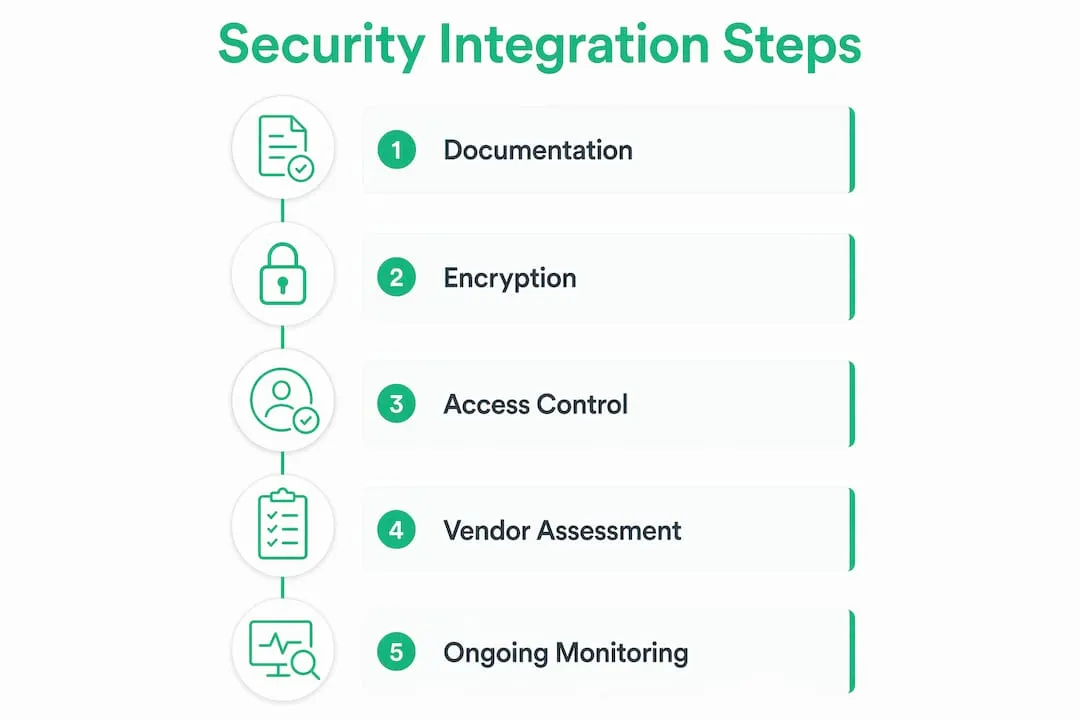
Security reviews are the most underestimated bottleneck in enterprise B2B sales. Deals stall for weeks in security review queues while procurement teams wait for documentation that sales reps either do not have or do not know how to locate. This delay compounds across a pipeline. A deal that stalls for six weeks in security review is a deal that may miss a budget cycle entirely.
The solution is treating security documentation as a sales asset rather than a compliance artifact. Security artifacts such as SOC 2 reports, penetration test summaries, data processing agreements, and architecture diagrams function as deal velocity assets when delivered proactively. They remove friction before buyers even ask, which signals organizational maturity and builds trust faster than any feature demo.
“Most security objections in sales stem from uncertainty. Proactive documentation and communication ease buyer concerns before they become blockers.” This observation from B2B SaaS research captures why the best-performing enterprise sales teams now maintain a ready-to-share security package as standard practice.
Security also functions as a differentiator in competitive evaluations. When two vendors offer comparable features, the one with cleaner security credentials and faster documentation response wins the procurement vote. Companies weaving security into their value propositions close more deals and increase deal velocity. That is not a soft benefit. It is a measurable revenue outcome.
The practical implication for sales teams is clear. Security is no longer something you hand off to IT when a prospect asks. It belongs in your demo narrative, your proposal, and your champion enablement materials. Buyers need to carry the security story internally to their own legal and IT stakeholders. If you do not give them the right materials, they will improvise, and improvised security answers rarely satisfy enterprise procurement.
What security standards and frameworks enterprise buyers expect
Enterprise buyers in 2026 evaluate sales software vendors against a defined set of security frameworks. Understanding these frameworks helps IT decision-makers set vendor qualification criteria and helps sales leaders speak credibly during procurement conversations.
| Framework | Core requirement | Relevance to sales software |
|---|---|---|
| SOC 2 Type II | Continuous controls testing across security, availability, and confidentiality | De facto minimum for CRM and sales engagement platforms handling customer data |
| ISO 27001 | Formal information security management system with documented risk treatment | Required by many European enterprise buyers and government-adjacent organizations |
| NIST CSF | Risk-based framework covering identify, protect, detect, respond, and recover | Increasingly required for AI-driven sales tools and platforms with federal clients |
| GDPR | Data subject rights, lawful processing, and breach notification within 72 hours | Mandatory for any sales software processing data of EU residents |
| HIPAA | Protected health information controls, audit logs, and business associate agreements | Required when sales software is used in healthcare or life sciences verticals |
AI-driven sales tools must align with NIST and Gartner TRiSM frameworks, with granular access controls that allow vendors to demonstrate governance rather than simply claim it. This matters because AI features in sales software, such as conversation intelligence and predictive scoring, process large volumes of customer interaction data. Buyers want to know exactly how that data is used, stored, and protected.
A technical RFP checklist for evaluating CRM vendor security should include logging and audit trail capabilities, multi-tenancy data isolation, SLA commitments for breach notification, integration security controls, and identity management standards. Buyers who skip these evaluation criteria during procurement often discover gaps after contract signature, at which point remediation is expensive and disruptive.
The emerging expectation in 2026 is AI data usage governance. Buyers want explicit contractual language specifying whether their data is used to train vendor AI models. Sales software vendors that address this proactively in their security documentation are winning deals that competitors lose during legal review.
Best practices for integrating security into your sales process
Integrating security into daily sales workflows requires shared ownership across sales, IT, and RevOps. Conflicting priorities and unowned data flows between integrated sales platforms create blind spots that attackers exploit. The fix is not more tools. It is clearer accountability.
Follow this sequence to build a security-integrated sales process:
-
Assign a security liaison in RevOps. This person owns the relationship between the sales stack and the IT security team. They maintain the approved vendor list, track audit renewal dates, and serve as the first responder when a prospect raises a security question.
-
Build a deal-ready security package. Compile your SOC 2 Type II report, penetration test executive summary, data processing agreement template, and a one-page security overview into a single shared folder. Update it every time a new audit completes. Sales reps should be able to share this package within minutes of a prospect request.
-
Centralize security questionnaire responses. Security questionnaires are a major sales bottleneck in 2026. Automating and centralizing approved answers in a searchable repository cuts turnaround time dramatically and prevents inconsistent answers that create legal exposure. Tools purpose-built for this task store validated responses that legal and security teams have pre-approved.
-
Train reps to lead with security in demos. A two-minute security overview at the start of an enterprise demo signals credibility and preempts objections. Cover your compliance certifications, data residency options, and access control model before the prospect asks.
-
Audit your integrations quarterly. Unowned spaces between integrated sales platforms create major security risks through inconsistent controls and access token sharing. A quarterly review of all active integrations, API connections, and third-party data flows catches vulnerabilities before they become incidents.
Pro Tip: When a prospect’s security team sends a questionnaire, respond within 48 hours with your pre-built package attached. Speed of response signals organizational security maturity as clearly as the content of your answers.
Effective secure sales prospecting also means protecting the data you collect during outreach. Every contact record, email exchange, and call recording represents personal data with legal protections. Sales teams that treat prospecting data with the same rigor as CRM data reduce their regulatory exposure and build reputations that enterprise buyers notice.
Key takeaways
Security in sales software is a direct revenue driver. Teams that treat it as a front-line asset close faster, qualify more enterprise deals, and reduce procurement friction across every stage of the pipeline.
| Point | Details |
|---|---|
| Security drives deal velocity | Proactive security documentation removes procurement bottlenecks and shortens sales cycles measurably. |
| SOC 2 Type II is the baseline | Enterprise buyers require AES-256 encryption, TLS 1.3, MFA, and penetration testing as minimum vendor qualifications. |
| Shared ownership prevents blind spots | Sales, IT, and RevOps must jointly govern the sales stack to eliminate unowned data flows and access risks. |
| Questionnaire automation protects revenue | Centralizing pre-approved security answers cuts response time and prevents inconsistent answers that stall deals. |
| AI governance is the new frontier | Buyers now require explicit contractual language on AI data usage, making this a procurement differentiator in 2026. |
Security is the sales advantage most teams are ignoring
I have watched sales teams lose enterprise deals not because their product was inferior, but because their security documentation was a mess. A prospect’s IT team sends a 60-question security questionnaire. The sales rep forwards it to IT. IT responds in three weeks with answers that contradict what legal said six months ago. The deal dies in procurement. The competitor with a clean SOC 2 report and a 48-hour response time wins.
The uncomfortable truth is that most sales organizations still treat security as IT’s problem. They hand it off the moment a technical question arrives and then wonder why deals stall. The teams I have seen close the most enterprise business do the opposite. They own the security narrative. They know their certifications, they can explain their encryption model in plain language, and they have a security package ready to share before the prospect even asks.
Secure sales licenses and tools matter here too. If the platforms your reps use daily are not themselves compliant and audited, you are creating a vulnerability in the very tools you use to build customer relationships. Security starts with the software your team touches every day, not just the software you sell.
The sales teams that will win in 2026 are the ones that make security a competitive advantage rather than a compliance checkbox. That shift in mindset is the most underutilized revenue lever in B2B sales today.
— Toinon
How Salesnavsplit supports secure sales software access
Salesnavsplit provides authorized LinkedIn Sales Navigator seats at approximately 50% off standard pricing, sourced through verified reseller partnerships in the US and Europe. Every seat is genuine, compliant with LinkedIn’s terms of service, and activated through secure payment processing via Stripe. For sales professionals and IT decision-makers who need official, audited access to LinkedIn’s prospecting tools without the security risks of credential sharing or unverified third-party accounts, Salesnavsplit delivers exactly that. Fast activation within two business hours European time, transparent pricing, and verified reseller credentials mean your team gets Sales Navigator access that meets the security standards your procurement team expects.
FAQ
What is the role of security in sales software?
Security in sales software protects sensitive customer and organizational data through encryption, access controls, and compliance frameworks. It also accelerates deal cycles by reducing procurement friction when vendors present security credentials proactively.
Which security standard is required for CRM and sales software in 2026?
SOC 2 Type II is the de facto minimum standard, requiring AES-256 encryption, TLS 1.3, MFA, and regular penetration testing. ISO 27001 and NIST CSF are additionally required for European enterprise buyers and AI-enabled platforms.
How do security questionnaires affect sales performance?
Security questionnaires are a leading bottleneck in enterprise sales, delaying deals by weeks when responses are slow or inconsistent. Centralizing pre-approved answers in a searchable repository cuts turnaround time and protects pipeline velocity.
Who owns security in a sales organization?
Security governance in a sales stack requires shared ownership across sales, IT, and RevOps. Assigning a RevOps security liaison to maintain vendor compliance records and respond to prospect inquiries prevents the blind spots that arise when security is treated as IT’s sole responsibility.
How does security affect trust during customer interactions?
Proactive security transparency, sharing audit reports, data processing agreements, and compliance certifications before buyers ask, signals organizational maturity and builds trust faster than product features alone. Buyers who trust a vendor’s security posture move through procurement faster and with fewer objections.