
What Is Sales Data Privacy? A 2026 Guide for Sales Pros
What Is Sales Data Privacy? A 2026 Guide for Sales Pros
TL;DR:
- Sales data privacy involves collecting, using, and storing customer data only with proper consent and legal compliance. It is essential for maintaining trust, avoiding penalties, and operationally managing control over contact and behavioral information in sales. Implementing operational measures like consent management, data minimization, and staff training ensures compliance across sales processes.
Sales data privacy is the practice of collecting, storing, and using customer personal information only with proper consent, clear purpose, and full compliance with applicable data protection laws. For sales professionals and small business owners, this means treating contact details, purchase histories, and behavioral data as protected assets, not just raw material for outreach. Laws like the GDPR and the California Consumer Privacy Act (CCPA) impose legal obligations that go far beyond good intentions. Understanding what sales data privacy requires, and what it costs to ignore it, is now a baseline competency for anyone running a sales operation.
What is sales data privacy and why does it matter?
Sales data privacy, known formally as customer data privacy in legal and compliance contexts, covers personal information such as names, email addresses, phone numbers, purchase history, and behavioral data collected during the sales process. The core obligation is straightforward: you may only collect data you need, use it for the purpose you stated, and share it with parties the customer has agreed to. Small businesses apply this by restricting employee access to CRM records and being explicit with customers about how their data will be used.
The role of data privacy in sales extends beyond legal compliance. When a prospect gives you their contact information, they are extending trust. Misusing that data, whether by selling it to a third party or using it for purposes never disclosed, breaks that trust and exposes your business to regulatory penalties. Privacy in sales data is therefore both a legal requirement and a commercial asset.
Sales data types that fall under privacy protection include:
- Contact information: names, email addresses, phone numbers, physical addresses
- Transaction data: purchase history, deal values, contract terms
- Behavioral data: website visits, email open rates, content downloads
- Enriched data: third-party appended firmographics or technographics
Each category carries different risk levels and different obligations depending on the jurisdiction where your customer resides.
Pro Tip: Map every data type your sales team collects against the legal basis you rely on for processing it. If you cannot name a lawful basis for a specific data field in your CRM, stop collecting it.
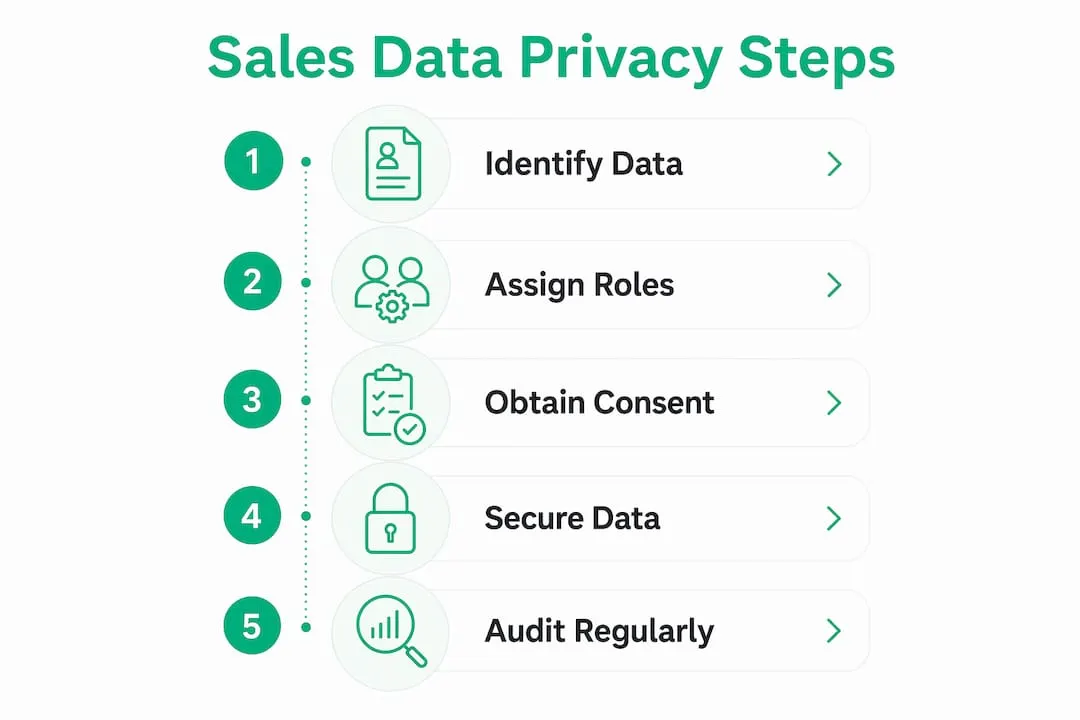
What is the difference between sales data privacy and data security?
Data privacy and data security are related but distinct disciplines, and confusing the two leads to fragmented compliance programs. Salesforce defines data privacy as governing authorized use of personal information, while data security refers to the technical and organizational measures that prevent unauthorized access. You can have strong security and still violate privacy if you use data in ways the customer never consented to.
Think of it this way: a locked filing cabinet is a security measure. Deciding who is allowed to open that cabinet and for what purpose is a privacy decision. Both matter, but they require different policies, different owners, and different workflows.
For sales teams, the practical distinction looks like this:
- Data privacy controls: consent management, data minimization policies, retention schedules, purpose limitation documentation
- Data security controls: encryption, access controls, monitoring for breaches, multi-factor authentication on CRM platforms
Privacy and security are complementary but separate concepts. A sales organization that invests only in security tools like firewalls and endpoint protection while ignoring consent documentation and data retention policies will still face regulatory exposure. GDPR enforcement actions have repeatedly targeted companies with strong technical security but poor privacy governance.
Pro Tip: Assign a privacy owner and a security owner within your sales operations team. These roles can overlap in a small business, but the responsibilities must be documented separately to avoid gaps.
What roles do data controllers and processors play in sales data privacy?
Under GDPR, the controller decides why and how personal data is processed, while the processor acts only on the controller’s instructions. This distinction directly affects how liability and compliance responsibility are assigned across your sales stack.

Most sales organizations act as data controllers. When you collect a prospect’s email address and load it into your CRM, you are deciding the purpose and means of that processing. Your CRM vendor, such as Salesforce or HubSpot, typically acts as a data processor, handling the data on your behalf under a Data Processing Agreement (DPA).
The table below clarifies the key differences:
| Role | Who decides purpose? | Who bears primary liability? | Common sales example |
|---|---|---|---|
| Data controller | Yes, the controller decides | Controller holds primary accountability | Your company collecting lead data |
| Data processor | No, follows controller’s instructions | Processor liable for own failures | Your CRM vendor storing that data |
| Joint controller | Shared decision-making | Both parties share accountability | Co-marketing campaigns with partners |
A critical nuance: a company can be controller for some data and processor for others, depending on the specific processing activity. A sales agency that manages outreach on behalf of a client is a processor for that client’s data but a controller for its own employee records. Mapping these roles per data flow, rather than assuming a single role across all operations, is what separates compliant sales organizations from those that face enforcement.
Joint controllership is particularly relevant for sales partnerships. When two companies co-sponsor a webinar and share the attendee list, both parties are joint controllers. Joint controllership requires clear agreements that specify each party’s transparency obligations and the process for handling data subject requests.
What are the key data privacy regulations affecting sales?
Sales data privacy laws exist at both federal and state levels in the US, and at supranational level in the EU. The two frameworks most relevant to sales professionals are the GDPR and the CCPA, as amended by the California Privacy Rights Act (CPRA).
GDPR applies whenever you process personal data of EU residents, regardless of where your business is located. Its core principles include lawfulness, purpose limitation, data minimization, accuracy, storage limitation, and accountability. For sales teams, this means you need a documented lawful basis for every outreach campaign, and you cannot repurpose a contact’s data for a different campaign without reassessing that basis.
CCPA and CPRA give California residents the right to know what data is collected, the right to delete it, and the right to opt out of its sale. Data minimization and purpose limitation under CPRA align closely with GDPR principles, meaning a compliance program built for one framework provides a strong foundation for the other.
“California’s $12.75 million CCPA settlement with General Motors in 2026 is the largest CCPA fine to date. The settlement included strict restrictions on data retention and the sale of consumer data, and it arose directly from GM’s failure to provide proper notice or obtain consent before monetizing driver behavior data.” Source: White & Case
The GM case is a landmark signal for sales operations. GM was not a data broker in the traditional sense. It was a company that collected customer data through a product and then shared it with third parties without adequate disclosure. Any sales organization that uses data enrichment tools, shares lead lists with partners, or sells customer data as part of a business model faces the same category of risk.
Sales data enrichment practices carry hidden privacy liabilities because public information can still qualify as personal data when aggregated or enhanced. A contact record assembled from LinkedIn, a company website, and a data broker is a processed personal data set, not just public information.
Pro Tip: Conduct a data audit every six months. List every source of prospect data your team uses, confirm the legal basis for each, and verify that your vendor contracts include current DPAs.
What are best practices for maintaining sales data privacy compliance?
Effective sales data protection combines legal understanding with operational discipline. Privacy compliance is a cross-functional responsibility embedded in sales operations, not a one-time legal review. The following practices apply directly to sales teams and small businesses managing CRM data and outreach programs.
-
Limit data collection to necessary fields. Your CRM should not contain data fields your team never uses. If you collect job title but never segment by it, remove the field. Data minimization reduces your compliance surface area and the damage potential of any breach.
-
Set retention and deletion schedules. Define how long you keep contact records for active prospects, inactive leads, and churned customers. Automated deletion workflows in platforms like Salesforce or HubSpot can enforce these schedules without manual intervention.
-
Obtain and document explicit consent. Consent must be explicit, documented, and managed by the controller, especially when third-party tools are involved in data collection or outreach. A checkbox on a landing form is not sufficient if the language is vague. Document the consent mechanism, the date, and the specific purpose stated.
-
Audit third-party vendor relationships. Every tool in your sales stack that touches personal data requires a signed DPA. This includes email sequencing tools, data enrichment platforms, and analytics providers. Practitioners confirm that sales teams cannot rely on vendors to handle compliance on their behalf. Internal documentation of lawful basis and data origin is required regardless of vendor promises.
-
Train your sales team on privacy responsibilities. Effective compliance combines legal knowledge with operational processes including staff training, policy enforcement, and vendor oversight. A sales rep who does not understand why they cannot add a purchased contact list to the CRM without a lawful basis is a compliance liability. Training does not need to be lengthy. A 30-minute annual session covering consent, data minimization, and breach reporting covers the essentials for most small teams.
For a detailed look at how these principles apply to LinkedIn prospecting specifically, the compliant LinkedIn prospecting guide from Salesnavsplit covers the workflow step by step.
Key takeaways
Sales data privacy requires documented consent, defined data roles, and operational controls that go beyond technical security measures.
| Point | Details |
|---|---|
| Privacy vs. security | Privacy governs authorized data use; security prevents unauthorized access. Both are required but managed separately. |
| Controller vs. processor | Map your role per data flow. Most sales teams are controllers and bear primary compliance accountability. |
| Regulatory risk is real | California’s $12.75M GM settlement shows that data monetization without consent carries significant financial penalties. |
| Data minimization is law | GDPR and CPRA both require collecting only what you need and deleting it when the purpose is fulfilled. |
| Compliance is operational | Consent documentation, vendor DPAs, and staff training are the practical mechanisms that make privacy real. |
Privacy is a sales operations problem, not just a legal one
I have spent years watching sales teams treat privacy as something the legal department handles before a product launch and then never touches again. That model is broken, and the GM settlement makes it impossible to defend.
The most common misconception I encounter is that buying data from a reputable vendor transfers the compliance burden. It does not. When you load enriched contact records into your CRM and send outreach, you are the controller. You decided the purpose. You own the liability. The vendor’s terms of service do not change that.
What actually works is treating privacy as a sales operations discipline. That means building consent checkpoints into your CRM workflows, not just your legal agreements. It means your sales manager knows what a DPA is and why it matters. It means your data retention policy is enforced by automation, not by someone remembering to delete old records.
The sales professionals who will navigate the next wave of enforcement without disruption are the ones who have already made privacy part of how they run their pipeline, not a compliance checkbox they revisit once a year. The regulations are not getting simpler. The enforcement is not getting lighter. Proactive adaptation is the only position that makes commercial sense.
— Toinon
Access compliant sales tools without the full price tag
Understanding sales data privacy is the first step. Using tools that support compliant prospecting is the next one. LinkedIn Sales Navigator is the leading B2B prospecting platform, and its data handling practices are built around GDPR and CCPA requirements, giving sales teams a structured, consent-aware environment for outreach.
Salesnavsplit provides official Sales Navigator licenses at up to 50% off standard pricing through verified reseller partnerships in the US and Europe. Every seat is genuine, activated within two business hours European time, and invoiced through Stripe. For small businesses and individual reps who need compliant prospecting tools without the full enterprise price, this is the most direct path to getting started. You can also review the legal guide to sales tool usage to understand exactly what compliance looks like in practice before you commit to any platform.
FAQ
What is sales data privacy in simple terms?
Sales data privacy is the obligation to collect, store, and use customer personal information only for stated purposes, with proper consent, and in compliance with laws like GDPR and CCPA. It applies to any sales team that handles contact details, purchase history, or behavioral data.
Do sales data privacy laws exist in the US?
Yes. The CCPA and its amendment, the CPRA, apply to businesses handling California residents’ data. Multiple other US states have enacted similar laws, and federal privacy legislation is under active discussion as of 2026.
What is the difference between customer data privacy and data security?
Customer data privacy governs who is authorized to use personal data and for what purpose. Data security refers to technical measures like encryption and access controls that prevent unauthorized access. Both are required for a compliant sales operation.
How do I secure sales data in a CRM?
Limit access permissions to only the team members who need each data field, set automated deletion schedules for inactive records, sign DPAs with every vendor that touches your data, and document the lawful basis for every data collection activity.
What happens if a sales team violates data privacy regulations?
Penalties vary by jurisdiction. California’s CCPA allows fines of up to $7,500 per intentional violation. The 2026 GM settlement reached $12.75 million, demonstrating that regulators will pursue significant enforcement actions against companies that monetize or share consumer data without proper notice and consent.