
Legal Guide to Sales Tool Usage for Sales Pros
Legal Guide to Sales Tool Usage for Sales Pros
TL;DR:
- Sales tool compliance mandates operational configuration to meet legal obligations across email, calling, SMS, and AI outreach channels. Violations can result in significant fines and reputation damage, especially if suppression, consent, and disclosures are mishandled or misclassified. Proactively auditing, integrating suppression lists, documenting consent, and enforcing oversight will protect organizations and turn compliance into a sales advantage.
Sales tool compliance is defined as the set of legal obligations that govern how businesses use email platforms, telemarketing systems, SMS tools, and AI-powered outreach software in commercial sales activity. Violating these rules carries penalties up to $53,088 per violation under the CAN-SPAM Act alone, making legal awareness a direct financial concern. The major frameworks shaping this legal guide to sales tool usage include the CAN-SPAM Act, the Telemarketing Sales Rule (TSR), the Telephone Consumer Protection Act (TCPA), and the EU AI Act. Whether you use Salesforce, HubSpot, Outreach.io, or LinkedIn Sales Navigator, the legal exposure depends on how you configure and operate each tool, not just what you say in your messages.
What federal regulations govern sales tool usage in outreach?
The CAN-SPAM Act is the foundational U.S. law for commercial email, and it applies to all commercial email without any B2B exception. That means your cold outreach to a CFO at a Fortune 500 company carries the same legal requirements as a promotional email to a retail consumer. Every commercial email must include a valid physical postal address, a clear identification of the sender, and a working opt-out mechanism. The FTC enforces these rules actively, and penalties accumulate per message, not per campaign.
Opt-out handling is where most sales teams fail. Opt-out requests must be honored within 10 business days, and the unsubscribe mechanism must remain functional for 30 days after the email is sent. You cannot charge a fee or require a login to opt out. This is not a technicality. It is a compliance threshold that your email platform must be configured to meet automatically.
The TSR and TCPA govern phone and text outreach. Marketing calls and texts using autodialers or prerecorded messages require signed, written prior express consent from the recipient. The TSR also mandates caller ID transmission, mandatory disclosures at the start of calls, and restrictions on calling hours (8 a.m. to 9 p.m. local time). The FTC expanded the TSR in 2024 to cover inbound calls offering technical support services, adding disclosure and recordkeeping requirements that affect sales teams running inbound-to-outbound hybrid campaigns.
A significant 2025 court ruling from the Eleventh Circuit struck down the FCC’s new one-to-one consent restrictions, reverting to earlier TCPA standards that allow multi-party consent. Companies can now obtain consent covering multiple identified sellers or affiliates in a single consent form. This matters for sales teams using shared lead generation platforms or affiliate-sourced contact lists.
Pro Tip: Document every consent collection event with a timestamp, the specific language shown to the prospect, and the channel used. A consent record without context is nearly worthless in litigation.
How do legal requirements vary across sales tool categories?
The legal risk profile of a sales tool changes based on the communication channel it uses and the technology it deploys. Email tools, calling platforms, SMS systems, and AI-powered outreach each carry distinct compliance obligations. The table below maps the key differences.

| Tool type | Consent requirement | Key disclosure | Opt-out standard | Governing law |
|---|---|---|---|---|
| Email outreach (e.g., HubSpot, Mailshake) | No prior consent required for B2B cold email | Physical address, sender ID | Honor within 10 business days | CAN-SPAM Act |
| Autodialer/prerecorded calls | Signed written prior express consent | Caller ID, identity disclosure at call start | Immediate on request | TCPA, TSR |
| SMS marketing platforms | Signed written prior express consent | Identity, opt-out instructions | Immediate on request | TCPA, TSR |
| AI-generated outbound campaigns | Human oversight + transparency disclosure | Campaign-level approval record | Per-channel standard applies | EU AI Act (Aug 2026) |
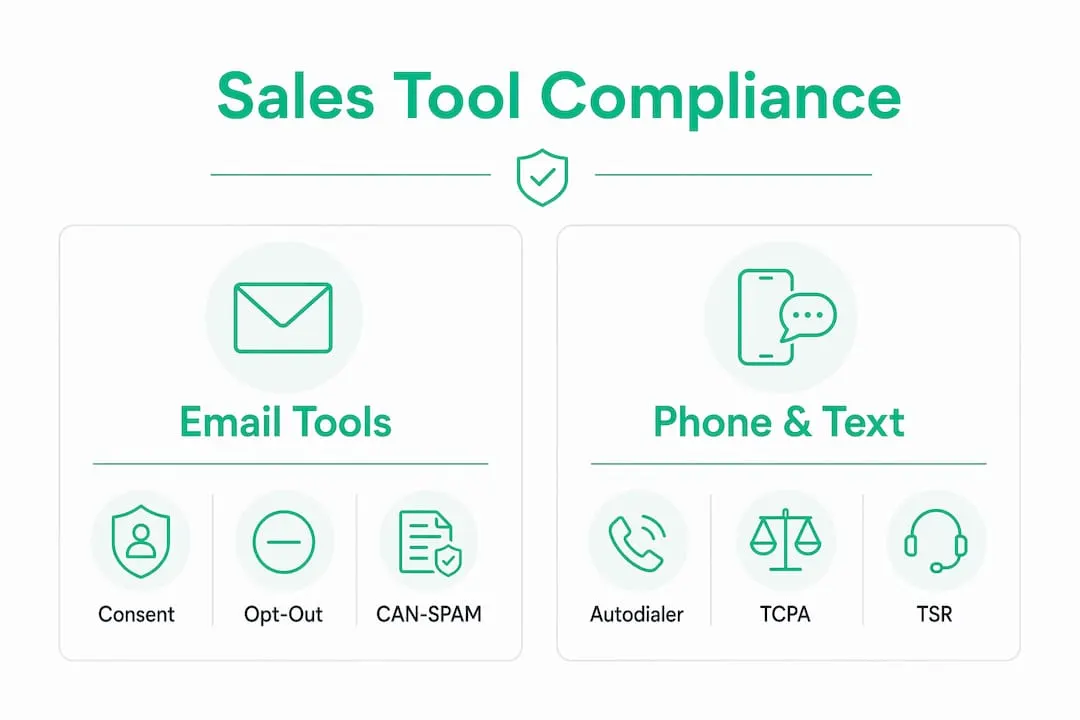
The most counterintuitive finding here is that tool technology classification determines legal exposure more than message content does. A sales rep manually dialing from a CRM operates under a different legal regime than a rep using a power dialer that qualifies as an autodialer under TCPA definitions. Legal review of your stack should focus on how each tool places calls or sends messages, not just what the scripts say.
AI-generated outreach adds a third layer of complexity. The EU AI Act mandates human oversight for AI-generated campaigns by August 2026, with transparency disclosures required at the campaign level. If your team uses tools like Apollo.io or Clay to generate personalized outreach at scale, you need campaign-level approval records and the ability to pause in-flight sequences. This applies to any company selling into the EU, regardless of where the company is headquartered.
Pro Tip: Before onboarding any new sales tool, ask the vendor directly: “Does this platform use an autodialer or automated system as defined under TCPA?” The answer changes your entire consent workflow.
What practical steps ensure your sales tools stay compliant?
Using sales tools legally requires more than reading a terms of service document. It requires configuring each platform to enforce compliance at the operational level. Here is a practical sequence for sales professionals and business owners.
-
Audit your tool stack by channel. List every tool that touches outbound communication: email sequencers, dialers, SMS platforms, LinkedIn automation tools, and AI content generators. Classify each by the technology it uses (autodialer, prerecorded voice, email API) and map it to the applicable law. This audit is the foundation of your compliance program.
-
Build suppression lists into every platform. Suppression infrastructure failures cause CAN-SPAM violations even when an unsubscribe link is present. Your opt-out list must sync across all tools in real time. If a prospect unsubscribes from a HubSpot sequence, that suppression must propagate to Outreach, your SMS platform, and any other tool touching that contact.
-
Configure consent collection before any autodialer or SMS campaign. Create consent forms that capture the prospect’s signature, the date, the specific sellers covered, and the communication channels authorized. Store these records in a CRM field or dedicated compliance database. For compliant LinkedIn prospecting, consent workflows look different but the documentation standard is the same.
-
Set calling hour restrictions in your dialer settings. Most enterprise dialers like Five9 and Dialpad allow you to configure time-zone-aware calling windows. Set these to enforce the 8 a.m. to 9 p.m. local time rule automatically. Do not rely on reps to self-police this.
-
Implement human oversight for AI-assisted campaigns. Deployers of AI outbound campaigns bear direct responsibility for oversight and disclosures, even when using third-party AI solutions. Assign a named reviewer to approve each AI-generated campaign before launch. Log the approval with a timestamp and the reviewer’s identity. Build a pause or override capability into your campaign workflow so you can stop in-flight sequences if a compliance issue surfaces.
-
Train your sales team on opt-out handling. Reps who manually receive opt-out requests by phone or email must know the 10-business-day processing window and must route those requests to your suppression system immediately. A verbal opt-out on a sales call carries the same legal weight as a written one.
For a deeper look at how these steps apply to B2B outreach specifically, the guide on compliant sales software covers platform-level configuration in detail.
What are the risks and common compliance pitfalls to avoid?
The financial exposure from sales tool violations is not theoretical. CAN-SPAM penalties reach $53,088 per violation, and TCPA class action settlements regularly reach into the millions. Beyond fines, enforcement actions generate public records that damage brand credibility with the enterprise buyers you are trying to reach.
The most common compliance failures in sales tool usage fall into four categories:
- Broken suppression infrastructure. An unsubscribe link in an email footer does not satisfy CAN-SPAM if the opt-out is not processed within 10 business days and propagated across all sending tools. Most violations occur at the suppression layer, not the message content layer.
- Misclassifying the technology. Sales teams often assume that because a tool is marketed as a “sales engagement platform,” it falls outside TCPA autodialer rules. Autodialer classification depends on technical function, not marketing language. If the tool dials numbers from a list without human initiation per call, it likely qualifies.
- Incomplete or stale consent records. Consent obtained two years ago for a different product or seller does not cover your current campaign. Consent must be specific, current, and documented.
- No human oversight for AI campaigns. Teams using AI tools to generate and send outbound sequences at scale without a review and approval step are already out of compliance with EU AI Act requirements taking effect in August 2026.
“The companies that get hit hardest are not the ones that ignored compliance entirely. They are the ones that had a compliance checkbox but never built it into their actual tool configuration.” This distinction matters because documentation without operational enforcement creates a false sense of security that makes violations more likely, not less.
Pro Tip: Run a quarterly compliance audit on your three highest-volume outreach tools. Pull a sample of 50 sent messages and verify that suppression, disclosures, and consent records are intact for each one.
Key takeaways
Sales tool compliance requires operational enforcement at the platform level, not just policy documentation or unsubscribe links.
| Point | Details |
|---|---|
| CAN-SPAM covers all commercial email | B2B cold email carries the same legal requirements as consumer email, with penalties up to $53,088 per violation. |
| Technology classification drives TCPA risk | Whether a tool qualifies as an autodialer determines consent requirements, regardless of message content. |
| Suppression must be system-wide | Opt-out requests must propagate across every sending platform within 10 business days. |
| EU AI Act applies by August 2026 | AI-generated outbound campaigns require campaign-level human oversight and approval records. |
| Consent records must be specific and current | Consent must name the seller, the channel, and the date. Generic or stale consent does not satisfy TSR or TCPA standards. |
Why compliance is actually your sales advantage
I have spent years watching sales teams treat legal compliance as a tax on their outreach volume. The instinct is understandable. Every opt-out rule, consent requirement, and disclosure obligation feels like friction on a process that is already hard enough. But the teams I have seen build durable, scalable outreach programs are the ones that treated compliance as a design constraint from day one, not an afterthought.
Here is what I have found to be true in practice: the discipline required to build compliant suppression lists, document consent, and configure tools correctly also produces cleaner data, better segmentation, and higher deliverability. A suppression list that is current and accurate is also a more precise targeting list. A consent workflow that captures specific intent produces warmer prospects. The legal requirement and the sales best practice are often the same action.
The area where I see the most avoidable risk right now is AI-generated outreach. Teams are deploying AI tools at scale without understanding that the EU AI Act places responsibility on the deployer, not the vendor. If you are using an AI tool to generate and send outbound sequences into European markets, you are the accountable party. Building a campaign approval layer is not bureaucracy. It is the minimum viable compliance posture for 2026.
The regulatory environment is moving faster than most sales tool vendors acknowledge. Staying current on TCPA case law, FTC enforcement priorities, and EU AI Act implementation timelines is part of the job now. The sales professionals who treat that as a competitive advantage will outperform those who treat it as a burden.
— Toinon
How Salesnavsplit supports compliant sales prospecting
Salesnavsplit provides official LinkedIn Sales Navigator seats at up to 50% off standard pricing, sourced through verified reseller partnerships in the US and Europe. Every seat is a genuine, licensed account that complies with LinkedIn’s terms of service, which matters directly for sales teams building compliant outreach workflows on LinkedIn. Using an unauthorized or shared credential creates legal and platform risk that no compliance program can offset.
For sales professionals and business owners who want to run effective LinkedIn prospecting without the overhead of full retail pricing, Salesnavsplit offers fast activation within two business hours European time, official invoicing through Stripe, and transparent pricing. You can review the terms of use to confirm how the licensing structure aligns with your compliance requirements before committing.
FAQ
What is the CAN-SPAM Act and does it apply to B2B sales email?
The CAN-SPAM Act applies to all commercial email messages, including B2B cold outreach, with no exception for business-to-business communication. Penalties reach up to $53,088 per violation, and every email must include a valid physical address, sender identification, and a working opt-out mechanism.
Do I need consent before sending cold sales emails?
CAN-SPAM does not require prior consent for commercial email, but it does require a functioning opt-out mechanism honored within 10 business days. Consent requirements become mandatory when using autodialers or prerecorded messages for calls and texts under TCPA and TSR.
What makes a sales tool an autodialer under TCPA?
A tool qualifies as an autodialer based on its technical function, specifically whether it dials numbers from a list without human initiation per call, not based on how the vendor markets it. This classification determines whether signed written consent is required before contacting prospects.
How does the EU AI Act affect AI-powered sales outreach?
The EU AI Act requires human oversight and campaign-level approval records for AI-generated outbound marketing, with full compliance required by August 2026. Companies selling into EU markets are responsible for this oversight even when using third-party AI tools.
What is the fastest way to reduce legal risk across my sales tool stack?
Build a system-wide suppression list that syncs opt-outs across every sending platform in real time, and audit each tool’s technology classification to confirm whether TCPA consent requirements apply. These two steps address the most common sources of enforcement exposure.
Recommended
- Sales tools checklist: Build your lean B2B outreach stack - SalesNavSplit Blog
- Stay compliant: smart sales tools for LinkedIn & B2B outreach - SalesNavSplit Blog
- What Is Compliant Sales Software: A Guide for Sales Pros - SalesNavSplit Blog
- The best types of B2B sales tools for smarter prospecting - SalesNavSplit Blog