
Legal License Sourcing: A Practical Guide for Executives
Legal License Sourcing: A Practical Guide for Executives
TL;DR:
- Legal license sourcing involves acquiring and managing licenses that ensure compliance with laws and regulations.
- It requires continuous audits, precise classification of licenses, and early engagement with regulators to prevent operational risks and legal liabilities.
Legal license sourcing is the process of acquiring and maintaining legally compliant software and operational licenses required to run a business without regulatory or legal exposure. Most executives treat licenses as paperwork. They are not. A license is an active legal permission, and losing it, or never properly obtaining it, can shut down operations, void acquisitions, and expose your company to liability. This guide to legal license sourcing covers the four major license categories, compliance audit workflows, regulated-industry considerations, and the most common mistakes that cost businesses time and money.
What types of software licenses exist and how do you categorize them?
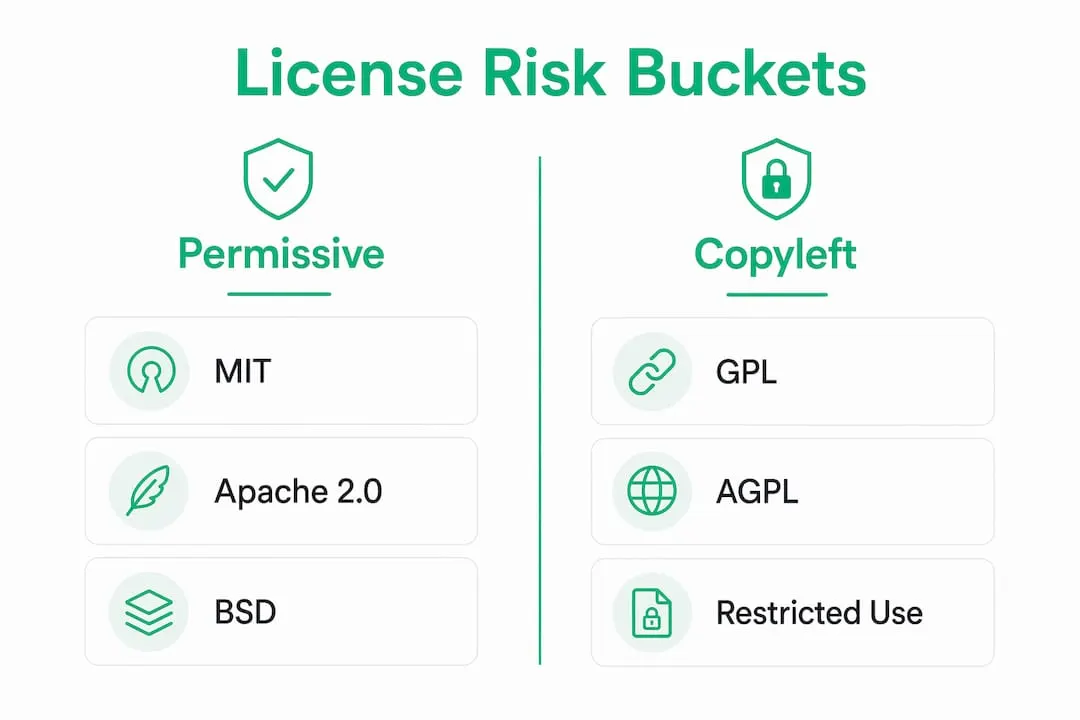
Software licenses fall into four risk buckets, and every package your business uses belongs in one of them. License risk categories are defined as: allowed, allowed-with-notice, restricted, and forbidden. Placing every dependency into one of these buckets before deployment is the foundation of any serious legal license procurement guide.
Permissive licenses: low risk, clear obligations
Permissive licenses like MIT, Apache 2.0, and BSD sit in the “allowed” or “allowed-with-notice” buckets. They require attribution, meaning you must include the original copyright notice in your product or documentation. The obligation is minimal, but ignoring it still constitutes a license violation.
Apache 2.0 adds one layer beyond MIT: it includes an explicit patent grant. That grant protects your business from patent claims by the original contributor. For commercial software, Apache 2.0 is generally the safer choice over plain MIT when patent exposure is a concern.
Copyleft licenses: high risk in commercial products

Copyleft licenses like GPL and AGPL sit in the “restricted” or “forbidden” buckets for most commercial use cases. GPL requires that any software incorporating GPL code must also be released under GPL. That obligation effectively bars GPL code from most proprietary products.
AGPL closes what engineers call the “SaaS loophole.” AGPL’s network trigger means that if your SaaS product runs AGPL code server-side and users interact with it over a network, you must publish your source code. Many engineering teams miss this because the software never ships to end users in the traditional sense. The risk is real and frequently underestimated.
| License Type | Examples | Key Obligation | Commercial Risk |
|---|---|---|---|
| Permissive | MIT, BSD | Attribution notice | Low |
| Permissive + Patent | Apache 2.0 | Attribution + patent grant | Low |
| Copyleft | GPL | Source code release | High |
| Strong Copyleft | AGPL | Source release on network use | Very High |
| Forbidden | SSPL, Commons Clause | Prohibits commercial use | Prohibited |
Pro Tip: Build a license policy document that maps each bucket to a clear approval workflow. “Allowed” licenses get auto-approved. “Restricted” licenses require legal sign-off before any engineer merges the dependency.
How do you implement an effective license compliance and audit process?
Compliance is not a one-time check. Continuous license auditing integrated into CI/CD pipelines is the industry standard for maintaining an auditable evidence trail. A single audit at project launch becomes outdated the moment a developer adds a new package.
The four-step audit workflow
-
Scan all dependency layers. Use tools like syft or cdxgen to generate a Software Bill of Materials (SBOM). An SBOM lists every package, its version, and its license. This document becomes your compliance evidence in audits and M&A due diligence.
-
Reconcile metadata sources. Package manager metadata, embedded license files, and source code headers sometimes disagree. The most restrictive license found in any of those three sources controls. Never rely on a single metadata field.
-
Flag transitive dependencies. Transitive dependency risks are the most common blind spot in license sourcing strategies. A package you approved may itself depend on a GPL library. Tools like
npm ls --allorpip-treeexpose the full dependency tree. Check it. -
Monitor version changes. A package may ship under MIT today and switch to AGPL in its next major release. License changes between versions introduce unexpected compliance risks that initial audits never catch. Set up automated alerts for version upgrades that alter license terms.
Pro Tip: Store your SBOM as a versioned artifact alongside your build outputs. When an auditor or acquirer asks for license compliance evidence, you hand them a file, not a spreadsheet built from memory.
Machine-readable license policies in formats like SPDX or YAML take this further. SPDX-formatted policies enable automated enforcement directly in your build pipeline, removing the friction between legal requirements and engineering workflows. Static PDFs sitting in a shared drive do not scale. Machine-readable formats do.
What are the key considerations when sourcing licenses in regulated industries?
Operational licenses in regulated industries are fundamentally different from software licenses. A cannabis dispensary license, a telecom operating permit, or a healthcare facility authorization is not a document you own. Licenses are active regulatory permissions tied to specific owners, governance structures, and operational conditions. That distinction changes everything in an acquisition or ownership transfer.
Change-of-control provisions and M&A risk
Most regulated licenses include change-of-control provisions. These clauses require the licensee to notify the relevant regulator and obtain approval before completing any ownership transfer. Closing a deal without that approval does not just create a compliance problem. It can void the license entirely, leaving the acquiring company with an asset it cannot legally operate.
Regulators in sectors like cannabis, healthcare, and telecom run on their own approval timelines. Regulatory approval timelines can delay a closing by months, and no amount of deal pressure accelerates them. Executives who treat license transfer as a post-closing task routinely discover this the hard way.
Fit-and-proper tests are the standard regulatory tool for evaluating incoming owners. Regulators assess the incoming owner’s integrity, financial stability, and governance capacity before approving any transfer. Failing this test after a deal closes is not a recoverable situation.
Industry-specific licensing risks in M&A require early engagement with regulators, not late-stage legal review. The practical steps for executives include:
- Identify every license the target company holds and classify each by transferability.
- Determine which licenses carry change-of-control provisions and map the approval timeline.
- Engage the relevant regulator before signing, not after.
- Build regulatory approval milestones into the deal timeline as hard conditions, not assumptions.
- Assign a dedicated point of contact for regulator communications throughout the process.
How do you avoid the most common pitfalls in legal license sourcing?
The most expensive mistakes in legal license acquisition share a common cause: teams treat licensing as a one-time task rather than a continuous process. The following best practices address the failure modes that appear most often across software and operational licensing contexts.
Audit transitive dependencies, not just direct ones. Most teams check the packages they explicitly install. They miss the packages those packages depend on. A single GPL library buried three levels deep in a dependency tree can trigger a source-release obligation across your entire codebase.
Do not assume SaaS exempts you from copyleft. This misconception is widespread among engineering teams. AGPL specifically closes the SaaS exemption. If your product uses AGPL code server-side, you have a copyleft obligation regardless of whether you distribute software to users.
Align licensing diligence with M&A timelines. License due diligence belongs at the start of deal structuring, not in the final weeks before closing. Discovering a non-transferable license or a pending regulatory review at the last minute creates leverage problems and can kill deals.
Maintain machine-readable policies. A license policy that lives in a PDF is a policy that engineers cannot enforce automatically. SPDX and YAML formats integrate directly into CI/CD pipelines and produce audit logs without manual effort.
Track license exceptions with expiration dates. When legal approves a restricted license for a specific use case, that approval should carry an expiration date and a named owner. Open-ended exceptions accumulate and become invisible compliance debt.
Pro Tip: Treat your license exception register the same way you treat security vulnerabilities. Assign a severity, an owner, and a remediation deadline. Review it quarterly.
Understanding why official licenses matter for business operations goes beyond legal compliance. Unofficial or gray-market licenses create audit exposure, vendor relationship risk, and potential service interruptions that official procurement eliminates entirely.
Key Takeaways
Legal license sourcing requires continuous auditing, early regulatory engagement, and machine-readable policies to prevent compliance failures across both software and operational licenses.
| Point | Details |
|---|---|
| Categorize every license | Assign each software dependency to an allowed, restricted, or forbidden bucket before deployment. |
| Audit transitive dependencies | Use tools like syft or cdxgen to expose hidden copyleft licenses buried in full dependency trees. |
| Treat operational licenses as active permissions | Engage regulators before any ownership transfer, not after closing, to avoid losing operating authority. |
| Use machine-readable policies | SPDX or YAML formats enable automated enforcement and produce audit-ready evidence without manual effort. |
| Monitor version changes continuously | A package can shift from MIT to AGPL between releases; automated SBOM diffing catches these changes early. |
Why I think most executives are solving the wrong licensing problem
Most of the licensing conversations I see inside companies focus on cost. Teams want cheaper licenses, faster procurement, and less friction with vendors. Those are real concerns. But the deeper problem is that most organizations have no clear owner for licensing compliance. Legal assumes engineering handles it. Engineering assumes legal approved it. Procurement closes the deal and moves on.
The result is a compliance gap that nobody sees until an audit, an acquisition, or a vendor dispute makes it visible. By then, the remediation cost dwarfs whatever was saved on procurement.
The executives who get this right treat licensing as an operational discipline, not a legal formality. They assign a named owner to the license register. They build compliance checks into engineering workflows rather than scheduling annual reviews. They engage regulators early in any deal that touches a regulated license. And they insist on official, verified licenses rather than gray-market alternatives that create liability without any of the cost savings they promise.
The compliance requirements for professional services organizations make this especially clear. When your business depends on licensed tools for client-facing work, an unofficial or non-compliant license is not just a legal risk. It is a reputational one.
Proactive compliance is cheaper than reactive remediation. That is not an opinion. It is the consistent finding of every licensing audit I have seen go sideways.
— Toinon
How Salesnavsplit approaches official license sourcing for sales teams
Salesnavsplit offers a direct solution for sales teams that need official LinkedIn Sales Navigator licenses without paying full retail price. The platform sources seats through verified reseller partnerships in the US and Europe, ensuring every seat is genuine, compliant with LinkedIn’s terms of service, and activated within 24–48 hours.
For executives focused on cost control without compliance risk, Salesnavsplit provides official invoicing through Stripe, transparent pricing, and a clear legal framework for every seat. You can review official Sales Navigator seats at up to 50% off standard pricing, or check the LinkedIn Sales Navigator discount page for current plans. If you want to understand exactly how the reseller model works before committing, the safety and legality overview covers the full compliance structure.
FAQ
What is legal license sourcing?
Legal license sourcing is the process of identifying, acquiring, and maintaining software and operational licenses that comply with applicable laws, vendor terms, and regulatory requirements. It covers both open-source software licenses and regulated industry permits.
What is the difference between permissive and copyleft licenses?
Permissive licenses like MIT and Apache 2.0 require attribution but allow commercial use without releasing your source code. Copyleft licenses like GPL and AGPL require you to release your source code if you distribute or, in AGPL’s case, serve the software over a network.
Why do regulated industry licenses require pre-closing regulatory approval?
Regulated licenses are active permissions tied to specific owners and governance structures. Change-of-control provisions require regulator approval before any ownership transfer; completing a deal without that approval can void the license and halt operations.
What is a Software Bill of Materials (SBOM) and why does it matter?
An SBOM is a structured list of every software component in a product, including its version and license. It serves as the primary compliance evidence in audits and M&A due diligence, and it enables automated license monitoring when stored as a versioned build artifact.
How often should a business audit its software licenses?
License audits should run continuously inside CI/CD pipelines rather than on a fixed annual schedule. Version upgrades can change license terms between releases, so automated scanning with tools like syft or cdxgen is the only reliable way to catch new obligations before they become violations.