
How to Identify Genuine Resellers for Business Purchases
How to Identify Genuine Resellers for Business Purchases
TL;DR:
- Verifying reseller authenticity involves checking official partner directories and cross-referencing business details to avoid counterfeit licenses. Genuine resellers display clear legitimacy signals such as secure websites, verified contact information, and consistent positive reviews. Slowing down and performing multi-point verification helps prevent falling for reseller fraud and unverified listings.
A genuine reseller is defined as an authorized, transparent seller who holds verifiable permission from the original brand or software provider to distribute its products. Knowing how to identify genuine resellers protects your business from counterfeit licenses, credential theft, and financial loss. The risks are real: unauthorized resellers often sell invalid licenses, cloned credentials, or products that violate the original vendor’s terms of service. Verification is not optional for businesses buying sales tools, software seats, or professional licenses. The standard industry term for this process is reseller due diligence, and it covers authorization checks, business legitimacy signals, and transaction history analysis.
How to verify a reseller’s authorization and official status
Authorization verification is the first and most decisive step in spotting real resellers. A reseller can use a brand name in their store title, their domain, or their marketing copy without holding any official relationship with that brand. That brand name alone is insufficient proof of authorization. Always start at the brand’s official website and look for a partner directory, authorized reseller list, or certified channel program.
Here is a practical sequence for confirming official status:
- Visit the brand’s official website. Search for a “Find a Reseller,” “Partner Directory,” or “Authorized Sellers” page. LinkedIn, for example, maintains records of its official channel partners.
- Cross-reference the seller’s name and business registration. The seller’s legal name on invoices must match what appears in the brand’s authorized list.
- Look for marketplace badges. Major platforms issue verified seller or brand-authorized badges. These are tied to account-level vetting, not self-declared.
- Confirm regional authorization. A reseller authorized in Germany may not hold authorization to sell in the United States. Cross-regional authorization varies by vendor agreement, so ask directly if the seller covers your region.
- Contact the brand directly. Send a short email to the vendor’s partner support team with the reseller’s name and ask for confirmation. Most legitimate vendors respond within one to two business days.
Understanding authorized partner listings shifts your verification workflow from reactive to proactive. You start from a confirmed list and work outward, rather than trusting a seller’s claims and trying to disprove them.
Pro Tip: Save the brand’s official partner directory URL as a bookmark. Before any purchase from a new reseller, open that page first. This single habit eliminates the majority of authorization fraud.

What business legitimacy signals tell you about a reseller
Business legitimacy signals are the operational details that separate credible sellers from fraudulent ones. Auditing five core criteria confirms whether an online seller is worth trusting: HTTPS security, verifiable contact details, diverse independent reviews, secure payment options with chargeback rights, and a clear returns policy. Failing two or more of these criteria strongly indicates a high-risk seller. That benchmark applies directly to resellers of software licenses and sales tools.
Key legitimacy signals to audit
- HTTPS and domain security. A valid SSL certificate is the baseline. Check that the padlock appears in the browser bar and that the domain does not mimic a brand name with slight misspellings.
- Physical address and verifiable contact details. A legitimate reseller lists a real business address, a working phone number, and a support email. Test the contact methods before you pay.
- Independent, cross-platform reviews. Reviews that appear only on the seller’s own website carry little weight. Look for consistent feedback on Google Business, Trustpilot, or LinkedIn company pages.
- Secure payment methods with dispute rights. Valid resellers use payment methods like credit cards or PayPal that offer consumer dispute protections. Wire transfers, cryptocurrency, or direct bank transfers offer no recourse if the transaction fails.
- Clear refund and return policy. A trustworthy reseller states its refund terms in plain language. Vague or absent policies are a warning sign.
The Better Business Bureau recommends that AI-generated review summaries supplement, not replace, official verifications from government registries, licensing boards, and recognized trustmarks. Use AI tools to speed your research, but confirm findings through official channels.
| Signal | What to check | Red flag |
|---|---|---|
| HTTPS security | SSL certificate active, domain spelling correct | Missing padlock, misspelled domain |
| Contact details | Address, phone, and email all verifiable | PO box only, no phone number |
| Customer reviews | Present on multiple independent platforms | Reviews only on seller’s own site |
| Payment options | Credit card or PayPal with dispute rights | Wire transfer or crypto only |
| Refund policy | Clear terms with timeline and process | Vague language or no policy listed |
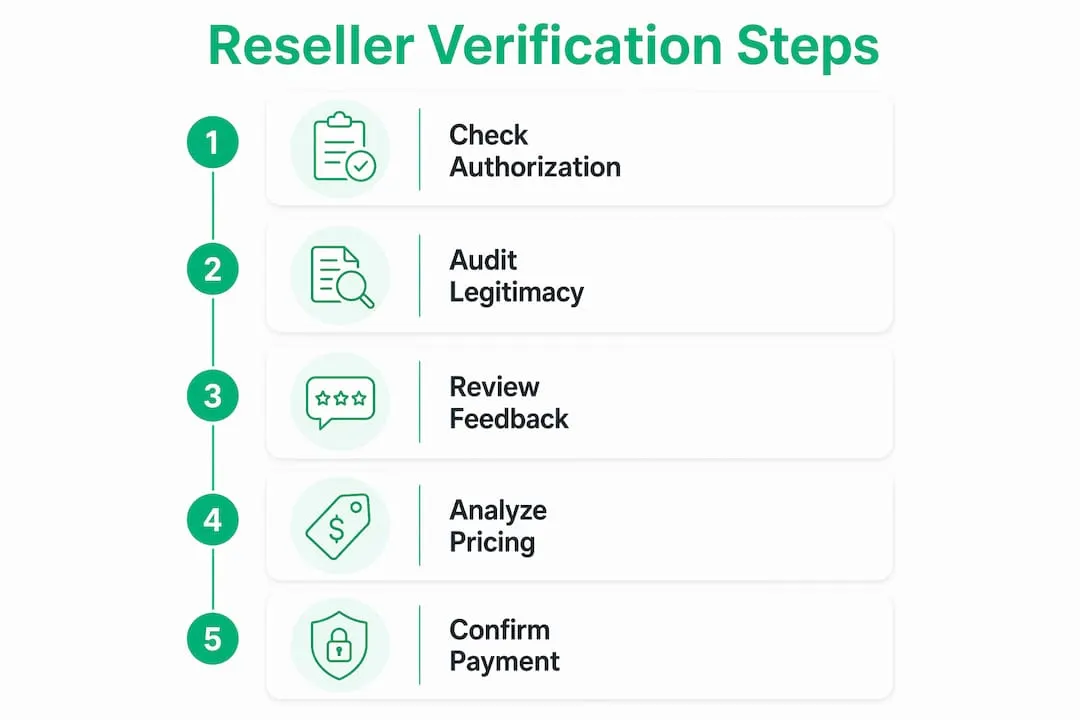
Pro Tip: Run the seller’s business address through Google Maps. A legitimate reseller’s address resolves to a real office or commercial space. A residential address or a vacant lot is a signal worth investigating further.
How to analyze reseller reviews and transaction history
Review analysis is where most buyers make mistakes. A high star rating is easy to manufacture. What is harder to fake is the specific detail found in genuine customer feedback. Genuine reviews mention specific product details, authentication steps, and return experiences. Generic praise like “Great seller, fast shipping” tells you almost nothing about whether the product was legitimate.
Look for these patterns when reading reseller reviews:
- Specificity. Real buyers describe the product they received, the activation process, or a support interaction. Vague praise is a signal of manufactured reviews.
- Review timing. A sudden cluster of five-star reviews posted within a short window is a classic “review dump.” Legitimate sellers accumulate feedback steadily over time.
- Negative review handling. Check how the seller responds to critical feedback. Professional, solution-focused replies indicate a real business. Defensive or dismissive responses do not.
- Cross-platform consistency. A seller with strong reviews on one platform but no presence elsewhere warrants skepticism. Authentic businesses leave traces across multiple channels.
- Long-term transaction records. On major marketplaces, authorized sellers maintain at least 95% positive feedback over sustained periods. New accounts with unexplained positive spikes are suspicious.
“Experienced buyers rely heavily on detailed reviews citing authentication or return experiences, which are harder to fake than generic praise. A review that walks through the unboxing, the license activation, and a support ticket carries more weight than a hundred five-star ratings with no context.”
One practical step that separates serious buyers from casual ones: request a timestamped verification photo from the reseller before completing the purchase. Seller refusal of this request is a near-definitive indicator of fraud. A legitimate reseller has the product or the license and will confirm it without hesitation.
What pricing and listing red flags reveal about a reseller
Price is the most visible signal, and it is also the most commonly misread one. A discount is not automatically suspicious. Authorized resellers often access volume pricing, regional pricing structures, or promotional agreements that allow them to offer genuine products below standard retail. The problem starts when the discount is extreme and unexplained. Prices more than 60% below official retail without a valid reason are a primary red flag for counterfeit or unauthorized products. That threshold applies directly to software licenses and sales tools.
Beyond price, listing quality reveals a great deal about a reseller’s legitimacy:
- Listing accuracy. Product descriptions, photos, and category placement must match the actual product. Mismatched images or descriptions copied from unrelated listings indicate replicated or fake stock.
- Inventory homogeneity. Sellers with many identical high-demand products listed simultaneously are suspect. Legitimate liquidators or authorized resellers have varied inventory that reflects real purchasing patterns.
- Evasive seller responses. Ask a specific question about the product, the license terms, or the activation process. A genuine reseller answers directly. Vague or deflecting responses indicate the seller lacks real knowledge of the product.
- Off-platform transaction requests. Any seller who asks you to complete the deal via personal email, WhatsApp, or a separate payment link is bypassing the platform’s buyer protections. This is a consistent pattern in reseller fraud.
- Unusual payment demands. Requests for wire transfers, gift cards, or cryptocurrency in exchange for software licenses are definitive warning signs.
Pro Tip: Before buying a software license from a reseller, search the exact product name plus “authorized reseller” on the vendor’s official site. If the seller does not appear, treat the listing as unverified regardless of how professional it looks.
Key Takeaways
Identifying legit resellers requires verifying authorization, auditing business legitimacy signals, and analyzing review specificity before any purchase.
| Point | Details |
|---|---|
| Start with authorization | Check the brand’s official partner directory before trusting any reseller claim. |
| Audit five legitimacy signals | HTTPS, contact details, independent reviews, secure payments, and clear refund policy all matter. |
| Read reviews for specificity | Genuine reviews describe authentication steps and return experiences, not just star ratings. |
| Watch pricing thresholds | Prices more than 60% below retail without explanation signal unauthorized or counterfeit products. |
| Demand verification proof | Request a timestamped photo or license confirmation. Refusal is a definitive red flag. |
What I have learned from vetting resellers the hard way
The biggest mistake I see businesses make is treating reseller verification as a one-time check. They confirm the seller’s name against a brand directory, see a match, and stop there. That is not enough. Authorization status changes. Resellers lose their certified status, get acquired, or let their agreements lapse. A seller who was legitimate six months ago may not be today.
The second mistake is over-relying on a single trust signal. A professional website does not mean the business is real. A high review count does not mean the reviews are genuine. A low price does not mean the product is counterfeit. Each signal only carries weight when it is confirmed by two or three others. I use a personal checklist that covers authorization, payment safety, review specificity, and direct contact verification. No single item on that list closes the deal alone.
Regional nuances matter more than most buyers realize. A reseller authorized to distribute software licenses in Europe may operate under different compliance rules than one based in the United States. Buyer protections vary by jurisdiction, and so does the enforceability of refund claims. When buying official licenses for sales tools used across borders, confirm that the reseller’s authorization covers your specific region and that your payment method gives you dispute rights under your local consumer protection framework. Understanding the LinkedIn reseller model in detail before purchasing is one of the most practical steps a B2B buyer can take.
The uncomfortable truth is that most reseller fraud succeeds because buyers are in a hurry. Slowing down by even 20 minutes to run a proper multi-point check eliminates the vast majority of risk.
— Toinon
Salesnavsplit offers verified LinkedIn Sales Navigator seats
Businesses that need LinkedIn Sales Navigator at a lower cost without sacrificing security have a direct option in Salesnavsplit. The platform provides official Sales Navigator seats sourced through verified reseller partnerships in the US and Europe, at approximately 50% below standard LinkedIn pricing.
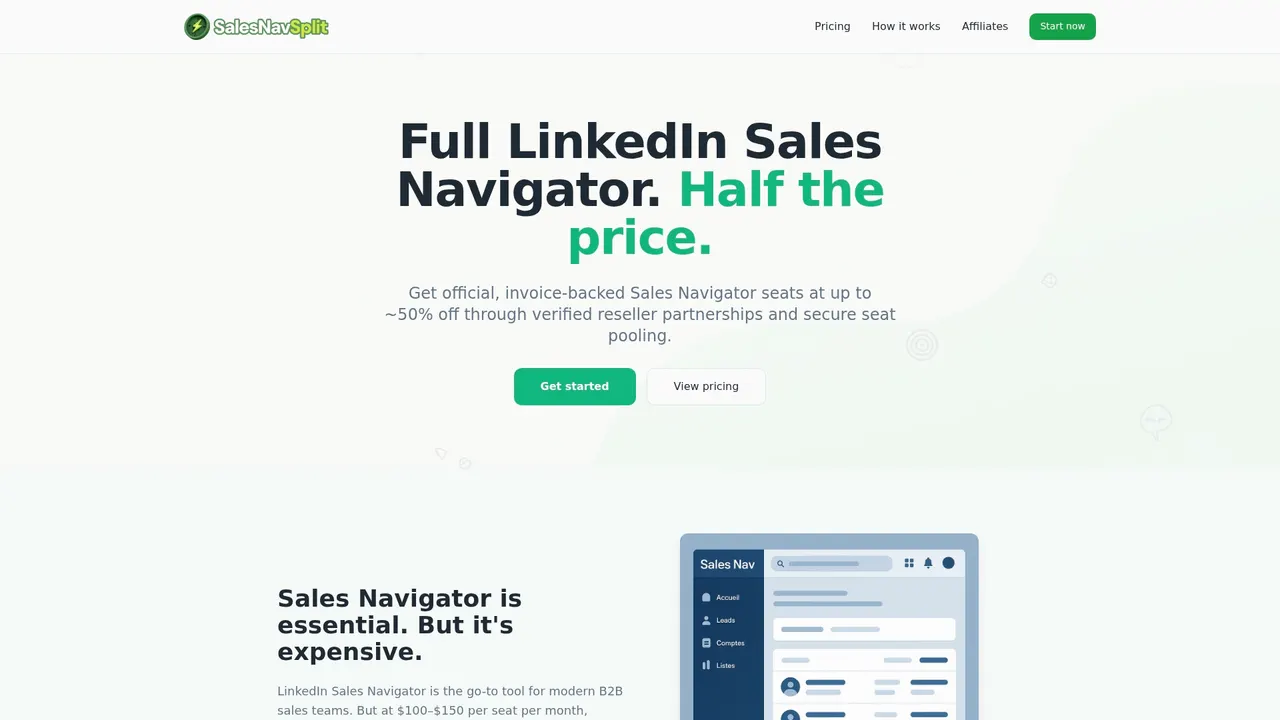
Every seat comes with official invoicing through Stripe, activation within 24–48 hours, and full compliance with LinkedIn’s terms of service. Payment runs through Stripe, which means you retain standard dispute rights on every transaction. Salesnavsplit publishes its reseller model and safety practices openly, so you can verify the authorization structure before committing. For teams that want a discounted Sales Navigator license without the risk of unauthorized credentials, Salesnavsplit is a straightforward, documented option.
FAQ
What makes a reseller genuinely authorized?
A genuinely authorized reseller holds a formal agreement with the original brand or software vendor and appears in that vendor’s official partner directory. Authorization is verifiable directly through the brand’s website or partner support team.
How do I spot fake reviews on a reseller’s profile?
Fake reviews tend to be generic, clustered in short time windows, and absent from independent platforms. Genuine reviews describe specific product details, activation steps, or support interactions that are difficult to fabricate at scale.
What payment methods confirm a reseller is legitimate?
Legitimate resellers accept credit cards or PayPal, both of which offer consumer dispute protections. Requests for wire transfers, cryptocurrency, or gift cards are consistent indicators of fraud.
Is a big price discount always a red flag?
Not always. Authorized resellers can access volume or regional pricing that allows genuine discounts. The threshold to watch is a price more than 60% below official retail without a clear, verifiable explanation.
How do I verify a reseller’s authorization quickly?
Go directly to the brand’s official website, find the authorized partner or reseller directory, and search for the seller’s legal business name. If the name does not appear, contact the brand’s partner support team for confirmation before purchasing.
Recommended
- What is a LinkedIn reseller? Guide to saving on Sales Navigator - SalesNavSplit Blog
- LinkedIn Reseller Explained: Save on Sales Navigator Safely - SalesNavSplit Blog
- Sales licenses explained: What B2B sellers need to know - SalesNavSplit Blog
- Is SalesNavSplit Safe & Legal? How the Reseller-Seat Model Works | SalesNavSplit