
Top B2B Sales Tactics 2026 to Win More Deals
Top B2B Sales Tactics 2026 to Win More Deals
TL;DR:
- Effective B2B sales strategies in 2026 focus on signal-based outbound, multi-threading, and value-based selling supported by disciplined pipeline hygiene. Reps build credibility through social selling and utilize AI for personalized outreach, emphasizing relevance over volume. Successful teams measure and scale proven tactics while maintaining strong sales-marketing alignment and post-sale expansion practices.
B2B sales in 2026 looks nothing like it did five years ago. Buyers do their own research, ignore generic outreach, and expect reps to know their business before the first call. If you’re trying to figure out which of the top b2b sales tactics 2026 actually move the needle versus which ones just burn your team’s time, you’re asking exactly the right question. This article breaks down the tactics that consistently lift win rates and pipeline velocity, with specific execution steps you can put to work this quarter.
Table of Contents
- Key takeaways
- 1. How to select the top b2b sales tactics in 2026
- 2. Signal-based outbound prospecting
- 3. Multi-threading: engaging multiple stakeholders per deal
- 4. Social selling on LinkedIn
- 5. AI-powered personalization and omnichannel outreach
- 6. Value-based selling and consultative discovery
- 7. Sales-marketing alignment, pipeline hygiene, and post-sale expansion
- My take on what actually works in 2026
- Upgrade your prospecting with the right tools
- FAQ
Key takeaways
| Point | Details |
|---|---|
| Signal-based outbound works | Target prospects showing real buying signals to increase relevance and response rates. |
| Multi-threading protects deals | Engaging 3 or more stakeholders per deal can improve win rates by up to 30%. |
| AI boosts reps, not replaces them | Use AI to reclaim admin time and personalize outreach, but always add human judgment. |
| Pipeline hygiene drives close rates | Removing deals stuck beyond 45 days can lift close rates by 20 to 40% in a single quarter. |
| Alignment multiplies results | Sales and marketing sharing KPIs and content strategy shortens cycles and increases retention. |
1. How to select the top b2b sales tactics in 2026
Not every tactic belongs in every playbook. Before adding something new to your process, run it through a short filter:
- ICP fit: Does this tactic reach the exact buyers you close? A tactic that works for enterprise software AEs may not suit a founder selling professional services to mid-market.
- Deal size match: High-touch tactics like executive briefings make sense for six-figure deals. For smaller deals, the math doesn’t hold.
- Buyer-centricity: 61% of buyers prefer doing initial research without a rep. Any tactic that pushes too early disrupts that preference and costs you the relationship.
- AI readiness: Can this tactic be partially automated without losing the personal relevance that makes it work?
- Measurability: If you can’t tie the tactic to win rate, pipeline velocity, or revenue expansion, you can’t scale it intelligently.
Pro Tip: Run a quarterly tactic audit. Score each method your team uses against these five criteria and drop anything that scores below three out of five. Most teams are running six tactics when three would close more revenue.
2. Signal-based outbound prospecting
Cold outbound died. Signal-based outbound is what replaced it. The core idea is simple: instead of blasting every company in your ICP with the same sequence, you trigger outreach based on events that indicate real buying intent.
Useful signals include a funding announcement, a new VP of Sales joining, a tech stack change detected through a tool like Bombora or G2, or a company expanding into a new market. These events create a natural reason to reach out, and they make your opening line feel relevant rather than random.
Hyper-personalization that references specific triggers like these increases conversion rates meaningfully. The practical step is to set up automated signal alerts in your CRM or a dedicated intent platform, then route those alerts to the right rep within 24 hours. Speed matters. A signal that is two weeks old is barely worth using.
Pro Tip: Build a signal playbook with specific messaging templates for each trigger type. A “new CRO” signal warrants a completely different email than a “tech install” signal. Don’t let reps improvise every time.
3. Multi-threading: engaging multiple stakeholders per deal
Single-threaded deals are fragile. Your champion leaves, changes roles, or loses internal support, and the deal collapses with no backup. Multi-threading solves this by deliberately mapping and engaging multiple contacts across the buying committee from early in the cycle.

Engaging 3 or more stakeholders improves win rates by up to 30%. That number alone should change how you structure your discovery calls. When you meet a champion, your immediate goal is to understand the org chart and get introductions to the economic buyer, the end users who will advocate internally, and any technical evaluators who can veto the deal.
LinkedIn Sales Navigator makes this significantly easier. You can map the buying committee, track job changes among key contacts, and get alerts when new stakeholders join the account. For teams that do this at scale, having access to Sales Navigator tools built specifically for stakeholder tracking is worth the investment.
4. Social selling on LinkedIn
Social selling is not posting content and hoping prospects notice you. Done correctly, it is a deliberate process of building credibility with your ICP before they ever enter a formal sales cycle.
78% of salespeople using social selling outsell peers who don’t. The mechanics behind that stat involve consistent activity: commenting substantively on posts from target accounts, sharing original perspectives on problems your buyers face, and using LinkedIn messaging to build relationships before pitching anything.
The sequence matters. Follow a prospect’s activity for two to three weeks, engage with their content, then reach out with a message that references something specific they shared. Referrals earned through these warm social relationships convert at 3 to 5 times the rate of cold outbound and close 35% faster. Yet fewer than 30% of B2B teams run a formal referral program. That gap is an opportunity you can take this quarter.
5. AI-powered personalization and omnichannel outreach
AI is now embedded in most sales stacks. 96% of marketers and sales leaders use AI, and 45% report efficiency gains that reduce the productivity gap by roughly $270,000 per rep. Those numbers reflect real workflow changes, not experimentation.
The practical application for outbound is this: use AI to draft the first version of a personalized email that references a specific signal, then have the rep edit it with genuine insight before sending. The AI saves time. The human edit saves credibility. Skipping the human review is where most teams go wrong. Generic AI outreach is easy to spot and even easier to delete.
For omnichannel execution, buyers touch an average of 10 interaction channels during their buying journey. A coordinated approach assigns each channel a specific role:
- Email: detailed value propositions and case studies
- LinkedIn: relationship building and signal monitoring
- Phone: high-priority follow-up on opened content or meeting no-shows
- Digital deal rooms: asynchronous collaboration with the buying committee
Pro Tip: Run a message consistency audit across channels every 30 days. If your email sequence, LinkedIn messages, and call scripts tell different stories about your value proposition, you are creating confusion inside the buyer’s organization. Tag all interactions in your CRM by channel and review for coherence.
You can go deeper on this in Salesnavsplit’s breakdown of outreach tactics for 2026.
6. Value-based selling and consultative discovery
Feature-led selling loses to competitors who speak the buyer’s financial language. Value-based selling reframes every conversation around what it costs the prospect to not solve the problem.
Here is a practical four-step discovery framework for AEs who want to sell this way:
- Diagnose before prescribing. Ask about current processes, team structure, and existing tools before mentioning your product. Understand their KPIs.
- Quantify the cost of inaction. If a prospect’s team spends 10 hours per week on a task your product automates, calculate the annual cost in salary. Make the number concrete.
- Map to business outcomes. Connect your product’s capabilities to metrics the economic buyer cares about: revenue, retention rate, margin, or headcount efficiency.
- Build a proof pack. Assemble case studies, ROI models, and reference contacts that match the prospect’s industry and deal size. Give your champion the ammunition to sell internally.
Objections at this stage are almost always one of four types: budget, stakeholder alignment, competitive consideration, or timing. Each has a specific counter. For budget objections, return to the cost-of-inaction number. For timing objections, identify what external event would make the problem more urgent and frame your solution around that event.
Pro Tip: Coach AEs to listen for the phrase “we’re not ready yet.” That usually means there is no internal champion making the case. Your job is to help your contact build that internal business case, not to wait for them to figure it out alone.
7. Sales-marketing alignment, pipeline hygiene, and post-sale expansion
These three practices are where sustainable revenue growth actually lives. Most teams treat them as separate workstreams. The best teams treat them as one system.
Sales-marketing alignment
Shared KPIs between sales and marketing are the foundation. When marketing measures lead volume and sales measures close rate, the incentives conflict. When both teams measure pipeline velocity and revenue, they cooperate. Joint content calendars tied to buyer stages, coordinated ABM campaigns, and weekly pipeline reviews with both functions in the room are the operational mechanics that make alignment real.
Pipeline hygiene
Deals stuck beyond 45 days need a clear next step or they need to be removed from the forecast. Teams that enforce this rule consistently see close rate improvements of 20 to 40% within a single quarter. The discipline feels painful. The results are not.
| Metric | What it tells you |
|---|---|
| Pipeline velocity | How fast deals move from stage to stage |
| Win rate by stage | Where deals are stalling or dying |
| CAC vs. LTV ratio | Whether you’re acquiring customers at sustainable cost |
| Net Revenue Retention | How well post-sale expansion is performing |
| Days in stage | Flags stuck deals before they kill your forecast |
Post-sale expansion
Top-performing AEs own the full customer lifecycle, including cross-sell, upsell, and renewals. The hunter-farmer model is back, driven by data showing that AEs with skin in the game on Net Revenue Retention close expansions faster than siloed CS teams. The practical step is to schedule quarterly account mapping sessions where AE and CS identify one expansion opportunity per active account and assign an owner before leaving the room.
For deeper guidance on managing this in your CRM, the Salesnavsplit guide on B2B pipeline management covers this with LinkedIn-specific workflows.
My take on what actually works in 2026
I’ve watched teams adopt every shiny tactic and underinvest in the fundamentals that actually compound. Here is what I’ve found to be consistently true.
Multi-threading and tight pipeline hygiene together are more powerful than any single new tactic. When you protect deals by diversifying your stakeholder relationships and you keep your forecast clean of dead weight, your win rate math improves even before you layer in AI tools.
The AI personalization piece is real, but the risk is that AI can reclaim up to 72% of reps’ time from admin tasks only if the saved time goes toward higher-quality conversations. I’ve seen teams use that efficiency to send more generic outreach at higher volume. That is the wrong direction. 73% of buyers actively avoid irrelevant outreach. More volume without more relevance just accelerates the unsubscribe.
What I respect most in 2026 is the sales leader who keeps their team focused on a short list of proven tactics, measures them with discipline, and scales only what the data justifies. The teams trying to run ten b2b sales strategies 2026 simultaneously are losing to the teams running three of them exceptionally well.
— Toinon
Upgrade your prospecting with the right tools
If these b2b sales tactics 2026 resonate with the way you want to build your pipeline, LinkedIn Sales Navigator is the most direct way to execute them. It powers signal-based outbound, multi-threading visibility, and social selling at scale. The problem most sales teams face is the cost.
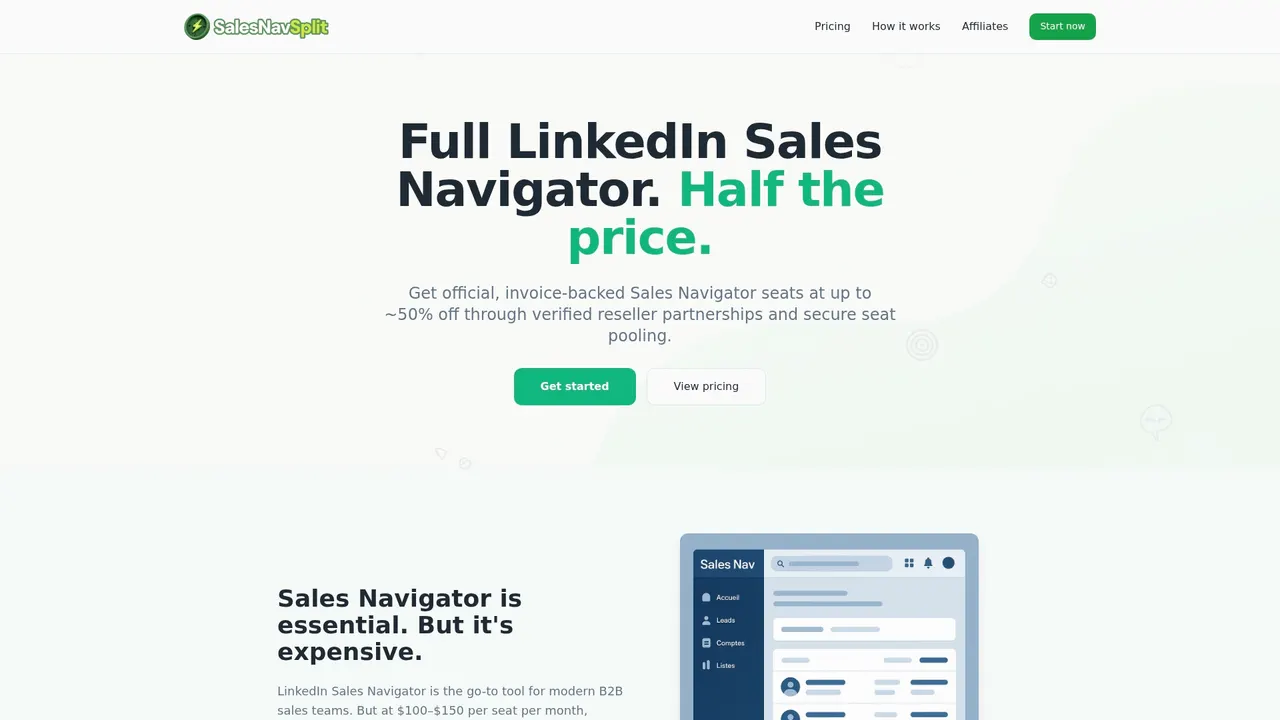
Salesnavsplit offers official Sales Navigator licenses at up to 50% off standard pricing, sourced through verified reseller partnerships in the US and Europe. Seats are genuine, LinkedIn-compliant, and activate within two business hours European time. If your team has been running B2B selling tips 2026 without the tools to back them up, this is the practical fix that doesn’t require a six-figure software budget.
FAQ
What are the most effective B2B sales tactics in 2026?
Signal-based outbound, multi-threading, and value-based selling are consistently the top performers. Teams that combine these with disciplined pipeline hygiene see the largest gains in win rate and pipeline velocity.
How does multi-threading improve B2B win rates?
Engaging three or more stakeholders per deal improves win rates by up to 30% by reducing dependence on a single champion and giving your solution more internal advocates during the buying process.
Why does pipeline hygiene matter so much for B2B sales?
Removing deals stuck beyond 45 days from your active forecast can lift close rates by 20 to 40% in a quarter. It keeps forecasts accurate and forces reps to focus energy on deals that can actually close.
How should AI be used in B2B outreach without hurting response rates?
Use AI to draft personalized outreach based on specific buying signals, then have a rep edit the message with genuine context before sending. Generic AI-generated messages are easy to spot and damage sender reputation over time.
What role does LinkedIn play in B2B sales strategies in 2026?
LinkedIn supports social selling, stakeholder mapping, signal monitoring, and warm outreach at scale. Sales Navigator in particular gives reps the filters and alerts needed to run multi-threaded deals and smart LinkedIn strategies across large accounts efficiently.