
The Role of Savings for Marketing Agencies
The Role of Savings for Marketing Agencies
TL;DR:
- Agency savings are cash reserves used to bridge revenue gaps, fund payroll, and manage client delays. Improving billing practices and setting aside automated savings enable agencies to build stronger reserves for operational stability and growth. Maintaining separate accounts and adjusting savings targets based on risk enhances financial resilience and strategic decision-making.
Agency savings are defined as cash reserves held separately from operating funds, specifically to absorb revenue gaps, fund payroll during slow periods, and protect the business from client payment delays. The role of savings for marketing agencies goes well beyond a rainy-day fund. Agencies face structural cash flow problems that most businesses do not: clients pay on Net-30 to Net-90 terms while payroll runs every two weeks, and project revenue can vanish overnight when a client churns. Industry benchmarks from Alto Accounting recommend a minimum cash buffer of 3–4 months of fixed overhead, with high-risk agencies targeting 10–30% of annual revenue in reserves. Getting this right is one of the most consequential financial decisions an agency owner makes.
How do client payment terms affect the need for savings?
The structural mismatch between when agencies pay and when clients pay is the root cause of most agency cash flow problems. Your team gets paid every two weeks. Your clients pay in 30, 60, or 90 days. That gap does not fix itself, and savings are what keep the lights on while you wait.
Biweekly payroll versus Net-90 billing creates a timing gap that forces agencies to fund operations from reserves rather than current revenue. The practical effect is that an agency billing $50,000 in january may not collect that cash until april. Without reserves, the agency borrows, delays vendor payments, or cuts staff.
Billing structure is the fastest lever to pull before savings can catch up. Agencies that require 30–50% upfront deposits on project work improve their cash runway by 30–60 days. That single change, accepted by more than 95% of clients, can reduce the immediate pressure on reserves while the agency builds its buffer over time.
Retainer billing advances work similarly. Billing a monthly retainer on the first of the month rather than the last shifts cash collection forward by up to 30 days. That is not a small adjustment. For an agency with $200,000 in monthly retainer revenue, it means $200,000 more in the bank at any given moment.
- Upfront deposits (30–50%): Collect before work begins. This is the single fastest way to close the payroll-to-payment gap.
- Retainer billing advances: Bill at the start of the period, not the end. Clients rarely push back when the contract is clear.
- Net-30 payment terms as a standard: Stop accepting Net-60 or Net-90 by default. Negotiate shorter terms at contract signing, not after the relationship is established.
- Late payment penalties: Include them in every contract. Agencies that charge late fees collect faster.
Pro Tip: Billing structure changes can improve cash flow more immediately than months of savings accumulation. Fix your billing terms first, then build your reserves on top of that stronger foundation.
What is the recommended savings target for marketing agencies?
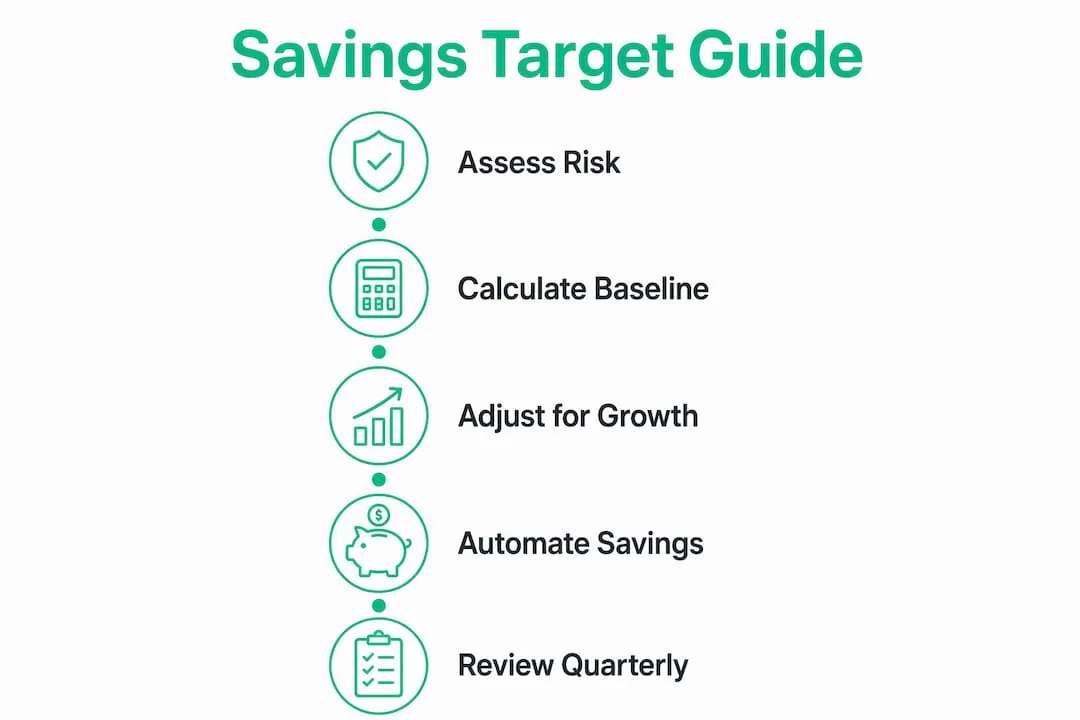
The right savings target depends on your risk profile, not a single universal number. A baseline reserve covers 3–4 months of fixed overhead. Fixed overhead includes payroll, rent, software subscriptions, and any recurring costs that continue regardless of revenue.
The formula works like this: multiply your monthly fixed costs by your target coverage months, then add a risk adjustment for client concentration and payment terms. If your largest client represents more than 25% of your revenue, or if your average payment terms extend to 90 days, reserve needs increase to 6 or more months of fixed expenses. That is not conservative. That is the math of what happens when a concentrated client churns or goes slow-pay.
| Risk Profile | Client Concentration | Payment Terms | Recommended Reserve |
|---|---|---|---|
| Low risk | Under 15% per client | Net-30 or faster | 3–4 months fixed overhead |
| Medium risk | 15–25% per client | Net-30 to Net-60 | 4–6 months fixed overhead |
| High risk | Over 25% per client | Net-60 to Net-90 | 6+ months or 10–30% of annual revenue |
| Growth phase | Any | Any | Add $80,000–$120,000 for each revenue doubling |
Growth deserves its own line in this table. Scaling from $1M to $2M in revenue requires additional working capital of roughly $80,000–$120,000 to pre-fund payroll and overhead before the new revenue is collected. Agencies that treat growth as a cash-positive event get blindsided. Growth consumes cash before it generates it.
The practical method to build toward these targets is automated allocation. Set aside 5–10% of every client payment the moment it lands in your account, transferred automatically to a dedicated savings account. This removes the decision from your hands and prevents reserves from being absorbed into operating cash flow before you notice.
Pro Tip: Calculate your reserve target quarterly, not annually. Client concentration and payment terms shift, and your target should shift with them. A quarterly review takes 20 minutes and keeps your savings goal calibrated to actual risk.
What practical methods can agencies use to build and protect savings?
Building savings requires a system, not willpower. The most common reason agency reserves stay at zero is that cash sits in a single operating account where it gets spent before anyone decides to save it.

Segregated savings accounts are the first requirement. Mixing reserves with operating funds leads to what financial advisors call “silent consumption.” The money disappears into payroll, vendor payments, and software renewals without anyone making a deliberate decision to spend it. A separate account, ideally at a different bank or in a money market account, creates a physical barrier that forces intentional withdrawal.
Automated transfers are the second requirement. Set a rule: every time a client payment clears, a fixed percentage moves to savings automatically. Most business banking platforms support this. The automation removes human error and ensures the reserve grows consistently even during busy periods when financial discipline is hardest to maintain.
- Treat savings as a non-negotiable expense. Put it in your budget as a line item, not a leftover. If savings only happen when there is money left over, they never happen.
- Use windfalls deliberately. When a large project closes or a client pays a lump sum, allocate a defined percentage to reserves before spending anything else.
- Maintain a credit line as a backup, not a substitute. A business line of credit covers short-term gaps but should not replace cash reserves. Interest costs erode margins, and lenders reduce credit lines exactly when you need them most.
- Review the reserve balance monthly. Knowing the number keeps it real. Agencies that track reserves monthly make better decisions about hiring, spending, and client acquisition.
Understanding the CFO’s role in cash management is worth studying even if you do not have a full-time CFO. The discipline of separating reserve planning from day-to-day cash decisions is a CFO-level habit that any agency owner can adopt.
Pro Tip: Open your savings account at a separate institution from your operating account. The friction of a manual transfer adds one extra step that prevents impulsive withdrawals during stressful weeks.
How do savings give marketing agencies a strategic advantage?
Savings create what financial planners call “strategic optionality.” That is the ability to make decisions based on what is right for the business rather than what is financially desperate. Agencies with strong reserves can walk away from bad-fit clients, hold firm on pricing, and invest in growth without borrowing.
The negotiating power that comes from financial stability is real and measurable. An agency owner who needs every client to make payroll cannot afford to fire a difficult client or push back on a price reduction request. An agency with six months of reserves can make that call without panic. That difference shows up in client quality, team morale, and long-term revenue.
Agencies with aligned CMO-CFO metrics and solid cash reserves see double the revenue growth compared to agencies where marketing and finance operate in silos. Financial stability is not just a defensive posture. It is a growth accelerator. (Bain & Company, cited in strategic agency savings research)
Savings also support better client acquisition decisions. Agencies that are not cash-constrained can afford to be selective, pursue longer sales cycles with larger clients, and invest in prospecting tools that pay off over months rather than weeks.
One caution: savings do not fix a profitability problem. If your gross margins fall below 50–60% or your utilization rates are poor, savings mask the symptom but do not treat the cause. Reserves are a buffer, not a business model. Agencies that use savings to survive low-margin work indefinitely end up depleting reserves without ever fixing the underlying issue.
Key Takeaways
Savings are the foundation of agency financial health, enabling both operational stability and the strategic freedom to grow on your own terms.
| Point | Details |
|---|---|
| Minimum reserve target | Hold 3–4 months of fixed overhead as a baseline cash buffer at all times. |
| Risk-adjusted reserves | Increase reserves to 6+ months if any client exceeds 25% of revenue or pays on Net-90 terms. |
| Automate contributions | Transfer 5–10% of every client payment to a dedicated savings account automatically. |
| Segregate accounts | Keep reserves in a separate account to prevent silent consumption during busy periods. |
| Savings enable strategy | Strong reserves let you drop bad-fit clients, hold pricing, and invest in growth without borrowing. |
Why most agency owners get savings backwards
Most agency owners I have worked with think about savings the wrong way. They treat reserves as what is left after all the bills are paid. That framing guarantees the reserve stays at zero, because there is always another bill.
The mindset shift that actually works is treating savings as the first expense, not the last. Before payroll, before software, before anything: a percentage of every payment goes to reserves. That sounds rigid, but it is the only approach that works consistently. Willpower and good intentions do not survive a stressful quarter.
The other mistake I see constantly is using a single bank account for everything. Agency owners look at their balance, see $80,000, and feel comfortable. What they do not see is that $60,000 of that is earmarked for payroll, vendor payments, and taxes due next month. The visible number is not the real number. Segregated accounts make the real number visible.
The agencies that handle financial pressure best are not the ones with the highest revenue. They are the ones that built boring, automated savings habits early and never stopped. A $500,000 agency with four months of reserves is in a stronger position than a $2M agency living paycheck to paycheck. That is not a hypothetical. I have seen it play out repeatedly.
Savings also change how you sell. When you are not desperate for revenue, you pitch better clients, negotiate better terms, and close deals that actually improve your margins. Financial stability is a sales advantage that most agency owners never think to connect to their sales team growth.
— Toinon
How Salesnavsplit supports smarter agency financial decisions
Marketing agencies that build strong cash reserves also need reliable, cost-effective tools to keep their sales pipelines full. Predictable new business reduces the client concentration risk that drives reserve requirements higher in the first place.
Salesnavsplit provides authorized LinkedIn Sales Navigator seats at approximately 50% off standard pricing, through verified reseller partnerships in the US and Europe. For agency owners managing tight budgets, that cost reduction directly improves the margin available to fund reserves. Every dollar saved on a sales tool is a dollar that can go toward your cash buffer. Salesnavsplit seats are genuine, compliant with LinkedIn’s terms of service, and activate within 24–48 hours. Explore the full Sales Navigator options to find the right fit for your agency’s prospecting needs, or check the current Sales Navigator discount to see exactly what you would save.
FAQ
What is the minimum savings target for a marketing agency?
The minimum cash reserve for a marketing agency is 3–4 months of fixed overhead costs. Agencies with high client concentration or long payment terms should target 6 or more months.
How does client concentration affect how much an agency should save?
When a single client represents more than 25% of revenue, reserve requirements increase significantly. Losing that client creates an immediate cash shortfall that only a larger reserve can absorb without layoffs or borrowing.
Why should agency savings be kept in a separate account?
Mixing reserves with operating funds leads to silent consumption, where reserves disappear into routine expenses without any deliberate decision to spend them. A segregated account makes the reserve visible and harder to accidentally deplete.
Can billing changes reduce how much savings an agency needs?
Yes. Requiring 30–50% upfront deposits and billing retainers at the start of the month can improve cash runway by 30–60 days. Better billing terms reduce the gap that savings must cover, though reserves remain necessary for unexpected client losses.
Do savings fix an agency’s profitability problems?
Savings do not fix low margins or poor utilization rates. Target gross margins of 50–60% are the real fix for profitability. Reserves protect against timing gaps and unexpected losses, but they cannot compensate for a business model that generates insufficient profit.
Recommended
- Marketing Agency Sales Process: Win More Clients in 2026 - SalesNavSplit Blog
- Cost-effective sales outreach strategies that actually work - SalesNavSplit Blog
- Sales tools checklist: Build your lean B2B outreach stack - SalesNavSplit Blog
- LinkedIn Sales Navigator Seats - Up to 50% Off | Official Licenses