
Official Reseller Certification: What Business Owners Must Know
Official Reseller Certification: What Business Owners Must Know
TL;DR:
- Official reseller certification is a legal partnership with a manufacturer that grants rights to sell, support, and represent branded products. It is distinct from a resale certificate, which is a state tax permit allowing tax-exempt inventory purchases. Proper verification involves checking official dealer directories and contacting vendor support to confirm reseller status.
Official reseller certification is a formal contractual agreement between a manufacturer and a business that grants the right to sell, support, and represent branded products under vendor-defined standards. This is not a tax document or a state permit. It is a legal business partnership with real obligations attached. Understanding what is official reseller certification matters whether you are a startup trying to sell software tools or an established B2B team looking to add credibility to your sales operation. The distinction between this certification and a resale certificate trips up thousands of business owners every year, and the consequences range from voided warranties to lost authorization.
What is official reseller certification and how does it differ from a resale certificate?
Official reseller certification is a contractual business partnership, not a government-issued tax document. A vendor grants this status to a business that meets specific commercial, technical, and operational standards. In return, the certified reseller gets the right to sell branded products, access official pricing, and represent the vendor’s brand in the market.
A resale certificate is an entirely different instrument. It is a state-issued tax permit that allows a business to purchase inventory without paying sales tax at the point of purchase, with the expectation that the end customer pays tax at the point of sale. Losing a valid resale certificate can trigger double taxation on inventory purchases. Losing vendor authorization can void product warranties and expose a business to legal liability.
The confusion between the two is common and costly. Mixing up these two documents can lead to mishandled taxes or loss of legal protections on products sold. A business can hold a valid resale certificate and still be an unauthorized seller. Conversely, a certified reseller still needs a resale certificate to handle tax obligations correctly. Both documents serve distinct functions, and a serious reseller needs both.
- Official reseller certification: A contractual agreement with a vendor granting sales and support rights, enforcing brand standards for pricing, marketing, and customer service.
- Resale certificate: A state tax permit allowing tax-exempt inventory purchases; issued by a state tax authority, not a manufacturer.
- Key legal difference: Certification is a private commercial agreement. A resale certificate is a government-issued compliance document.
- Consequence of confusion: Operating without vendor authorization risks voided warranties, legal exposure, and loss of customer trust.
Pro Tip: Always keep your resale certificate and your vendor authorization agreement in separate folders. Treating them as the same document is one of the most common compliance mistakes new resellers make.
What are the typical requirements to become a certified reseller?
The reseller certification process is more demanding than most business owners expect. Vendors use it as a screening mechanism to protect their brand, their pricing integrity, and their existing channel partners. Meeting the threshold requires preparation across legal, financial, and operational dimensions.
The typical application process follows these steps:
-
Register your business legally. Vendors require proof of corporate registration, a valid tax ID, and in many cases a business license specific to the product category you intend to sell.
-
Prepare financial documentation. Most vendors conduct credit checks and require trade references and audited financial statements. These evaluations confirm that a reseller has the financial capacity to meet purchase obligations without damaging the vendor’s brand reputation.
-
Meet minimum purchase commitments. Many programs set minimum annual purchase thresholds around €10,000 or equivalent, depending on the vendor and region. This filters out casual or low-volume applicants who cannot sustain a real commercial relationship.
-
Submit your application to the vendor’s channel management team. The review process typically takes multiple weeks. Vendors assess your market reach, existing customer base, and ability to meet service standards.
-
Pass any required technical assessments. Many programs distinguish between “Authorized” and “Certified” tiers. The base Authorized status is often a prerequisite for advanced Certified tiers, which require passing technical exams and meeting customer satisfaction metrics.
-
Sign the reseller agreement. This contract defines your territory, pricing obligations, marketing standards, and the conditions under which the vendor can revoke your status.
-
Activate your account and begin ordering. Some vendors require an initial stocking order before granting full access to their partner portal, pricing tools, and marketing materials.
The timeline from application to approval varies by vendor. Simple programs may approve within two to four weeks. Enterprise software vendors with multi-tier partner program certification structures can take two to three months. Rejection is possible if your financials are weak, your market territory overlaps with an existing partner, or your technical qualifications fall short.
What are the benefits and obligations of being a certified reseller?

Certification delivers concrete commercial advantages that unauthorized sellers simply cannot access. The benefits are real, but they come with obligations that vendors enforce strictly.
Benefits of reseller certification
- Access to official pricing and margins. Certified resellers receive wholesale or partner pricing that is not available to the general public. This margin is the financial foundation of the reseller business model.
- Marketing support and co-op funds. Many vendors provide certified partners with marketing materials, co-branded content, and funding for joint campaigns. This reduces the reseller’s own marketing costs.
- Warranty backing. Buying from an officially certified reseller guarantees product authenticity and full warranty coverage. Unauthorized sellers often provide no warranty at all.
- Brand legitimacy. Certification signals to customers that your business meets the vendor’s standards. This directly affects purchasing decisions, especially in B2B software sales.
- Tier progression and greater benefits. Vendor programs typically offer multiple tiers such as Registered, Silver, and Gold. Moving up unlocks better pricing, priority support, and exclusive product access.
Obligations you accept at certification
Certification is not a one-time achievement. Vendors enforce strict conditions through reseller programs to manage brand consistency, and they revoke status immediately for non-compliance. Resellers must comply with Minimum Advertised Price (MAP) policies, meaning you cannot publicly advertise products below the vendor’s floor price. You must also meet support quality standards, respond to customer complaints within defined timeframes, and use only approved marketing materials.
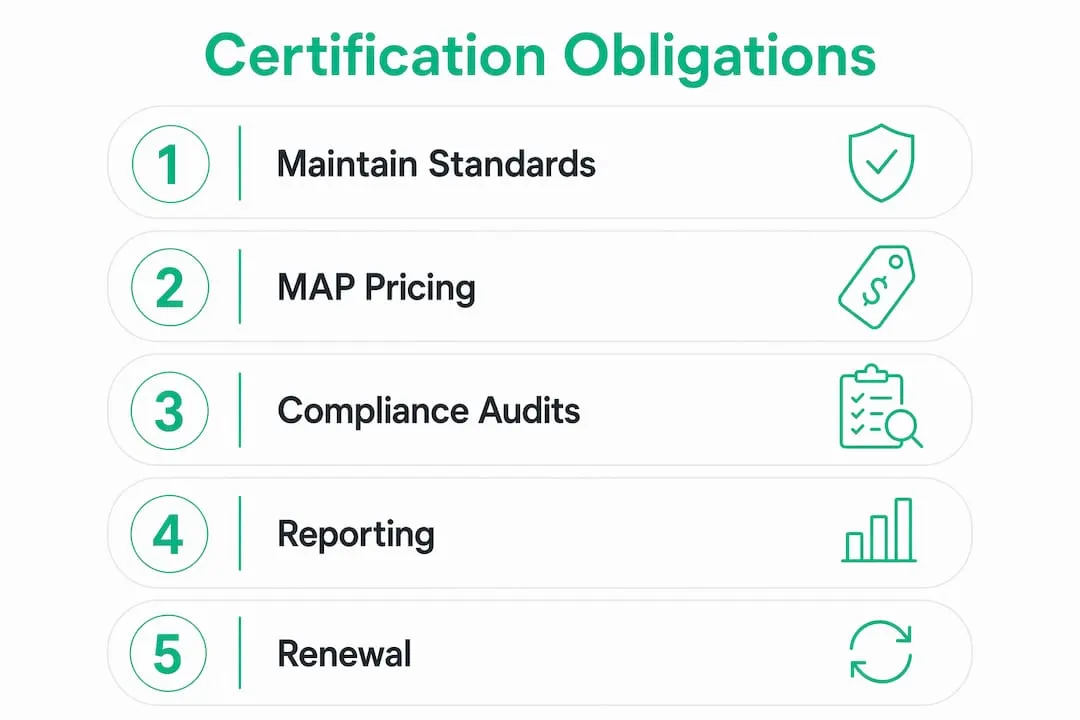
Non-compliance consequences are serious. A vendor can terminate your agreement without notice if you violate MAP pricing, misrepresent the product, or fail to meet service benchmarks. That termination also means losing access to partner pricing, marketing support, and warranty backing. For businesses that built their revenue model around a specific vendor relationship, losing certification can be devastating.
Pro Tip: Read the MAP policy section of your reseller agreement before signing. Violations are the leading cause of certification revocation, and many resellers discover the rules only after they have already broken them.
Understanding B2B sales compliance requirements before you sign a reseller agreement saves you from costly surprises later. The obligations are manageable, but only if you know them in advance.
How can you verify official reseller certification status?
Verification protects both buyers and resellers. A badge on a website or a claim in a sales pitch is not sufficient proof of certification. Reliance on reseller websites alone is insufficient. Official manufacturer channels provide the only trustworthy verification of reseller status.
Follow these steps to verify certification properly:
-
Use the manufacturer’s official dealer locator. Most major vendors publish a searchable directory of authorized partners on their website. Search by company name, region, or product category.
-
Contact the vendor’s channel management team directly. If a dealer locator is not available or the result is unclear, call or email the vendor’s partner support line. Ask them to confirm whether a specific business holds active certification.
-
Request the reseller’s partner ID or authorization letter. Legitimate certified resellers can provide documentation from the vendor confirming their status. A refusal to share this is a red flag.
-
Cross-reference the reseller’s claimed tier. Verification methods should include cross-referencing official sources to protect buyers and maintain market integrity. If a reseller claims Gold or Certified status, the vendor’s portal should confirm it.
-
Check for official invoicing and payment processes. Certified resellers typically issue official invoices through recognized payment processors and can provide documentation that ties back to the vendor’s systems.
The SaaS and software industry has made verification more critical than ever. As SaaS distribution channels grow more complex, the gap between authorized and unauthorized sellers widens. Buyers who skip verification risk purchasing counterfeit licenses, receiving no warranty support, and violating their own compliance obligations by using unlicensed software.
Understanding what a LinkedIn reseller does and how to confirm their authorization is a practical example of this verification process in action. The same principles apply across software, hardware, and professional tools.
Key Takeaways
Official reseller certification is a contractual vendor partnership that grants sales rights, enforces brand standards, and protects both resellers and buyers from legal and commercial risk.
| Point | Details |
|---|---|
| Certification vs. resale certificate | These are two separate documents. One is a vendor contract; the other is a state tax permit. |
| Financial requirements matter | Vendors require credit checks, trade references, and minimum purchase commitments before granting certification. |
| Obligations are strictly enforced | MAP pricing violations and service failures can result in immediate revocation of certified status. |
| Tier progression unlocks more benefits | Moving from Authorized to Certified status requires technical exams and delivers better pricing and support. |
| Verification requires official sources | Always confirm reseller status through manufacturer dealer locators or direct vendor contact, not website badges. |
Why reseller certification has become a brand control tool, not just a sales channel
The shift I have watched over the past several years is clear. Vendors used to treat reseller programs primarily as a way to extend their sales reach. Volume was the metric that mattered. If you moved enough units, you kept your status. That model is largely gone now.
Authorized reseller programs now prioritize technical competence over pure volume sales. This shift encourages partner investment in certified personnel for sustainable business advantages. What that means in practice is that vendors are using certification as a brand control mechanism first and a sales channel second. They want partners who can represent the product correctly, support customers properly, and protect pricing integrity in the market.
The challenge for resellers is that the bar keeps rising. Passing a technical exam two years ago does not guarantee you meet today’s standards. Vendors update certification requirements, and partners who do not keep pace lose status. I have seen businesses lose Gold tier status simply because they failed to recertify their technical staff on schedule.
For buyers, this shift is actually good news. A certified reseller today is more qualified and more accountable than one from a decade ago. The certification means something because vendors have made it harder to get and easier to lose.
— Toinon
Salesnavsplit makes official licensing accessible for B2B teams
Accessing officially licensed software tools at full retail price puts real pressure on small sales teams and startups. Salesnavsplit addresses this directly by providing verified, official LinkedIn Sales Navigator seats at approximately 50% off standard pricing, sourced through confirmed reseller partnerships in the US and Europe.
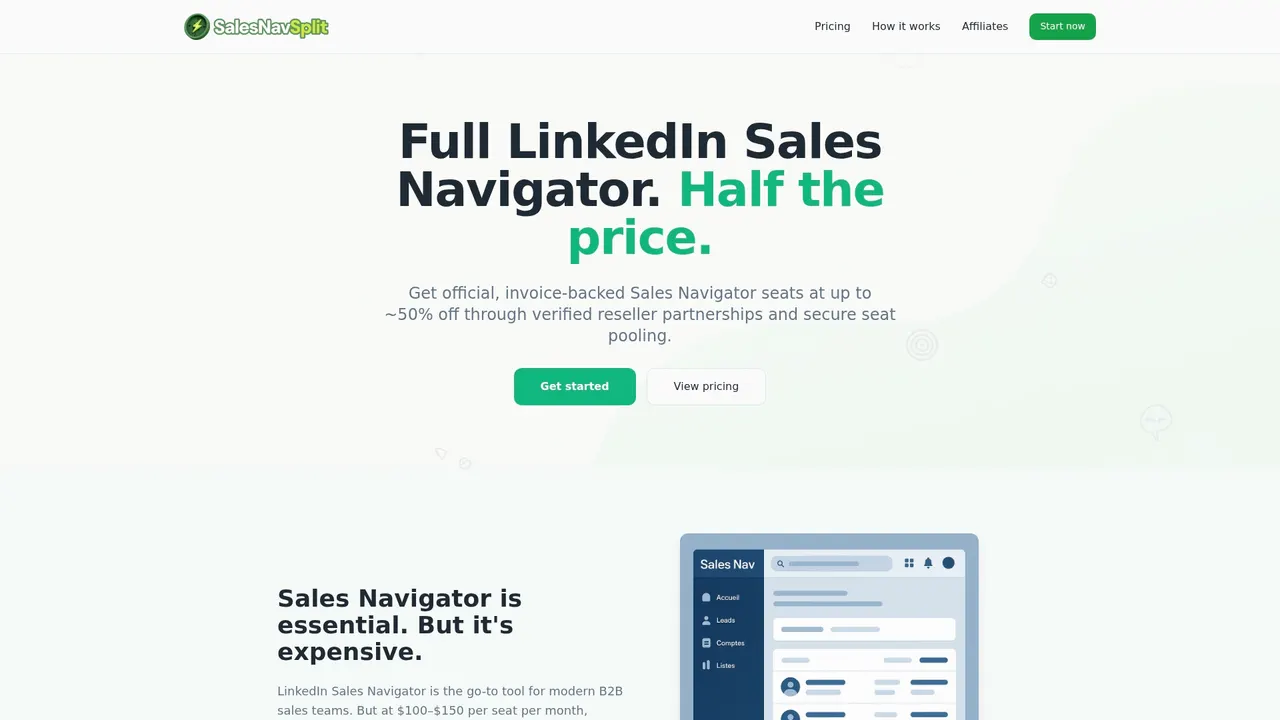
Every seat Salesnavsplit provides is genuine, compliant with LinkedIn’s terms of service, and backed by official invoicing through Stripe. Activation takes 24–48 hours. There are no credential hacks, no gray-market workarounds, and no compliance risk. For B2B teams that need official Sales Navigator access without the full retail cost, Salesnavsplit offers a straightforward path to licensed, protected software at a price that fits a real business budget.
FAQ
What is official reseller certification?
Official reseller certification is a formal contractual agreement between a manufacturer and a business granting the right to sell and support branded products under vendor-defined standards. It is a commercial partnership, not a government-issued permit.
How is reseller certification different from a resale certificate?
A reseller certification is a vendor contract governing sales rights and brand standards. A resale certificate is a state tax document allowing tax-exempt inventory purchases. They serve completely different legal and commercial functions.
What documents do I need to apply for reseller certification?
Most vendors require corporate registration documents, a valid tax ID, trade references, and audited financial statements. Some programs also require proof of technical qualifications or staff certifications.
Can a vendor revoke my reseller certification?
Yes. Vendors can and do revoke certification immediately for violations such as MAP pricing breaches, misrepresentation of products, or failure to meet customer service standards.
How do I verify that a reseller is officially certified?
Use the manufacturer’s official dealer locator or contact the vendor’s channel management team directly. Website badges and self-reported claims are not reliable verification on their own.
Recommended
- Sales licenses explained: What B2B sellers need to know - SalesNavSplit Blog
- LinkedIn Reseller Explained: Save on Sales Navigator Safely - SalesNavSplit Blog
- What is a LinkedIn reseller? Guide to saving on Sales Navigator - SalesNavSplit Blog
- Is SalesNavSplit Safe & Legal? How the Reseller-Seat Model Works | SalesNavSplit