
Discounted Sales Software Benefits for SMBs in 2026
Discounted Sales Software Benefits for SMBs in 2026
TL;DR:
- Discounted sales software offers significant cost savings and access to features like automation and AI-driven forecasting.
- Timing, negotiation, and verifying feature inclusion are key to maximizing value and avoiding long-term support issues.
Discounted sales software is defined as any licensed sales technology acquired below standard retail pricing through reseller programs, seasonal promotions, or negotiated volume agreements. For small to mid-sized businesses, the advantages go well beyond saving money. CRM and sales force automation tools reduce manual data entry by 17% and cut lead response times by up to 61%, according to a meta-analysis of more than 23,000 observations. Those are operational gains that compound over time. When you access those same capabilities at a fraction of the cost, the return on investment shifts dramatically in your favor. This article breaks down exactly where the value comes from and how to capture it.
1. What are the top discounted sales software benefits for SMBs?
Cost savings are the most visible benefit, but they are not the most important one. The real advantage is that lower upfront costs let you redirect budget toward adoption, training, and integration, which are the factors that actually determine whether software pays off.
Budget reallocation. When you pay less for licenses, you free up funds for onboarding specialists, custom integrations, and sales coaching. Those investments directly increase the return you get from the software itself.
Automation of manual work. Sales force automation tools cut manual data entry by 17% across large-scale studies. For a five-person sales team, that translates to hours reclaimed every week for prospecting and closing.
Faster lead response. Software that routes and prioritizes leads automatically reduces response times by up to 61%. Speed matters in B2B sales. Responding first to an inbound lead dramatically increases the probability of winning the deal.
AI-driven forecasting. AI-driven sales agents deliver a median 23% faster speed-to-market, with some use cases reaching 50% velocity gains, according to G2’s 2025 AI Agents Insights Report. Discounted tiers increasingly include these AI features, meaning you no longer need an enterprise budget to access them.
Scalability without penalty. Many discounted plans offer usage-based or seat-flexible pricing. That structure lets you grow the tool alongside your team without renegotiating from scratch.

Pro Tip: Before signing any discounted software agreement, confirm that AI features and API access are included in the discounted tier, not locked behind a premium upgrade.
2. How timing and negotiation strategies maximize discount value
The size of your discount depends heavily on when and how you buy. Seasonal software discounts can reach 20–70% savings when timed to events like Black Friday, fiscal year-end, or vendor quota cycles. That range is wide because buyers who negotiate actively capture far more than those who simply wait for a promotional email.
Buy at the right moment
Vendors are most motivated to close deals when their own fiscal quarters are ending. Approaching a vendor in the final two weeks of their quarter gives you real leverage. They want to hit quota. You want a lower price. That alignment is the foundation of every good software negotiation.
Stagger your renewals
Staggering renewals across different tools prevents a single renewal crunch where you are negotiating everything at once with no fallback position. It also lets you align each renewal to the vendor’s fiscal calendar, which is where the best discounts live.
Negotiate the pricing model, not just the price
Rigid per-seat licensing punishes growth. Push for usage-based or tiered pricing that scales with actual activity. A model that charges by active users rather than total seats can cut your effective cost significantly as your team fluctuates.
Convert savings into adoption budget
A 30% discount on licenses means nothing if your team does not use the software. Redirect a portion of the savings into structured onboarding. Software adoption rates rise sharply when teams receive hands-on training in the first 30 days.
Pro Tip: Ask vendors for a 90-day pilot at the discounted rate before committing to an annual contract. Most will agree rather than lose the deal entirely.
Watch the discount ceiling
Discounts above 20% reduce lifetime value by 30% due to higher churn and lower average revenue per user, based on ProfitWell data from more than 18,000 companies. That finding applies to vendors offering discounts, but it signals something important for buyers too. Vendors who discount aggressively may be under financial pressure, which can affect long-term support quality and product investment.
3. What features make discounted sales software a strategic investment?
The best discounted sales tools are not stripped-down versions of enterprise platforms. They are full-featured products offered at lower prices through reseller channels, volume agreements, or promotional windows. The features that matter most are the ones that directly affect revenue.
Workflow automation. Automating routine tasks like follow-up emails, meeting scheduling, and lead assignment frees your reps for conversations that require human judgment. Automation and AI integration in sales software drives measurable productivity gains by reducing manual entry and improving deal forecasting.
Integrated CRM and pipeline analytics. A sales tool without a connected CRM creates data silos. Integrated systems give you a single view of every deal, contact, and activity. That visibility is what makes accurate forecasting possible.
AI-assisted upselling and deal intelligence. G2 industry analysts note that smart buyers prioritize platforms offering connected architecture and pricing flexibility over feature bloat. AI tools embedded across pricing tiers help reps identify upsell opportunities and flag at-risk deals without requiring a separate analytics subscription.
Connected software architecture. Tools that integrate with your existing email, calendar, and marketing platforms prevent the manual data transfer that kills productivity. Evaluate integration depth before price.
Here is a quick framework for evaluating discounted sales software features against your actual needs:
| Feature category | Why it matters | What to verify before buying |
|---|---|---|
| Workflow automation | Reduces manual tasks and speeds up sales cycles | Confirm automation is included in discounted tier |
| CRM integration | Prevents data silos and supports accurate forecasting | Check native integrations vs. paid add-ons |
| AI forecasting tools | Improves deal prioritization and revenue prediction | Verify AI features are not locked behind upgrades |
| Pricing flexibility | Supports growth without renegotiation | Ask about usage-based or active-seat models |
| Vendor support level | Affects adoption and long-term ROI | Review support SLA included at discounted price |
Evaluate revenue impact first. Price is a secondary filter, not the primary one. A tool that costs 40% less but delivers 20% of the value is not a deal. It is a distraction.
4. When should SMBs choose discounted over full-price sales software?
The answer depends on how central the tool is to your sales process and how fast your needs are likely to change. Lifetime deals can be viable for stable, non-core tasks, but they often lack the rapid support and feature updates that enterprise subscriptions provide. That distinction matters more than most buyers realize.
Choose discounted software when:
- Your sales workflow is stable and well-defined, with low likelihood of major process changes in the next 12–24 months.
- The tool handles a supporting function, such as email tracking or meeting scheduling, rather than your core pipeline management.
- You have confirmed that the discounted tier includes the specific features your team will actually use.
- You are buying through a verified reseller with a clear support path and legitimate licensing.
Be cautious with discounted software when:
- The tool will serve as your primary CRM or revenue forecasting system.
- Your team is growing fast and your feature needs will shift significantly within the year.
- The vendor’s support tier at the discounted price is limited to email-only with multi-day response times.
SMBs should avoid lifetime deals for core sales functions due to the lack of ongoing updates and support. That guidance applies broadly to any deeply discounted offer on mission-critical software. For cost-effective sales outreach tools and prospecting platforms, discounted licensing through verified resellers is a different story. Those tools benefit from established feature sets and clear compliance structures.
The right question is not “Is this discounted?” It is “Does this discount come with the support and update cadence my team needs to succeed?”
Key takeaways
Discounted sales software delivers the strongest ROI when buyers combine verified licensing, strategic timing, and a clear feature evaluation framework before committing.
| Point | Details |
|---|---|
| Automation drives real gains | CRM and SFA tools cut manual data entry by 17% and lead response times by up to 61%. |
| Timing determines discount size | Seasonal and fiscal year-end windows can deliver 20–70% savings with active negotiation. |
| Discount ceiling carries risk | Discounts above 20% correlate with 30% lower lifetime value due to churn, per ProfitWell data. |
| Feature access must be verified | Confirm AI tools, integrations, and support are included in the discounted tier before signing. |
| Lifetime deals suit non-core tools | Reserve deeply discounted or one-time deals for stable, supporting functions, not core pipeline management. |
What I have learned about buying sales software at a discount
The biggest mistake I see SMB owners make is treating a discount as the finish line. They find a 40% off deal, sign quickly, and then spend the next six months fighting low adoption and missing integrations. The discount was real. The value was not.
The procurement calendar is an underused asset. Most sales teams renew everything in january because that is when their fiscal year starts. That is exactly when vendors have the least incentive to negotiate. Shifting even one or two renewals to march or september, when vendors are chasing quarterly quotas, changes the conversation entirely.
I have also seen teams get burned by aggressive discounting from vendors who were quietly cutting their R&D investment. A vendor offering 50% off with no clear reason is worth scrutinizing. Verified reseller programs, where the discount comes from a licensing structure rather than vendor desperation, are a fundamentally different and safer model.
The B2B sales tech trends point clearly toward productivity-per-rep as the metric that matters, not the number of features in a plan. Buy the tool that moves that number. Buy it at the best price you can negotiate. And make sure your team actually uses it.
— Toinon
How Salesnavsplit helps SMBs cut sales software costs
For SMBs that rely on LinkedIn for prospecting and outreach, the cost of LinkedIn Sales Navigator is one of the most common budget complaints. Salesnavsplit solves that directly.
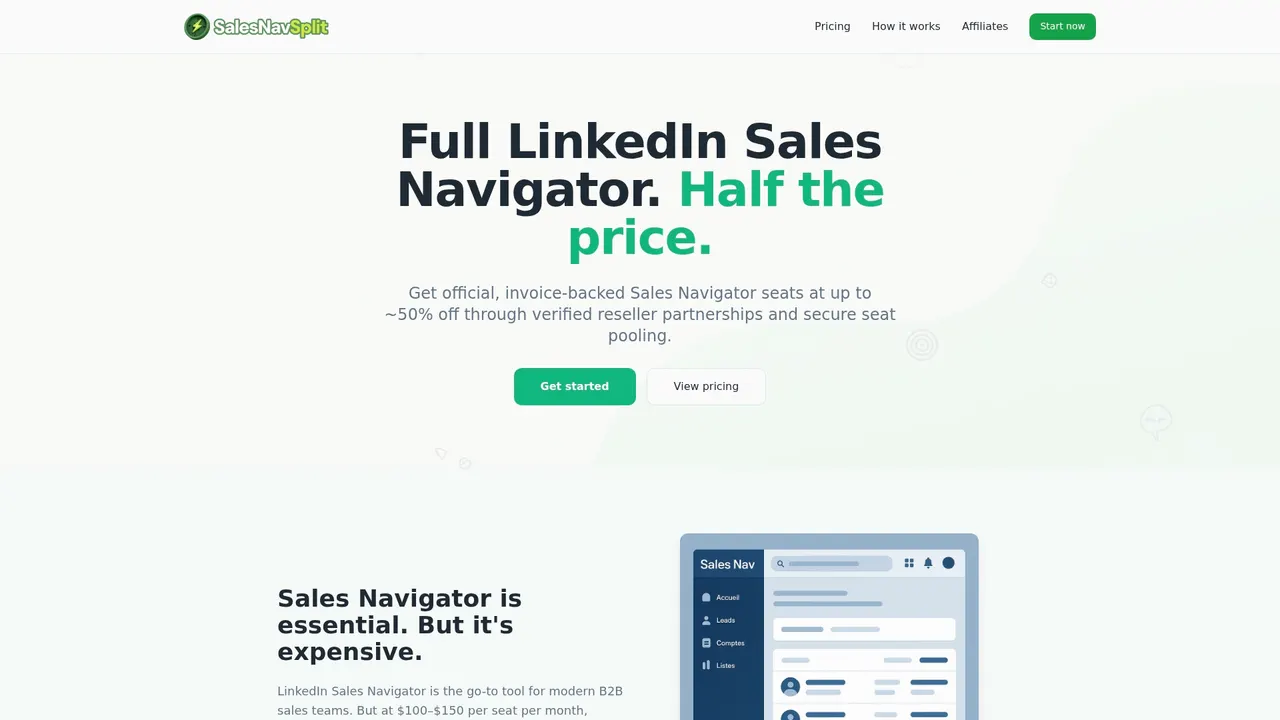
Salesnavsplit provides official Sales Navigator seats at approximately 50% off standard pricing through verified reseller partnerships in the US and Europe. The licenses are genuine, compliant with LinkedIn’s terms of service, and activated within 24–48 hours. Payments process through Stripe with official invoicing. If you want to reduce your Sales Navigator costs without sacrificing access or security, Salesnavsplit is worth a direct look.
FAQ
What are the main benefits of discounted sales software?
Discounted sales software reduces licensing costs while delivering the same core features, including automation, CRM integration, and AI-assisted forecasting. The savings can be redirected into onboarding and training, which directly improves adoption and ROI.
How much can SMBs save with strategic software procurement?
Seasonal and fiscal year-end discounts can reach 20–70% savings when buyers time purchases correctly and negotiate actively. The exact amount depends on vendor, volume, and contract structure.
Is discounted sales software safe to use?
Discounted software purchased through verified resellers with legitimate licensing is safe and compliant. The risk comes from unverified sources that may use credential sharing or unauthorized account access rather than official seat allocations.
When does discounted software hurt more than it helps?
Discounts above 20% correlate with 30% lower lifetime value in SaaS contexts, largely due to churn. For buyers, deeply discounted tools from financially stressed vendors may lack adequate support and update cadences for core sales functions.
What features should I prioritize when evaluating discounted sales tools?
Prioritize workflow automation, CRM integration, AI forecasting access, and vendor support level. Confirm that these features are included in the discounted tier and not reserved for higher-priced plans. The sales accelerator checklist from Salesnavsplit covers this evaluation in detail for B2B teams.