
Compliant Sales Operations Workflow: 2026 Guide
Compliant Sales Operations Workflow: 2026 Guide
TL;DR:
- A compliant sales operations workflow embeds legal and regulatory checkpoints into each pipeline stage to prevent non-compliant deals from progressing. Automating these checkpoints reduces administrative work and ensures consistent compliance, transforming sales pipelines into reliable systems.
A compliant sales operations workflow is a structured sales process that embeds legal and regulatory checkpoints directly into each pipeline stage, preventing non-compliant deals from advancing. Sales leaders at organizations using platforms like Salesforce and HubSpot are redesigning their pipelines around these checkpoints to cut regulatory risk without slowing revenue. Automated workflows can reduce administrative time per rep from 34–40 hours weekly down to 6–8 hours. That shift frees reps to sell while compliance runs in the background. The industry term for this approach is compliance-gated pipeline design, and it is the foundation of every efficient sales workflow built for regulated markets in 2026.
What is a compliant sales operations workflow, and why does it matter?
A compliant sales operations workflow combines pipeline management with built-in regulatory controls, so deals only move forward when specific legal conditions are met. For sales leaders in financial services, healthcare, or B2B SaaS, this is not optional. Regulators expect documented proof that your team followed the rules at every stage, not just at contract signing.
The practical difference between a standard pipeline and a compliance-gated one is where the enforcement happens. Standard pipelines rely on reps to self-report. Compliance-gated pipelines block stage advancement until a system confirms the requirement is satisfied. That shift moves compliance from a rep’s memory to a process control, which is far more reliable.
Sales operations best practices in 2026 treat compliance as a design constraint, not an afterthought. Organizations that build compliance into their sales process from day one spend less time on remediation and more time closing.
What are compliance gates, and how do they transform sales pipelines?
A compliance gate is a mandatory checkpoint in your pipeline that blocks a deal from advancing until a specific regulatory or legal condition is verified. Common examples include KYC (Know Your Customer) completion, KYB (Know Your Business) verification, legal sign-off on contract terms, and DNC (Do Not Call) list scrubbing. Each gate corresponds to a real regulatory obligation, not an internal preference.
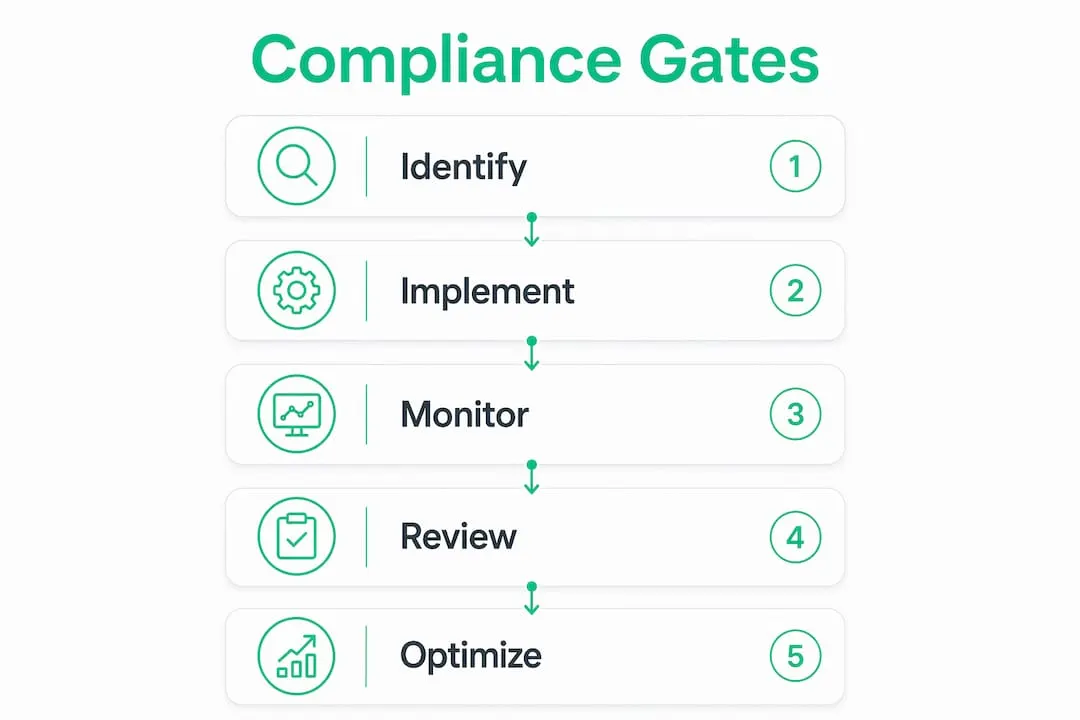
Shifting to compliance-gated pipelines typically takes 9–12 weeks to audit and implement fully. That timeline reflects the work required to map existing stages, identify where regulatory requirements apply, and configure your CRM to enforce the gates automatically. Rushing this process creates gaps that auditors will find.
Here is how to structure a gate-based pipeline redesign:
- Audit your current pipeline stages. Document every stage and identify which regulatory obligations apply at each one. Include legal, compliance, and sales operations in this review.
- Map obligations to stages. Assign each compliance requirement to the earliest pipeline stage where it can be verified. KYC, for example, belongs at qualification, not at contract.
- Configure CRM enforcement. Use Salesforce validation rules or HubSpot required fields to block stage advancement until the gate condition is logged as complete.
- Assign named ownership. Each compliance obligation needs an owner to avoid policy execution failure. DNC scrubbing, for instance, should have one named person or team responsible for its execution.
- Test with a pilot segment. Run one product line or territory through the gated pipeline before full rollout. Measure deal velocity and flag friction points before scaling.
Pro Tip: Measure compliance gate cycle times separately from overall deal velocity. If a gate consistently adds more than two business days, the process behind it needs redesign, not the gate itself.
Compliance gates do slow individual deals slightly during the first quarter of implementation. That is expected. The payoff is audit readiness at any moment and a dramatic reduction in regulatory remediation costs.
How can automation and AI support a compliant and efficient sales workflow?
Automation is the engine that makes compliance-gated pipelines practical at scale. Without it, compliance gates become manual checklists that reps resent and skip. With it, gates run automatically in the background while reps focus on conversations.
The most effective uses of AI and automation in a compliant sales workflow include:
- Auto-qualification scoring. AI models score inbound leads against your ICP criteria and flag disqualifying signals before a rep invests time. This keeps non-compliant or low-fit prospects out of the pipeline early.
- CRM data sync with confidence thresholds. Auto-writing CRM fields without confidence thresholds causes data quality failures. Best practice: auto-write only above a high confidence score, queue mid-confidence updates for human review, and block low-confidence writes entirely.
- Workflow orchestration. Tools like Salesforce Flow and HubSpot Workflows trigger compliance tasks automatically when a deal reaches a gated stage. The system sends the KYC request, logs the response, and updates the gate status without rep involvement.
- Meeting intelligence. AI transcription tools capture conversation evidence directly from calls. That evidence feeds compliance scoring without relying on rep memory or manual entry.
The risk of automation without governance is real. Automation permissions accumulate over time, a pattern called “agent creep,” where automated processes gain access to CRM objects and fields far beyond what they need. This creates security exposure and compliance risk simultaneously.
The fix is a least-privilege architecture. Automation should access only the specific objects and fields it needs for each task, nothing broader. Audit your automation permissions quarterly and revoke anything that has expanded beyond its original scope.

Pro Tip: Build a human-in-the-loop review step for any AI action that modifies a compliance-relevant CRM field. The review adds minutes. The protection it provides is worth far more.
What audit trail standards and governance controls does compliance require?
An audit trail is the documented record of every action taken in your sales process, including who did it, when, and why. Regulators do not accept verbal assurances. They require records. AI sales operations must capture specific fields for every interaction to meet audit standards.
| Audit trail field | Purpose |
|---|---|
| Timestamp | Proves when the action occurred |
| Action type | Identifies what was done (score, send, update) |
| Model version | Documents which AI model made the decision |
| Input features | Records what data the model used |
| Decision output | Logs the result and confidence level |
| Human reviewer | Captures who approved mid-confidence actions |
Field-level CRM change logs must record who changed what, when, and why. Without that granularity, forensic reconstruction during a regulatory inquiry becomes impossible. Most CRM platforms support field history tracking natively. Turning it off is a compliance failure waiting to happen.
Governance controls go beyond logging. They define who can access what data, how long records are retained, and who owns each compliance obligation.
“Treat compliance not as bureaucracy but as fundamental for building organizational trust.” — Gryphon.ai Outbound Compliance Guide
Data access controls should follow role-based permissions. Reps see their own records. Managers see their team. Compliance officers see everything relevant to their obligations. Encryption at rest and in transit is the baseline, not a premium feature. Retention policies must match your regulatory environment. FINRA, GDPR, and CCPA each have different requirements, and your CRM retention settings must reflect them.
What are the most common compliance failures in sales workflows?
The most damaging compliance failure is not a technical gap. It is a cultural one. Reps performing “box-checking” rather than providing real evidence create audit risk that no technology can fix. A rep who marks KYC as complete without actually verifying the customer has defeated the entire gate system.
Common compliance failures and how to prevent them:
- Performative compliance. Reps mark gates complete to move deals forward, not because the requirement is satisfied. Fix this by sourcing compliance evidence from system logs and meeting transcripts, not rep input.
- Ignoring immutable evidence. Manual data entry is biased and inaccurate. Immutable logs from call recordings and CRM system events are the only defensible evidence in a regulatory inquiry.
- Agent creep in automation. Automated processes accumulate permissions over time. A quarterly permission audit prevents this from becoming a security and compliance liability.
- Policing instead of coaching. Coaching reps on methodology compliance improves pipeline quality better than auditing their data entry. Reps who understand why a gate exists are far more likely to satisfy it correctly.
- No named compliance owner. Compliance obligations without a named owner get skipped. Assign ownership explicitly, document it, and review it quarterly.
Pro Tip: Score compliance gate completion from conversation evidence, not manual rep entry. AI transcription tools like Gong or Chorus can flag whether a required disclosure was made on a call, removing the rep from the evidence chain entirely.
The two-stage enforcement model addresses the coaching versus policing tension directly. During the draft stage, the system coaches the rep in real time. At the activation stage, the system gates the action if requirements are not met. This approach catches problems before they become violations, not after.
Key takeaways
A compliant sales operations workflow requires compliance gates, governed automation, and immutable audit trails working together as a system, not as separate initiatives.
| Point | Details |
|---|---|
| Embed compliance gates early | Assign each regulatory requirement to the earliest pipeline stage where it can be verified. |
| Use confidence thresholds for AI writes | Auto-write CRM fields only above high confidence; queue mid-confidence updates for human review. |
| Audit automation permissions quarterly | Revoke any permissions that have expanded beyond the original task scope to prevent agent creep. |
| Source evidence from system logs | Use meeting transcripts and CRM event logs, not rep input, as your compliance evidence base. |
| Assign named ownership | Every compliance obligation needs one named owner to prevent execution gaps. |
Compliance as a competitive advantage, not a constraint
Most sales leaders I speak with treat compliance as a tax on velocity. They design their pipelines first and bolt compliance on at the end. That approach fails every time, and the failure is expensive.
The organizations that get this right flip the sequence. They design compliance gates first and build the sales motion around them. The result is a pipeline that moves faster in the long run because deals that enter are qualified to close. No last-minute legal holds. No regulatory surprises at contract stage. No remediation cycles that kill quarterly numbers.
Automation paired with human review is the right architecture. Pure automation without oversight creates the agent creep and data quality problems described above. Pure human review without automation does not scale. The combination, where AI handles routine verification and humans review edge cases, is where the efficiency gains actually live.
My strongest recommendation is to implement compliance gates iteratively. Start with one stage, one gate, and one product line. Measure the gate cycle time and the deal velocity impact. Adjust before scaling. Organizations that try to implement a fully gated pipeline in one release almost always create more friction than they remove.
Measure two numbers every quarter: compliance gate cycle time and pipeline velocity by stage. If gate cycle time rises, the process behind the gate is broken. If pipeline velocity drops at a specific stage, the gate may be placed incorrectly. These two metrics tell you everything you need to know about whether your sales management compliance program is working or just adding overhead.
— Toinon
How Salesnavsplit supports compliant sales workflows
Building a compliant sales operations workflow requires the right tools from the start. Salesnavsplit provides authorized LinkedIn Sales Navigator seats at approximately 50% off standard pricing, sourced through verified reseller partnerships in the US and Europe. Every seat is genuine, invoiced through Stripe, and activated within 24–48 hours.
LinkedIn Sales Navigator gives your team the prospecting data and outreach capabilities needed to run an efficient sales workflow while staying within LinkedIn’s terms of service. Salesnavsplit makes those capabilities accessible without the full retail cost. Sales leaders building or scaling a compliant B2B sales operation can get official Sales Navigator seats at half the price, with full compliance and no credential risk.
FAQ
What is a compliance gate in a sales pipeline?
A compliance gate is a checkpoint that blocks a deal from advancing to the next pipeline stage until a specific regulatory requirement is verified. Common examples include KYC completion, DNC scrubbing, and legal sign-off.
How long does it take to implement a compliance-gated pipeline?
Implementing a compliance-gated pipeline typically takes 9–12 weeks, covering the audit of existing stages, gate configuration in your CRM, and pilot testing before full rollout.
What fields must an AI sales audit trail include?
An AI sales audit trail must capture the timestamp, action type, model version, input features, decision output, and the identity of any human reviewer for mid-confidence actions.
How do you prevent “box-checking” compliance in sales teams?
Source compliance evidence from system logs and meeting transcripts rather than rep input. AI transcription tools can verify whether required disclosures were made on calls, removing manual entry from the evidence chain.
What is agent creep, and why does it matter for sales compliance?
Agent creep is the gradual accumulation of excessive permissions by automated processes over time. It matters because over-permissioned automations create security exposure and can trigger compliance violations by accessing data outside their authorized scope.